Sunday, June 15, 2025
Oil rises, the dinar falls, and Baghdad faces the ramifications of Israeli-Iranian missiles.
Oil rises, the dinar falls, and Baghdad faces the ramifications of Israeli-Iranian missiles.
Although it is outside the immediate circle of conflict, Iraq appears to be in the eye of the storm. Its geographical location, its near-total dependence on oil, and the peg of its economy to the dollar exchange rate make it vulnerable to every geopolitical shock in the region. While Israel and Iran exchange airstrikes and inflammatory statements, the Iraqi market translates these fires into tangible crises: rising food prices, a volatile dollar, and fears of a slowdown in the flow of goods through ports and borders.
As Israeli airstrikes on Iran escalated, the Iraqi dinar began to slide. This decline is not merely a technical result of changes in the currency markets; it is an expression of general panic and deep concern about political and security repercussions that Iraq may not be able to contain. Dealing with the US dollar is no longer just an economic issue; it has also become highly politically sensitive, especially with the US Treasury Department's strict oversight of transfer and financing mechanisms within Iraq.
On Friday, following the unprecedented Israeli airstrikes on Iranian facilities, oil prices jumped nearly 5%, while the Iraqi dinar fell dramatically against the dollar, exceeding 146,000 dinars to $100 in some local markets, its lowest level in months.
Meanwhile, global oil markets are experiencing significant turmoil, with JP Morgan warning that oil prices could rise to $120 per barrel if geopolitical tensions in the Middle East escalate further.
Global oil prices rose, with Brent crude closing at $74.23, up 4.87%, while US crude also closed at $72.98, up 4.94%.
The dinar is the first to be affected
"What's happening in Tehran is directly felt in the markets of Rusafa and Karkh," says Ahmed Eid, an economic researcher, referring to the close relationship between regional stability and the status of the local currency.
"The sudden rise in the dollar price reflects a real state of panic, not only about the developments in the conflict, but also about its potential financial repercussions, especially if the United States resorts to tightening controls on transfers from the US Federal Reserve or imposing new banking restrictions," he added in an interview with Shafaq News.
Eid warns that the continued smuggling of dollars from Iraq to Iran is fueling monetary instability, saying, "The Iraqi economy is dependent on external balance. We don't produce; we buy everything from abroad, and with every tremor in the region, we are the first to suffer."
Black gold: a temporary gain or an impending disaster?
At first glance, high oil prices appear to be an opportunity to boost Iraq's treasury, especially given that more than 90% of its budget relies on crude oil revenues. However, recurring threats to energy corridors, most notably the Strait of Hormuz, reveal the fragility of this "profit." Every additional barrel sold today may not find a safe route tomorrow. Worse still, proposed alternatives, such as the Turkish Ceyhan pipeline, provide only partial coverage, amid ongoing logistical and political challenges.
"This short-term profit does not hide the real danger," says economic expert Safwan Qusay.
"Any threat to the Strait of Hormuz would mean that more than 3 million barrels of Iraqi oil per day would be at risk," Qusay says. "Even if the Turkish Ceyhan pipeline were activated as an alternative route, it would cover only a third of exports, with burdensome logistical costs requiring thousands of trucks. "
Approximately one-fifth of the world's oil trade—between 18 and 19 million barrels per day—passes through the Strait of Hormuz. Any military escalation affecting this vital artery would mean not only an Iraqi oil crisis, but also enormous pressure on prices and cash flows.
The indirect repercussions, however, appear more vague. The suspension of flights, the complexity of supply chains, and the potential displacement of Iranians or the return of Iraqi students and workers from Iran all add a new burden to the Iraqi state.
Financial expert Mahmoud Dagher told Shafaq News Agency that Iraq is still in the "economic resilience" phase, benefiting from high oil prices, but the door is open to more severe possibilities.
"The worst scenario is the closure of the straits, whether in the Arabian Gulf or the Red Sea, a card that Tehran or its allies in Yemen could play," Dagher says, adding that "this would be an uncontainable blow, not only to the Baghdad government, but to the entire Middle Eastern economy."
Iraq does not appear to have sufficient room for maneuver in this crisis. Between its near-total dependence on oil, weak domestic production, and the import of most basic commodities, any regional unrest becomes a daily matter for Iraqi citizens. As the crisis between Israel and Iran continues, attention is turning not only to the military fronts but also to the markets of Baghdad, where currencies, commodities, and fear determine the fate of millions.
In the absence of a real local production structure, the Iraqi economy is becoming something of a vehicle, completely linked to the regional locomotive. link
TIDBIT FROM FRANK26
Frank26
I went away from Wells Fargo because...they were just being paranoid and misleading people by telling them a lie that it's a scam. But I knew Chase was a little bit more focused and willing to work with us.
They were also just as stubborn but around...January they started to tell us, 'We don't know anything.' The attitude change.
Within the last two months I'm telling you I get more phone calls of people telling me, 'You're not going to believe what Chase just told me. They know.' Of course they know.
Everybody knows. It's not a secret. The problem is nobody knows when. Nobody know how much. Actually we know more of, how much than we know, when.
An economic expert told Al-Jarida Platform: The exchange rate is hostage to the political mood and regional shifts.
An economic expert told Al-Jarida Platform: The exchange rate is hostage to the political mood and regional shifts.
Economist Ahmed Hadhal spoke about the sensitivity of the dollar issue in Iraq and its direct impact on geopolitical and geoeconomic changes, emphasizing that the issue has become extremely complex internally and externally.
In an interview with Jarida Platform, Hathal stated that “since the end of 2022, and with the launch of the platform, the Central Bank has exhausted all monetary policy tools to address the gap between the parallel rate and the official rate. However, the problem is complex and does not only relate to the bank but also to the domestic market.” He explained that “60% of traders are still outside the platform, in addition to the lack of borders, which further complicates the crisis.”
He added that "the decline in the dollar's value coincided with the failure to approve the general budget and the instability of some foreign negotiations. The exchange rate is linked to economic, political, and media factors, and is a highly sensitive indicator of any crisis, statement, or event." He noted that "exchange rate fluctuations directly impact the purchasing power of citizens, merchants, companies, industrialists, importers, and even foreign investors."
Hedhal explained that "the loss of trust between society and the government is one of the most significant factors driving demand for the dollar as a more stable and valuable currency, especially given the lack of real production within Iraq.
Oil production constitutes more than 70% of the GDP, and the general budget constitutes 190% of this GDP. These indicators raise concerns among citizens and investors about the possibility of a decline in the value of the dinar."
He concluded by saying, "The exchange rate issue is linked to the psychological factors of citizens and investors, and there is a close relationship between behavioral economics and traditional economics, which makes currency stability necessitating addressing confidence in monetary and fiscal policies, ensuring their stability, and preventing sudden changes." link
DINAR EXCHANGE 🚨 Iraq’s $16 Trillion Resource Revelation!
DINAR EXCHANGE
 Iraq’s $16 Trillion Resource Revelation!
PM Advisor Salih unveils Iraq’s vast mineral wealth, positioning it as the 9th richest globally. With plans to diversify the economy and reduce oil dependence, could this be the catalyst for the Iraqi Dinar’s revaluation? #Iraq #IQD #EconomicDiversification #DinarRevaluation #DinaresGurus
Iraq’s $16 Trillion Resource Revelation: A Catalyst for Dinar Revaluation?
Iraq’s Prime Minister’s Financial Advisor, Mazhar Mohammed Salih, recently announced that the nation’s natural resources are valued at over $16 trillion. This immense wealth, encompassing minerals like thorium, uranium, phosphate, sulfur, and lithium, positions Iraq as the ninth richest country globally in terms of natural resources.
The Iraqi government is actively pursuing economic diversification, aiming to reduce its heavy reliance on oil revenues. By developing the mining sector, which is expected to contribute at least 10% to Iraq’s GDP during its initial development phase, Iraq seeks to stabilize its economy and strengthen the Iraqi Dinar (IQD).
According to Basel III requirements, a nation’s currency should reflect its tangible assets. With Iraq’s vast untapped resources, there’s a compelling case for a revaluation of the IQD.
Iraq’s $16 Trillion Resource Revelation!
PM Advisor Salih unveils Iraq’s vast mineral wealth, positioning it as the 9th richest globally. With plans to diversify the economy and reduce oil dependence, could this be the catalyst for the Iraqi Dinar’s revaluation? #Iraq #IQD #EconomicDiversification #DinarRevaluation #DinaresGurus
Iraq’s $16 Trillion Resource Revelation: A Catalyst for Dinar Revaluation?
Iraq’s Prime Minister’s Financial Advisor, Mazhar Mohammed Salih, recently announced that the nation’s natural resources are valued at over $16 trillion. This immense wealth, encompassing minerals like thorium, uranium, phosphate, sulfur, and lithium, positions Iraq as the ninth richest country globally in terms of natural resources.
The Iraqi government is actively pursuing economic diversification, aiming to reduce its heavy reliance on oil revenues. By developing the mining sector, which is expected to contribute at least 10% to Iraq’s GDP during its initial development phase, Iraq seeks to stabilize its economy and strengthen the Iraqi Dinar (IQD).
According to Basel III requirements, a nation’s currency should reflect its tangible assets. With Iraq’s vast untapped resources, there’s a compelling case for a revaluation of the IQD.
Iraq's trade with Iran is again confusing the dollar. Hantoush warns of a tight spot!
Iraq's trade with Iran is again confusing the dollar. Hantoush warns of a tight spot!
Economic expert Mustafa Hantoush confirmed that Iraq still has significant trade with Iran that is not covered by the official price, leading to continued pressure on the parallel market.
In a statement to Jarida Platform , Hantoush stated that “millions of travelers to Iran are also contributing to increased pressure on the parallel market. With the improvement of the Iranian currency thanks to negotiations with the United States and the reduction of remittances, this pressure has eased somewhat.”
He explained that “the Central Bank’s step to increase the limits on some cards has partially contributed to the solution, but the worsening situation and the return of remittances may push the parallel exchange rate up again.”
He added, "Iraq is now required to adopt new monetary policies to manage trade with Iran and passenger traffic. The solution may be through a tripartite account or a gold barter, as some countries in the region are doing, to extricate Iraq from this tight spot." link
TIDBIT FROM MNT GOAT
Mnt Goat
I try to bring you the progress of the monetary reforms, mostly following the plan to get back to FOREX...
This is a huge effort for Iraq as it is right in the middle of a very volatile area of the world right now...
Unfortunately, Iraq is a centuries old, major trading partner with Iran. So, I hope now you can see the uphill challenge facing Iraq when the U.S. wants to sanction Iran.
It is hard to do. This RV plan we watch is the Dr Shabibi’s plan from 2011. I am told the plan is still in effect and moving ahead...This to me was “WOW!” news.
Al-Sudani Affirms The Government's Support For Anyone Who Offers A National Industry With High Technology And Distinguished Specifications
Al-Sudani Affirms The Government's Support For Anyone Who Offers A National Industry With High Technology And Distinguished Specifications
Saturday, June 14, 2025, | Economic Number of reads: 280 Baghdad / NINA / Prime Minister Mohammed Shia Al-Sudani affirmed the government's support for anyone who offers a national industry with high technology and distinguished specifications.
The Prime Minister's media office said in a statement: "Al-Sudani inaugurated today the Al-Alamiya factory for the production of medical and industrial gases, one of the private sector projects in Baghdad.
Al-Sudani toured the factory's departments, which is the first of its kind in Iraq, in terms of integrated production lines and operational energy efficiency, praising the efforts of the workers in this important industrial project.
Al-Sudani stressed that there are many projects in the governorates that need industrial gases, especially iron factories in Karbala, Basra, Salah al-Din, and the Kurdistan Region of Iraq."
He pointed to the government's support for the industrial sector in general, and for businessmen and industrialists in the private sector,
and anyone who offers an achievement similar to this factory.
The Prime Minister stressed the support and provision of facilities for anyone who offers industry with high technology and distinguished specifications, pointing out the government's keenness to provide land for large industrial projects, which would open the door to important Iraqi industries that support the economy.
The factory was built on an area of 10 dunams at a cost of $ 32 million, and includes the tallest industrial tower in Iraq with a height of 69 meters, and its daily storage capacity is (1,250) tons of various products, while the production capacity of medical and industrial gases is (727,200) thousand tons annually, as nitrogen, argon, medical and industrial oxygen, and medical, industrial and food carbon dioxide will be produced.
The factory will meet about 80% of the needs of the Iraqi market for industrial and medical gases, and in the second phase, coverage and export will be completed. /End https://ninanews.com/Website/News/Details?key=1234371
IRAQ & DINAR STATUS
IRAQ & DINAR STATUS
Iraq is currently navigating a pivotal moment in its economic and monetary development.
The Iraqi dinar has not yet revalued and remains restricted, pending parliamentary approval of critical budget tables.
This approval is essential for enabling the dinar to enter global foreign exchange markets freely.
Meanwhile, Iraq is preparing to host a major investment forum showcasing 150 pre-approved projects across 12 sectors, including agriculture, oil, gas, and manufacturing—signaling a strategic move toward economic diversification.
The country is also advancing in its accession process to the World Trade Organization (WTO), a significant step toward reducing sanctions and opening its markets.
In parallel, Iraq is undertaking large-scale infrastructure projects, including the development of key ports and efforts to increase national revenue, reflecting optimism about future economic expansion.
International dynamics also play a role.
Pressure from the United States and the United Nations to stabilize Iraq’s oil output highlights the country’s geopolitical importance.
Additionally, legislative developments in the U.S.—such as a proposal to audit gold reserves—may signal broader shifts in global financial strategies.
However, uncertainty remains. Political instability, speculation about martial law, and unrest continue to present risks.
While Iraq’s efforts to reform its economy and integrate globally show progress, sustained success will depend on domestic political coherence, external cooperation, and the timely execution of its economic agenda.
Mazhar Saleh: The Government's Hypermarket Strategy Has Enhanced Market Stability And Reduced Inflation.
Mazhar Saleh: The Government's Hypermarket Strategy Has Enhanced Market Stability And Reduced Inflation.
Time: 2025/06/14 12:02:55 Read: 1,080 times {Economic: Al Furat News} The Prime Minister's financial advisor, Mazhar Mohammed Saleh, confirmed today, Saturday, that the government's trade policy, after adopting the semi-cooperative markets (hypermarkets) strategy, has represented an important development in the price defense policy against financing trade from the parallel exchange market currency, and has created sustainable and stable competitiveness in the pricing system.
Saleh explained in an interview with Al Furat News Agency, "This effective trade policy has led to the regularity and stability of the national market, particularly in the stability of the consumer price index, which is one of the pillars of measuring inflation in the country."
He pointed out that "the country is experiencing a significant decline in its annual inflation rate, coinciding with the approaching completion of the first half of this prosperous year." LINK
TIDBIT FROM MILITIAMAN
Militia Man
We're invested in the Iraqi dinar. We have a relationship with that country in the sense of investment...These guys have been where they were based off oil in the past. They were at a significant era exchange rate.
T oday they're at 1310...a triple zero stock ~ .000769.
Keep in mind when that project delete the zeros changes the value of the exchange rate they redenominate and they add a real effective exchange rate. That's what I'm looking for.
FRANK26: "SECURITY & STABILITY... MISSION ACCOMPLISHED!!!"
KTFA
FRANK26: "SECURITY & STABILITY... MISSION ACCOMPLISHED!!!"........F26
Iraq to become "a Massive Success Story"
10th June 2025
Iraq is experiencing unprecedented stability and security, creating significant opportunities for international businesses, according to Abir Burhan, Company Director of Al-Burhan Group (ABG), speaking at the Iraq Britain Business Council (IBBC) Spring Conference in London.
Burhan outlined how the operating environment has transformed dramatically over the past year, with the Iraqi government actively inviting international investment and reducing hostility towards foreign businesses. "We've been through the worst of it, and we finally see that Iraq is becoming really stable and secure," he told delegates.
ABG has positioned itself as a facilitator for international companies entering the Iraqi market, partnering with established firms including Menzies Aviation and Air BP to operate ground fuelling services at Iraqi airports. The company has achieved international operational standards with no reported incidents, demonstrating the viability of high-quality service delivery in the country.
"We allow companies to operate in a safe environment, to actually do their job, rather than worrying about the hurdles of dealing with the Iraqi infrastructure," Burhan explained.
The group has made substantial investments in Iraq's infrastructure over the past two years, including:
- A 300-room hotel development near Baghdad airport
- Construction of 1,200 affordable housing units in Wasit province
- Establishment of an operations centre to support international business activities
Burhan noted that ABG's security division has experienced reduced demand over the past year, which he views as a positive indicator of improving conditions. "We don't mind our security company not being busy, because we know that there are big advantages for businesses as well," he said.
The Operations Director expressed optimism about Iraq's economic prospects, predicting the country will become "a massive success story" within the next five to ten years. He emphasised the current government's commitment to attracting international investment and the noticeable improvement in security conditions.
Burhan acknowledged the pivotal role of the Iraq Britain Business Council in facilitating international business opportunities in Iraq over the past decade, describing their work as instrumental in bringing projects to fruition despite various challenges.
The comments reflect growing confidence in Iraq's business environment as the country continues to rebuild and modernise its economy following years of instability.
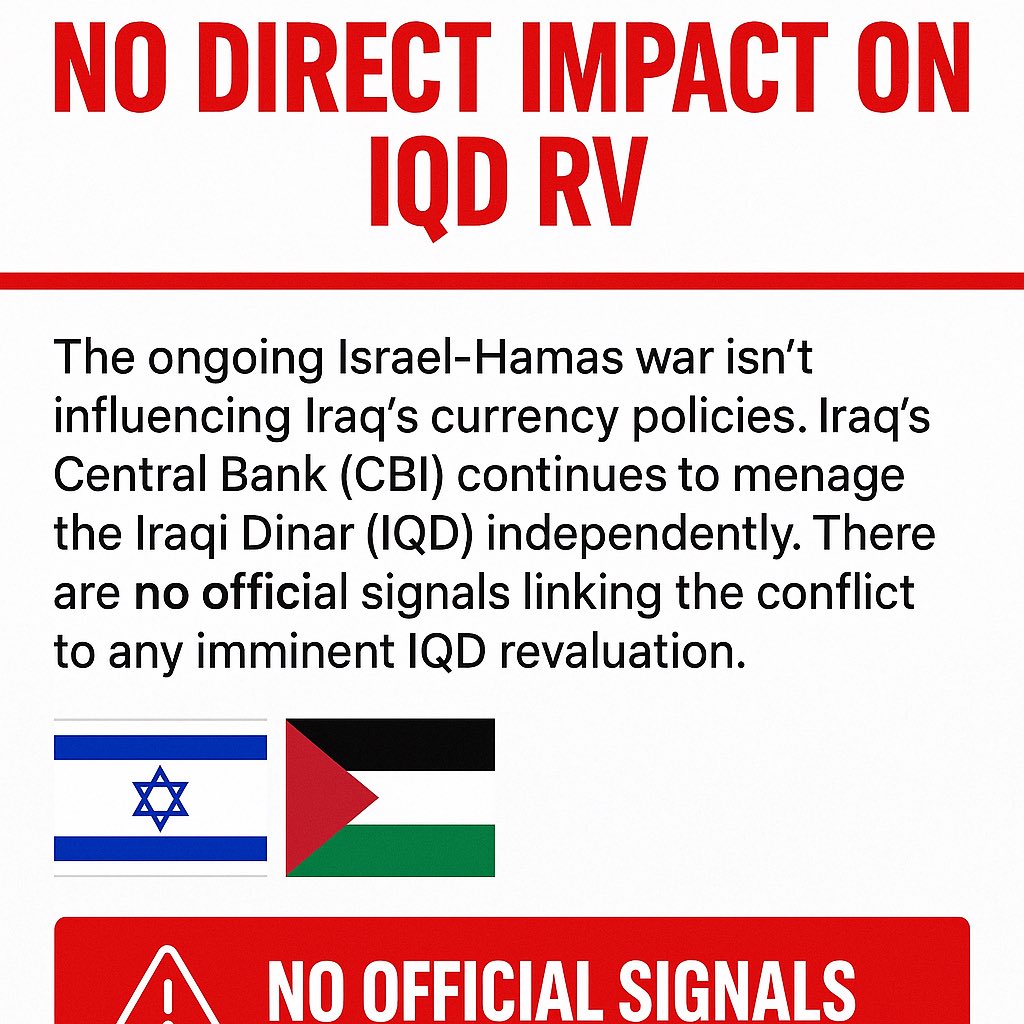
DINAR EXCHANGE 🔥 Israel-Hamas Conflict – No Direct Impact on IQD RV
DINAR EXCHANGE
 Israel-Hamas Conflict – No Direct Impact on IQD RV
•The ongoing Israel-Hamas war isn’t influencing Iraq’s currency policies.
Iraq’s Central Bank (CBI) continues to manage the Iraqi Dinar (IQD) independently.
There are no official signals linking the conflict to any imminent IQD revaluation. #iqd
Subscribe to:
Posts (Atom)