Wednesday, January 14, 2026
Experts: The Rise In The Parallel Market Exchange Rate For The Dollar Is Temporary
Experts: The Rise In The Parallel Market Exchange Rate For The Dollar Is Temporary.
Economic 2026/01/07 Baghdad: Hussein Thagab and Anwar Ayed The parallel exchange market in Iraq witnessed a significant increase in the dollar exchange rate against the dinar in recent days, reaching around 149,000 dinars per 100 dollars, which had a "slight" impact on the prices of various goods and materials.
Despite the rise in “parallel exchange rates”, specialists confirm that these surges are “temporary” and do not pose any economic concerns at all, especially with the precautionary measures taken by the “monetary authority” to absorb the severity of the rise.
The Prime Minister’s financial advisor, Dr. Mazhar Muhammad Saleh, had previously described the fluctuation in the exchange rate as “temporary” and not reflecting a structural imbalance, especially since it had practically become detached from the level of income and consumption.
Structural Factors
Economic and financial expert, Dr. Nabil Al-Abadi, believes that this phenomenon is not a coincidence or the result of a single factor, but rather the result of a complex interaction between a number of structural and circumstantial factors, internal and external, which can be analyzed into three reasons: internal structural and institutional factors, market behaviors and speculation, and external restrictions and influences.
Al-Abadi explained in an interview with Al-Sabah that, with regard to internal structural and institutional factors, the Iraqi economy is a mono-type economy, as oil revenues constitute the main source of hard currency, noting that this framework makes the balance of payments and the exchange rate highly vulnerable to the fluctuations of global oil markets.
Single Economy
Al-Abadi added that, on the monetary front, policies aimed at de-dollarization, which are essential for long-term monetary sovereignty, are being implemented rapidly. However, this implementation has been accompanied by stricter controls on dollar sales and remittance channels, leading to a reduction in supply through semi-official channels and pushing a significant portion of demand towards the parallel market.
Furthermore, the weakness of the private productive sector, whether industrial or agricultural, means the absence of an alternative domestic source of foreign currency beyond oil revenues, depriving the economy of a crucial lever for exchange rate stability.
In addition, recent developments in the customs system, particularly the requirement for prior documentation under the ASYCUDA system to obtain dollars at the official rate, have disrupted normal trade flows. He explained that this complexity and delay have driven a number of traders, especially medium-sized ones, to resort to the parallel market to finance their urgent transactions, thus increasing actual demand there.
Market And Speculation
Al-Abadi added that, regarding market behavior and speculation, in the absence of attractive and effective regulatory investment channels, a portion of local liquidity tends to be used for exchange rate speculation as a means of achieving quick profits. He explained that this speculation is often fueled by information noise and rumors, which amplifies short-term volatility. Informal practices have also been observed within the parallel market itself, such as price discrimination between different denominations of the same US dollar, indicating distortions in the market's operational mechanisms.
Regarding the third factor, “external restrictions and influences,” the financial and economic expert said that currency transfers through official Iraqi banking channels are facing increasing difficulties, especially when it comes to neighboring countries subject to international sanctions regimes.
He noted that this reality pushes the commercial sector’s need to transfer through these channels to the parallel market, creating additional structural demand. Moreover, the impact of the general regional and international geopolitical climate cannot be ignored, as any tensions lead to an increase in demand for hard currencies as a safe haven, which is reflected in the markets of fragile countries.
The impact of rumors
Al-Abadi added that in response to this analysis, official bodies are presenting a different narrative, focusing on the transient nature of this rise, as government officials describe it as “emergency and temporary,” and a result of rumors that can be contained, while emphasizing the stability of the official price at 1320 dinars to the dollar as a basic anchor. It is also believed that the reform measures in customs and the banking sector will soon begin to show their positive results.
He stressed that from a professional point of view, the official view, despite the necessary reassurance it provides, deals with the apparent symptoms more than it addresses the root causes, emphasizing that circumstantial factors such as new procedures and rumors play a stimulating role, but the roots of the crisis lie in that dangerous mix of a rentier, mono-economic economic structure, chronic weakness in domestic production, and the complexities of the geopolitical environment.
Repeated Cycles
He stated that without addressing this triad, the Iraqi economy and its currency exchange rate will remain vulnerable to repeated cycles of instability, with crises appearing intermittently and then temporarily disappearing before returning in other forms. He explained that the solution to the exchange rate dilemma does not lie in limited technical intervention to balance the parallel market or simply blaming speculators, despite the importance of these short-term measures.
The spokesperson stressed that a real and sustainable solution requires a comprehensive economic policy that aims to diversify sources of national income, stimulate the productive private sector through a supportive investment and legislative environment, and restructure the financial sector to be more efficient and inclusive.
He pointed out that these structural reforms are the only way to create an economy that is less dependent on the outside and more resistant to shocks, which in turn will reflect on the strength and stability of the national currency in the medium and long term.
Official Price Remains Stable
For his part, Haider Ghazi, the media officer of the Central Bank of Iraq, confirmed that there has been no change in the exchange rate of the dollar against the dinar, and it remains fixed at 1,320 dinars per dollar, explaining that what is being circulated as an exchange rate is only the demand of the unofficial market for dollars outside the system of banks licensed to work in foreign transfers through correspondent banks.
In an interview with Al-Sabah, Ghazi attributed the main reason for the rise in the parallel market to the customs duty due to demand outside the banking system, noting that the application of the prior customs duty for transfer purposes may have put significant pressure on those seeking cash dollars, and was behind the rise in demand for the dollar against the dinar in local markets.
He explained that traders are required to bring the customs declaration (customs statement) from the ASYCUDA system before the bank transfer is made to them, adding that on many occasions the Central Bank of Iraq stated that the ways to obtain dollars are through: First, external transfers through banks in a systematic and documented manner with all parties, and second, through the traveler's dollar after depositing an amount in Iraqi dinars with companies of categories A and B, and it is received through outlets inside Iraqi airports, as the bank set the traveler's share per month at $3,000.
Supply And Demand
In addition, a number of traders reported that the rise in the dollar price led to fluctuations in the price of goods, especially imported ones. While they indicated that some commercial activities witnessed a temporary slowdown while awaiting the stabilization of the exchange rate, money exchange shop owners explained that the demand for the dollar had increased during the past few days, compared to a relative decline in supply, which contributed to the rise in the price in the parallel market.
Iraq’s economy is mainly dependent on oil revenues, which represent the largest share of the general budget resources. The local market also depends largely on imports to secure basic goods, making exchange rates an influential factor in the cost of imports and the prices of materials in the market.
Government Procedures
On a related note, economist Mustafa Faraj believes that fluctuations in the dollar exchange rate directly impact the local market, given the nature of the Iraqi economy. He stressed the importance of taking regulatory measures when the exchange rate rises, including controlling the market and regulating trade, as well as ensuring the regular distribution of the food basket to reduce the impact of price changes in basic commodities.
Faraj added that oil prices and geopolitical factors in the region play a role in influencing economic performance, noting that the general budget was built on specific oil price estimates, and with any change in these prices, challenges arise in managing spending.
He suggested that the recent rise in the dollar's price was temporary, linked to the implementation of new mechanisms for regulating trade at the beginning of the year.
Trade Finance Mechanisms
For his part, Professor of International Economics, Nawar Al-Saadi, said that the recent rise in the price of the dollar in the parallel market reflects imbalances in the mechanisms for financing foreign trade and managing the demand for foreign currency, more than it is an indication of weakness in the country’s dollar resources.
Al-Saadi explained that part of the demand for the dollar is related to trade outside official banking channels, in addition to the impact of speculation and psychological factors in the market, stressing that the continued gap between the official price and the parallel market price limits the ability of monetary policies to achieve stability.
Meanwhile, economist Ahmed Eid believes that the rise in the dollar's price came as a result of the convergence of several factors at the same time, including increased commercial demand at the beginning of the year, in addition to psychological and hedging factors among some market participants.
Eid added that these developments do not currently indicate a structural monetary crisis, unless the pressures continue for a longer period or are accompanied by broader economic changes.
Given these circumstances, local market participants are awaiting government measures to control exchange rate activity, amid expectations that the dollar's price trajectory in the coming period will be determined by the balance of supply and demand and trade financing mechanisms.
JEFF: IQD Revaluation Analysis: Central Bank Autonomy, Government Formation & Timing
IQD Revaluation Analysis: Central Bank Autonomy, Government Formation & Timing
One of the most misunderstood aspects of the Iraqi Dinar (IQD) revaluation is who controls the timing and what conditions are truly required. Recent commentary highlights a critical truth often overlooked:
The Central Bank of Iraq (CBI) is completely autonomous.
This single fact reshapes how the revaluation timeline should be viewed.
🏛️ The Central Bank of Iraq: Fully Autonomous Authority
The CBI does not need permission from:
Parliament
The Prime Minister
A fully formed government
The Central Bank can change the exchange rate whenever it deems appropriate.
The real question is not if they can —
The question is whether they believe sufficient stability has been achieved.
🔍 Government Formation: Is It a “Completed Level”?
What remains unknown — and unverifiable — is how the CBI internally defines stability.
Key considerations:
Does partial government formation qualify?
Is full political completion required?
Or is financial infrastructure more important?
There is no public confirmation of the criteria used.
We cannot verify their internal benchmarks.
We cannot confirm their thresholds.
We can only analyze logic and precedent.
⏳ Why a Rate Change Could Come Before Government Completion
Logically, it makes more sense for the CBI to adjust the rate before full government formation is completed.
Why?
Because major tasks still follow a rate change, including:
Approval of 150+ laws
Passage of the 2026 federal budget
Financial recalibrations tied to valuation
Waiting until everything is finished would delay processes that depend on a new rate.
📜 The 2026 Budget: A Key Indicator
One of the most important post-rate-change requirements is the 2026 budget.
Budgets:
Are calculated using currency value
Reflect national income expectations
Must align with international accounting standards
This strongly suggests that a rate change could logically precede budget approval, not follow it.
🇺🇸 The U.S., Iraq, and the “Payment” Question
A crucial historical reminder:
In January 2020, former President Donald Trump stated that the United States would not exit Iraq until it was paid.
This raises an important clarification.
💰 What Does “Paid” Actually Mean?
The U.S. (and others) hold large amounts of Iraqi dinar.
However:
Holding dinar without value is not payment
Payment occurs only when value is applied
That happens when the currency is revalued and reinstated
They are not paid until the dinar has value.
Only after reinstatement does settlement truly occur.
🧠 Featured Snippet for Google Discover
The Central Bank of Iraq is autonomous and can change the IQD rate at any time. Government formation may not be a required condition, as major legal and budgetary steps logically follow a rate change, not precede it.
❓ Q&A: Key Questions Answered
Q: Can the Central Bank change the rate without a full government?
Yes. The CBI is autonomous and does not require political completion.
Q: Do we know their internal stability requirements?
No. There is no public or verifiable confirmation.
Q: Why would they revalue before government formation is complete?
Because many laws and budgets depend on the new rate.
Q: Is the 2026 budget important?
Yes. Budgets require a known currency value to be accurate.
Q: When is the U.S. considered “paid”?
When the dinar held gains value through reinstatement.
🧩 Final Analysis
This is not about speculation.
This is about logic, structure, and monetary mechanics.
The Central Bank is autonomous
Political timelines do not dictate monetary authority
Budgets, laws, and settlements require valuation
Payment occurs only when value exists
The order matters.
🔗 Stay Connected – Official Platforms
🌐 Blog:
https://dinarevaluation.blogspot.com/
📢 Telegram:
https://t.me/DINAREVALUATION
📘 Facebook:
https://www.facebook.com/profile.php?id=100064023274131
🐦 Twitter / X:
https://x.com/DinaresGurus
▶️ YouTube:
https://www.youtube.com/@DINARREVALUATION
🔥 Hashtags
#IQDRevaluation #CentralBankIraq #DinarRV #IraqGovernment
#CBIAutonomy #IraqBudget2026 #CurrencyReinstatement
#GlobalFinance #MonetaryPolicy #IQDUpdate #DinarNews
Jeff
The central bank is completely autonomous. They can change the rate whenever they want. What we don't know is do they perceive or deem the formation of the government as a level being completed. Is that a level of stability regarding the rate change?
We'll never know. We can't confirm. We have no way to verify that...It does make sense for them to change the rate before the government is done formed and completed. Reason why is they still have quite a bit of things they have to do after the rate changes. They have to approved 150+ laws. One of those would be the '26 budget.
Remember Trump said back in January of 2020 the US is not going to exit until they pay us. Well, we have a gazillion dinar, but technically they haven't paid us until that dinar has a value applied to it. That's when we're paid, when they've revalued and the currency that we have has value...and they've reinstated.
The Ministry Of Interior Is Pursuing Dollar Speculators
The Ministry Of Interior Is Pursuing Dollar Speculators
First 2026/01/14 Baghdad: Sorour Al-Ali The Ministry of Interior intensified its efforts to protect economic security and pursue those manipulating the dollar exchange rate, taking action against (91) accused persons, in parallel with strengthening traffic control and developing roads, which contributed to reducing accidents by (33%) and organizing data for more than (12) million cars through a modern national electronic database.
The Ministry's spokesman, Brigadier General Miqdad Miri, said in a joint press conference held yesterday, Tuesday, with the Director General of the Traffic Directorate, Lieutenant General Dr. Uday Samir: that the legal procedures to prosecute those manipulating the price of the dollar included (91) defendants in various governorates, in addition to monitoring (104) activities related to imported food items to ensure consumer protection and market control.
On the traffic front, the Ministry confirmed that the efforts of the General Directorate of Traffic contributed to a 33% decrease in accidents during 2025 compared to 2024, along with a reduction in traffic fatalities through monitoring common violations, most notably using a mobile phone while driving and inattentiveness. The measures included regulating traffic on internal and external roads through 473 traffic centers and 1,354 field vehicles, addressing accident black spots, and designating safer lanes.
As part of the digital transformation, information on more than (12) million vehicles was registered and standardized in the national database and linked to the national system, in addition to activating electronic booking and issuing license plates through (27) traffic sites, which contributed to improving discipline and facilitating procedures.
For The Citizens.
The Director General of Traffic, Lieutenant General Uday Samir, confirmed that all these steps aim to enhance economic and traffic security, raise awareness of the laws, and ensure the safety of citizens on the roads, while continuing to follow up on violators firmly. https://alsabaah.iq/126442-.html
Swisher1776: IQD Revaluation, Banks are Ready
IQD Revaluation Update: Banks Are Ready as Iraq Aligns Its Financial Infrastructure
The discussion surrounding the Iraqi Dinar (IQD) revaluation has intensified following new confirmations about Iraq’s banking system. Recent developments show that Iraq is not merely discussing reform — it is executing it at a structural level.
According to updated financial alignment disclosures, Iraq’s banks are now fully positioned, compliant, and operationally ready to receive a monetary rate change. This is not speculation. This is infrastructure.
🏦 Iraq’s Banking System: Centralized, Aligned, and Ready
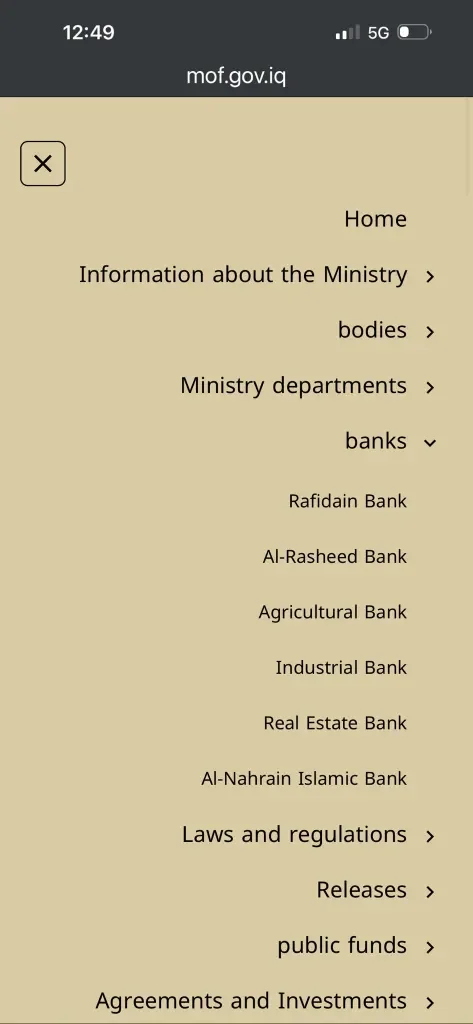
The Ministry of Finance (MOF) has officially consolidated Iraq’s state banks under a single “Banks” classification, reinforcing centralized oversight and coordinated execution.
All banks now operate under the standards, compliance requirements, and monetary framework of the Central Bank of Iraq (CBI).
This confirms one critical point:
Banks do not initiate a currency revaluation. They must be ready to receive it. And now, they are.
⭐ Rafidain Bank: Iraq’s Anchor Bank
Rafidain Bank has clearly emerged as Iraq’s lead anchor bank, setting the operational standard for the entire system.
Key Achievements:
Fully compliant with CBI regulations
Modern electronic banking systems implemented
Alignment with international banking standards
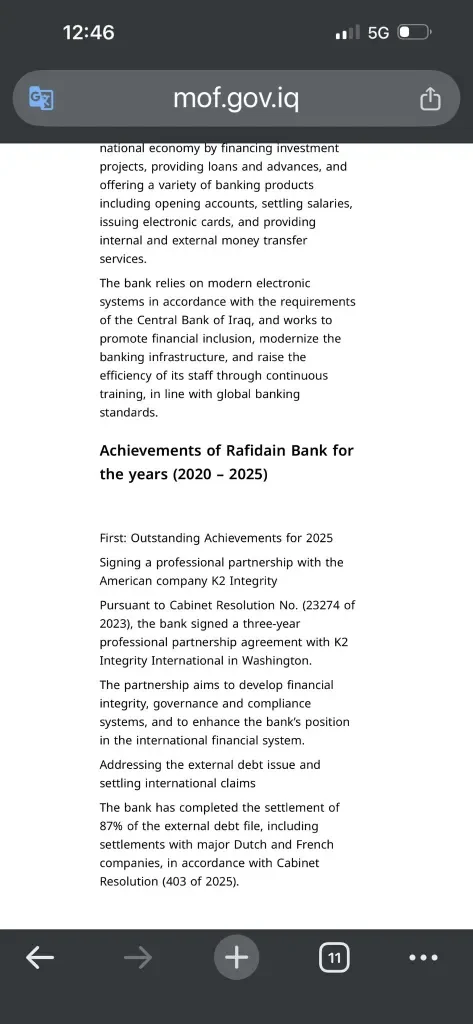
87% of external debt settled, including international claims
Strategic 2025 Partnership:
In 2025, Rafidain entered a three-year professional partnership with U.S. firm K2 Integrity, focused on:
Governance
Regulatory compliance
Financial integrity
Risk management
This is a major signal of international trust and readiness.
🔁 Rasheed Bank: Parallel Alignment
Rasheed Bank operates alongside Rafidain and historically moves in lockstep with:
Government accounts
Salary disbursements
Trade finance
Public sector payments
Its alignment confirms system-wide synchronization, not isolated readiness.
🌱 Development Banks: Structured Support, Not Rate Leadership
Agricultural Bank & Industrial Bank
These institutions function as development banks, meaning:
They do not set currency rates
They operate under the national monetary framework
System compatibility and compliance are the priority
Their readiness ensures economic growth channels are functional post-revaluation.
🏠 Real Estate Bank: Stability-Based Operations
The Real Estate Bank focuses on:
Domestic housing finance
Long-term lending
Mortgage infrastructure
Its role depends on currency stability, not foreign exchange exposure — another indicator that Iraq is preparing for a stable valuation environment.
☪️ Al Nahrain Islamic Bank: Fully Integrated
Although operating under Islamic finance principles, Al Nahrain Islamic Bank is:
Integrated into national payment systems
Aligned with settlement protocols
Compliant with national oversight
This confirms no fragmentation across banking models.
🧱 Featured Snippet: What This Really Means
Iraq’s banking system is now hierarchically aligned under the Ministry of Finance and Central Bank of Iraq, with anchor banks ready, development banks synchronized, and specialty banks integrated — signaling full readiness to receive an IQD rate change.
📌 Why This Matters for the IQD Revaluation
This alignment is not cosmetic.
This is financial infrastructure completion.
Banks do not lead a revaluation.
Banks must be ready to process, settle, comply, and operate when a rate changes.
That threshold has now been met.
❓ Q&A: Common Questions About the IQD RV
Q: Are banks announcing the revaluation?
No. Banks never announce rate changes. They prepare systems to receive them.
Q: Why is Rafidain Bank so important?
It serves as Iraq’s anchor bank, setting compliance, operational, and settlement standards.
Q: Does debt settlement matter?
Yes. Clearing external debt removes legal and financial obstacles to valuation changes.
Q: Are Islamic banks excluded?
No. They are fully integrated into national systems.
Q: Is this confirmation of an RV date?
No dates are announced. This confirms readiness, not timing.
🚀 Final Analysis
Iraq has quietly completed what many nations struggle to achieve:
Centralized banking oversight
International compliance
Debt resolution
Digital infrastructure
Cross-bank operational alignment
This is what readiness looks like.
Banks are not guessing.
Banks are not hoping.
Banks are ready.
🔗 Stay Connected – Official Platforms
🌐 Blog:
https://dinarevaluation.blogspot.com/
📢 Telegram:
https://t.me/DINAREVALUATION
📘 Facebook:
https://www.facebook.com/profile.php?id=100064023274131
🐦 Twitter / X:
https://x.com/DinaresGurus
▶️ YouTube:
https://www.youtube.com/@DINARREVALUATION
🔥 Hashtags
#IQDRevaluation #DinarRV #IraqBanking #RafidainBank #CBI #IraqEconomy
#CurrencyRevaluation #FinancialReform #MiddleEastEconomy #GlobalBanking
#IQDUpdate #DinarNews #EconomicInfrastructure #BankingReform
Swisher1776: IQD Revaluation, Banks are Ready
IQD RV: BANKS ARE READY. ANCHOR BANKS ALIGNED UNDER MOF AND CBI
The Ministry of Finance has formally listed Iraq’s state banks under a single “Banks” tab, confirming centralized oversight and coordinated reform.
Rafidain Bank is now clearly positioned as the lead institution. The bank is operating under Central Bank of Iraq requirements, has adopted modern electronic banking systems, and is aligned with global banking standards.
In 2025, Rafidain entered a three year professional partnership with the US firm K2 Integrity to strengthen governance, compliance, and financial integrity. The bank has also completed settlement of 87 percent of its external debt, including international claims.
Rasheed Bank is aligned alongside Rafidain and historically moves in parallel, particularly in government accounts, salary payments, and trade finance.
The Agricultural Bank and Industrial Bank are development banks. They do not set rates but operate under the national monetary framework, meaning alignment of systems and compliance is what matters, not pricing leadership.
The Real Estate Bank is domestically focused on housing finance and long term lending. Its role depends on currency stability rather than foreign exchange exposure.
Al Nahrain Islamic Bank operates under Islamic finance principles but remains fully integrated into national payment, compliance, and settlement systems.
This structure shows that Iraq’s banking system is being aligned hierarchically. Anchor banks first, development and specialty banks aligned operationally, all under centralized Ministry of Finance oversight and Central Bank standards.
This is not cosmetic. This is infrastructure.
Banks do not lead a rate change. Banks must be ready to receive the rate change. THEY ARE READY.
Tuesday, January 13, 2026
🔥 CLARE: Is Iraq Finally Breaking Free from Iranian Influence?
Iranian Influence in Iraq – Key Highlights
Shifting Political Landscape:
Recent developments suggest Iraqi political blocs are asserting greater independence in leadership decisions, including the prime minister selection process.Declining External Leverage:
Iran’s long-standing influence through allied parties and militias appears to be weakening amid internal divisions and growing public pressure.Rise of Iraqi Sovereignty Narrative:
Calls for national sovereignty and reduced foreign interference are gaining momentum among lawmakers and the general population.Regional & Global Factors:
Changing regional dynamics and international scrutiny may be limiting Iran’s ability to exert the same level of control as in previous years.What to Watch Next:
Coalition negotiations, militia activity, and official government appointments will be key indicators of whether this shift is temporary—or a true turning point.