Friday, February 27, 2026
CASH HOARDED IN HOME SAFES AND LOST TRUST IN BANK VAULTS
CASH HOARDED IN HOME SAFES AND LOST TRUST IN BANK VAULTS
At the heart of the banking confidence crisis that is hindering the spread of electronic payments in Iraq, the majority of economic transactions are still conducted in cash, while savings remain completely outside the formal banking system.
However, the average Iraqi citizen manages his daily life entirely by relying on paper money, as he withdraws his salaries in cash, pays for his purchases in cash, and keeps his savings at home away from banks.
Meanwhile, electronic payment cards have become a routine part of daily life in neighboring countries, revealing that Iraq is about twenty years behind in adopting the simplest modern financing tools.
This delay reflects “weak confidence in banks,” as observers describe it, since the huge amount of cash is hoarded inside homes and exceeds 90 trillion dinars, or about 90 percent of the total cash in circulation, according to the latest data from the Central Bank.
In addition, statistics indicate that less than 20 percent of the population has bank accounts, compared to more than 50 percent in Saudi Arabia and the UAE, where digital payments have been commonplace for years.
A Baghdad resident said via Facebook, “I prefer to keep my money at home for fear of any potential banking crisis, as past experiences do not encourage trust.” A local economic activist stated, “The sector needs radical reforms to build trust, especially with the push to end cash payments in government institutions by July 2026.” A banking source noted that “electronic transactions grew by 17.7 percent in the first quarter of 2025, but reliance on cash still prevails despite the launch of platforms such as ePassole in the Kurdistan Region.”
Despite these government efforts, the biggest challenge remains convincing citizens of the security of the digital system amid fears of losing or freezing deposits.
ARIEL: 🚨 IQD “Under the Radar” Claims: 1,310 to 1–3 IQD/USD? Gold-Backed Reset & Domestic Shock Scenario Explained
What’s “Under the Radar” in Iraq? Analyzing the 1–3 IQD/USD Revaluation Claim
A circulating post attributed to “Ariel” outlines a dramatic scenario:
Exchange rate reset from ~1,310 IQD/USD to 1–3 IQD per USD
Backed by 145+ tons of gold reserves
Supported by oil priced at $80–90 per barrel
Massive domestic liquidity surge
Banking system stress
Political shake-up targeting Iranian influence
These are extraordinary claims. Let’s examine them through economic logic and central banking mechanics.
The official authority responsible for Iraq’s exchange rate is the Central Bank of Iraq.
💱 Claim: Reset from 1,310 IQD/USD to 1–3 IQD/USD
This would represent a revaluation of approximately:
400× to 1,300× increase in value
For comparison:
Modern currency revaluations rarely exceed single-digit percentage adjustments.
A 400× overnight appreciation would be historically unprecedented in contemporary monetary systems.
Such a shift would:
Instantly multiply the purchasing power of every dinar holder
Collapse Iraq’s export competitiveness
Disrupt trade contracts
Trigger global forex volatility
No central bank has executed a move of this magnitude in modern floating or managed currency regimes.
🪙 Gold Backing: 145+ Tons Argument
Iraq does hold gold reserves. However:
Gold reserves function as:
Balance sheet stabilizers
Confidence anchors
Collateral buffers
They do not directly determine a fixed exchange rate in a modern managed currency system.
To back a 400× rate increase, Iraq would need:
Monetary base contraction
Massive redenomination
Structured capital controls
External trade recalibration
Gold alone cannot sustain that scale of currency appreciation without deep structural redesign.
🛢 Oil Revenue as Exchange Rate Support?
Oil priced at $80–90 per barrel certainly strengthens Iraq’s fiscal position. However:
Oil revenue:
Supports budget spending
Builds foreign reserves
Improves balance of payments
It does not automatically justify parity with the U.S. dollar.
Even major oil exporters like:
Saudi Arabia
Norway
Maintain carefully managed currency structures rather than hyper-revaluation events.
🏦 “Hyper-Liquidity Surge” Scenario
The claim suggests:
Purchasing power multiplies 400–1,300× overnight.
If this occurred:
Imports would become ultra-cheap
Domestic production would collapse
Inflation would likely spike due to demand shock
Government price controls would become necessary
Paradoxically, such a dramatic gain in currency value could destabilize internal markets rather than strengthen them.
💳 Banking System Overload & ATM Dry-Up?
A sudden 400× rate shift would create:
Immediate deposit revaluation issues
Contract renegotiations
Foreign debt repricing
Settlement confusion
Modern central banks avoid this by:
Gradual appreciation
Managed float adjustments
Controlled redenomination
Phased currency restructuring
There is currently no official confirmation that the CBI is launching a blockchain monetary layer tied to such an event.
📈 Inflation Spike Then Stabilization?
In reality, a sharp currency appreciation typically reduces import inflation. However:
If purchasing power multiplies instantly:
Consumer demand spikes
Asset bubbles form
Real estate surges
Speculative behavior accelerates
Stability would require extreme monetary discipline.
🏛 Political “Earthquake” & Proxy Removal
The post suggests political consequences involving:
Mohammed Shia' Al-Sudani
Removal of Iranian-linked proxies
While political reform and financial reform can intersect, exchange rate policy remains under the Central Bank of Iraq, not political factions directly.
Monetary policy decisions are technical and macroeconomic — not symbolic resets.
🔎 Featured Snippets
Could Iraq revalue from 1,310 IQD to 1–3 IQD per USD?
Such a 400× revaluation would be unprecedented in modern monetary history and would require massive structural reform.
Does gold backing guarantee a currency reset?
No. Gold reserves support balance sheet strength but do not automatically determine exchange rate value.
Would citizens become instantly wealthy after a 400× revaluation?
In theory, local purchasing power would rise dramatically, but severe economic distortions would likely follow.
Can a central bank raise a currency 1,000× overnight?
No modern central bank has executed an appreciation of that magnitude in a managed global system.
📊 Economic Reality Check
For Iraq to move from 1,310 to 1–3 IQD/USD, it would need:
Full redenomination (removing zeros)
Controlled monetary base contraction
Coordinated global banking transition
IMF-aligned structural reform
Formal international notification
Such a transformation would not occur covertly or “under the radar.”
❓ Q&A Section
Q: Is there official confirmation of a 1–3 IQD/USD rate?
No official statement from the Central Bank of Iraq confirms this.
Q: Does Iraq have significant gold reserves?
Yes, but gold reserves alone cannot justify a 400× exchange rate shift.
Q: Would inflation explode after such a revaluation?
Likely yes — due to sudden demand shock and asset speculation.
Q: Can oil revenue alone support dollar parity?
No. Exchange rate structures depend on monetary supply, reserves, trade balances, and macro policy — not just oil pricing.
📌 Final Perspective
Extraordinary financial transformations require:
Transparent policy communication
Coordinated international banking alignment
Legal frameworks
Monetary restructuring
A sudden 400× currency reset backed solely by gold and oil would contradict modern central banking practice.
Until official statements are issued by the Central Bank of Iraq, such projections remain speculative.
🔥 Trending Hashtags
#IraqiDinar #IQDUpdate #CurrencyRevaluation #MonetaryPolicy #GoldReserves #IraqEconomy #CBI #ForexAnalysis #GlobalFinance #DinarNews
📲 Follow for Structured Analysis & Updates
🌐 Blog: https://dinarevaluation.blogspot.com/
📲 Telegram: https://t.me/DINAREVALUATION
📘 Facebook: https://www.facebook.com/profile.php?id=100064023274131
🐦 Twitter (X): https://x.com/DinaresGurus
📺 YouTube: https://www.youtube.com/@DINARREVALUATION
ARIEL:
What is Going on Under the Radar (IQD-Update)
So I have something that was sent to me regarding some covert operations involving the C***l and possible contingencies they have in place for an Iran strike. This is from someone who apparently 1st posted this on Discord.
The IQD Revaluation Economic Effects
Immediate Domestic Effects Inside Iraq (First 30–90 Days)
Exchange rate resets from ~1,310 IQD/USD to a targeted range of 1–3 IQD/USD (pre-1991 parity zone), backed by 145+ tons of gold reserves + proven oil at $80–90/barrel.
Hyper-liquidity surge: domestic purchasing power multiplies 400–1,300× overnight for citizens holding physical dinar or CBI accounts. Consumer spending explodes cars, real estate, imported goods flood in.
Banking system overload: ATMs dry up in days, physical cash shortages force emergency printing of new lower-denomination notes while digital platforms (CBI’s new blockchain layer) come online.
Inflation spike then stabilization: prices for food, fuel, housing double–triple in first month before CBI rate controls and gold backing cap runaway effects.
Wealth redistribution: middle-class and returning diaspora become instant millionaires in local terms; old Ba’athist and militia-linked families who hoarded dollars lose relative power.
Political earthquake: PM al-Sudani’s government faces immediate pressure to purge Iranian proxies from ministries as public demands accountability for past theft.
ECONOMIC RECESSION: EROSION OF PURCHASING POWER DEEPENS THE CRISIS IN IRAQI MARKETS
ECONOMIC RECESSION: EROSION OF PURCHASING POWER DEEPENS THE CRISIS IN IRAQI MARKETS
Due to the ongoing economic recession, Iraqi citizens are suffering from the erosion of their purchasing power, which has led them to prefer adopting a conservative spending behavior.
Today, Iraqis are facing an unfamiliar economic scene: houses for sale with no buyers, car showrooms crowded with onlookers but devoid of buying and selling deals, and prices moving faster than people can keep up with them!
Fluctuations in the dollar exchange rate, jumps in the price of gold, delays in salaries, and severe economic and living crises looming on the horizon, all these factors have combined to freeze buying and selling activity in important markets.
Citizens today are adopting a more conservative spending pattern, driven by concerns about economic instability and fluctuating incomes. They are forced to postpone major purchasing decisions, such as buying cars or real estate, or entering into long-term financial commitments.
This trend reflects a prevailing sense of anticipation and caution in the market. There is a preference for holding cash rather than investing it in costly purchases or investments, in anticipation of any unforeseen economic developments.
The Baghdad Provincial Council had attributed the stagnation of the real estate market in the capital to the high amounts of fines and taxes on subdivided houses, indicating during December 2025 that recommendations were nearing completion that included reducing the fine for subdividing houses from five million to 250 or 500 thousand dinars, as well as imposing the tax on the sold area only and not on the entire original plot of land, in an attempt to address this stagnation.
Waiting for the dollar to stabilize
Citizen Abu Ahmed says in a press interview that he put his house up for sale more than four months ago due to financial circumstances, and to this day no serious buyer has come forward. He added in a press interview that everyone who asks about the house backs down when they know the price, or says they are waiting until the dollar prices stabilize.
He points out that in the past, a house would not remain on display for more than a month, but today the market is almost at a standstill.
An ill-advised gamble
Experts attribute this stagnation to the fluctuating exchange rate of the dollar against the Iraqi currency, and the high price of gold, which makes buying and selling real estate and cars an uncalculated gamble.
In this regard, economist Mustafa Faraj says, “There is a direct relationship between the price of gold and the dollar. Gold is a metal priced in dollars, and if the price of the dollar falls, the price of gold rises, and vice versa.”
He then explains that “Iraq is a rentier state and relies heavily on imports. Therefore, it is directly affected by the price of the dollar, especially in the field of cars, which are imported using hard currency,” adding that “the same applies to house prices. The dollar has a significant influence on the Iraqi market.”
He continues, saying that “real estate sales are currently experiencing a recession, which will continue in the coming period,” noting that “the situation of the Iraqi economy is difficult, due to a shortage of financial liquidity, which leads to delays in paying the salaries of state employees.”
According to Faraj, “Many people have resorted to investing in gold in light of the current geopolitical situation in the region. This has led to a surge in demand for gold, which has contributed to its price increase. In addition, there is a lack of trust among citizens in government banks. The fear of keeping money in banks pushes citizens to invest it in gold.”
Paralysis of buying and selling
Real estate office owners and car dealerships also complain of the stagnation and paralysis that has affected their businesses in the past period.
Radwan Al-Yassiri, owner of a car showroom in the Al-Bayaa area of Baghdad, confirms that he and his colleagues are suffering from an almost complete halt in car sales operations, noting in a press interview that “the direct sales area used to witness heavy congestion on Fridays, and the car market would be at its peak activity, but in recent weeks there have been very few sales and purchases.”
He adds that “the decline in car sales and purchases is linked to several factors, including the weak purchasing power of citizens, increased inflation, as well as the high customs duties imposed on car imports, the ban on importing cars that do not conform to specifications, in addition to the fluctuation of dollar exchange rates,” noting that “all these reasons have led to higher car prices, and made citizens hesitant to sell or buy them.”
He notes that “citizens are no longer buying new cars as they used to. Sales have dropped to near zero, and consumers have turned to buying used cars.”
Real estate agents who buy, sell, and rent properties face similar difficulties to those of showroom owners. Abdul Hassan Kadhim, a real estate agent in Baghdad’s Jihad neighborhood, says that the last house sale through his office was more than two months ago.
In a press interview, he explains that his current activity is limited to renting houses and organizing rental contracts, indicating that the fluctuation in the dollar exchange rate and the weakness of purchasing power are behind the stagnation of various sectors at the present time.
Erosion of purchasing power
According to specialists, the current stagnation in buying and selling in the real estate and automotive sectors is not a passing event, but may be a long-term indicator of a decline in the local economy.
Khaled Al-Jabri, head of the “Usul Foundation” for Economic Development, says that “what the economy is witnessing today is not a passing slowdown, but rather an actual contraction in demand, resulting from the erosion of the citizen’s purchasing power due to the delay in salaries, the increase in customs duties, and the stagnation of liquidity in .
🚨 Bruce “The Big Call” Intel: $5,000 Tariff Dividend, Tier4b Notifications & Iraq Border Closure — Fact Check & Analysis
Bruce “The Big Call” Claims: Major RV Events Set for March 2–3, 2026?
In the latest update attributed to Bruce of The Big Call, several bold claims were presented, including:
A $5,000 monthly “Tariff Dividend” for all U.S. citizens age 18+
Tier4b notification rollout by March 2, 2026
Currency exchanges beginning March 3, 2026
Iraq sealing its borders until exchanges begin
The Vietnamese Dong rate rising “a couple dollars”
A Dinar contract rate tied to one barrel of oil at Redemption Centers
Let’s break this down carefully and separate structured analysis from speculation.
A $5,000 monthly “Tariff Dividend” for all U.S. citizens age 18+
Tier4b notification rollout by March 2, 2026
Currency exchanges beginning March 3, 2026
Iraq sealing its borders until exchanges begin
The Vietnamese Dong rate rising “a couple dollars”
A Dinar contract rate tied to one barrel of oil at Redemption Centers
💵 $5,000 Monthly “Tariff Dividend” for 3 Years?
The claim states that a source inside the United States Department of the Treasury indicated:
All U.S. citizens age 18+ will receive $5,000 per month for three years, beginning March 3, 2026.
As of now:
There has been no official announcement from the Treasury.
No legislation authorizing such payments has been publicly passed.
No confirmation exists from Congress or the Executive Branch.
For a program of this magnitude, it would require:
Congressional approval
Budget allocation
Public policy documentation
Official Treasury disbursement procedures
Without those elements, this remains unverified commentary.
All U.S. citizens age 18+ will receive $5,000 per month for three years, beginning March 3, 2026.
There has been no official announcement from the Treasury.
No legislation authorizing such payments has been publicly passed.
No confirmation exists from Congress or the Executive Branch.
Congressional approval
Budget allocation
Public policy documentation
Official Treasury disbursement procedures
📲 Tier4b Notifications & Exchange Appointments
The update suggests:
Tier4b (Internet Group) notifications by Monday, March 2
Exchanges starting Tuesday, March 3
Zim bond redemptions included
The term “Tier4b” is not recognized by:
The U.S. Department of the Treasury
The Federal Reserve
The Central Bank of Iraq
Additionally, no major financial institution has publicly acknowledged:
Structured “Internet Group” exchange tiers
Private redemption scheduling frameworks
- Zim bond payout platforms
Tier4b (Internet Group) notifications by Monday, March 2
Exchanges starting Tuesday, March 3
Zim bond redemptions included
The U.S. Department of the Treasury
The Federal Reserve
The Central Bank of Iraq
Structured “Internet Group” exchange tiers
Private redemption scheduling frameworks
🇮🇶 Did Iraq Seal Its Borders?
The claim states that Iraq sealed its borders on February 25, 2026, to prevent money from entering or leaving the country until exchanges begin.
Border closures for monetary reform would typically involve:
Official government announcements
Public security statements
Coverage from recognized Iraqi media
Confirmation from the Iraqi Ministry of Interior
No verified public documentation confirms such a closure tied to currency exchanges.
Official government announcements
Public security statements
Coverage from recognized Iraqi media
Confirmation from the Iraqi Ministry of Interior
💱 Vietnamese Dong Rate Increase?
The post claims the Vietnamese Dong has risen “another couple of dollars.”
The official currency authority is the
State Bank of Vietnam.
A multi-dollar move in the Vietnamese Dong exchange rate would:
Represent an unprecedented percentage increase
Trigger global FOREX market volatility
Be immediately reported by financial news outlets
No confirmed FOREX data currently supports that claim.
Represent an unprecedented percentage increase
Trigger global FOREX market volatility
Be immediately reported by financial news outlets
🛢 Contract Rate Tied to a Barrel of Oil?
Another major claim:
The Dinar contract rate is tied to one barrel of oil price in Iraq.
The exchange rate of the Iraqi dinar is determined by the Central Bank of Iraq, based on:
Monetary policy
Foreign reserves
Trade balances
Inflation metrics
Peg or managed float structure
Oil revenue impacts national income — but there is no official mechanism publicly tying one dinar to the price of a single oil barrel in a direct redemption formula.
The Dinar contract rate is tied to one barrel of oil price in Iraq.
Monetary policy
Foreign reserves
Trade balances
Inflation metrics
Peg or managed float structure
🏦 Redemption Centers vs. Banks
The post again references “Redemption Centers.”
However:
No formal government registry of such centers exists
No official Treasury publication validates this structure
Banks handle foreign currency exchange under regulatory oversight
Investors should verify all exchange procedures through recognized financial institutions.
No formal government registry of such centers exists
No official Treasury publication validates this structure
Banks handle foreign currency exchange under regulatory oversight
🔎 Featured Snippets
Is the U.S. Treasury issuing $5,000 monthly tariff dividends?
There is no official confirmation or legislation authorizing a $5,000 monthly tariff dividend for U.S. citizens.
Are Tier4b exchange notifications confirmed?
No recognized financial authority has confirmed a Tier4b notification system.
Did Iraq close its borders for currency exchanges?
There is no verified public confirmation linking any Iraqi border closure to currency exchange events.
Is the Iraqi dinar tied to oil prices per barrel?
While oil revenue supports Iraq’s economy, the exchange rate is set by the Central Bank of Iraq and not directly pegged to one barrel of oil per dinar.
⚠️ Important Considerations
Claims involving:
Exact payout dates
Guaranteed dividends
Secret exchange tiers
Contract oil-based rates
Border closures tied to currency release
Require official documentation to validate.
Extraordinary financial events of this scale would:
Be covered by global media
Trigger financial market reactions
Require legislative approval
Be announced by central authorities
Exact payout dates
Guaranteed dividends
Secret exchange tiers
Contract oil-based rates
Border closures tied to currency release
Be covered by global media
Trigger financial market reactions
Require legislative approval
Be announced by central authorities
❓ Q&A Section
Q: Should I expect $5,000 monthly payments starting March 3, 2026?
There is no verified public confirmation of such payments.
Q: Are Zim bond redemptions officially scheduled?
No recognized financial authority has confirmed Zim bond redemption programs.
Q: Can a currency rate jump by several dollars overnight?
Major multi-dollar increases in sovereign currencies are extremely rare and would cause immediate global market reaction.
Q: Where should exchanges occur if a currency revalues?
Through recognized, regulated banking institutions.
📌 Final Thoughts
The claims presented are bold and specific, including exact dates and payment amounts. However:
No official confirmation supports them at this time
No government documentation validates them
No global financial reporting corroborates them
Investors should prioritize:
Official central bank statements
Verified financial news sources
Regulatory confirmations
Speculation spreads quickly — verification protects capital.
No official confirmation supports them at this time
No government documentation validates them
No global financial reporting corroborates them
Official central bank statements
Verified financial news sources
Regulatory confirmations
🔥 Trending Hashtags
#IraqiDinar #BigCall #Tier4b #TariffDividend #CurrencyExchange #DinarNews #ForexUpdate #ZimBonds #RVUpdate #FinancialNews
📲 Stay Connected for Ongoing Updates
🌐 Blog: https://dinarevaluation.blogspot.com/
📲 Telegram: https://t.me/DINAREVALUATION
📘 Facebook: https://www.facebook.com/profile.php?id=100064023274131
🐦 Twitter (X): https://x.com/DinaresGurus
📺 YouTube: https://www.youtube.com/@DINARREVALUATION
📲 Telegram: https://t.me/DINAREVALUATION
📘 Facebook: https://www.facebook.com/profile.php?id=100064023274131
🐦 Twitter (X): https://x.com/DinaresGurus
📺 YouTube: https://www.youtube.com/@DINARREVALUATION
Bruce, The Big Call
A source inside the US Treasury indicated all US Citizens age 18 and older were going to get a $5,000 Tariff dividend each month for three years for the Tariff dividend. That will be mirrored into our bank accounts by Tues. 3 March 2026.
Notification for Tier4b (Us, the Internet Group) to obtain appointments to exchange foreign currencies and Zim Bonds will come by Mon. 2 March 2026, with exchanges started by Tues. 3 March 2026.
Yesterday Wed. 25 Feb. 2026 Iraq sealed their borders (so money would not come in or out of Iraq) until the exchanges get going on Tues. 3 March 2026.
The Dong rate has gone up another couple of dollars. Contract Rate for the Dinar can be obtained at a Redemption Center and is tied to one barrel of oil price in Iraq.
DEPOSITING IRAQI OIL REVENUES IN NEW YORK BETWEEN FINANCIAL STABILITY AND ECONOMIC SOVEREIGNTY
DEPOSITING IRAQI OIL REVENUES IN NEW YORK BETWEEN FINANCIAL STABILITY AND ECONOMIC SOVEREIGNTY
(Mnt Goat: We can see now why the US Treasury does not release these funds to Iraq to invest in their own Sovereign Funds, managed by the CBI. Yes, it is this issue of Iranian control again, decisively shown by the nomination of Maliki for the prime minister position. He raided the CBI once before and he can do it again.)
The mechanism for depositing Iraqi oil revenues in accounts with the US Federal Reserve in New York is one of the most complex financial arrangements in the history of modern Iraq. Since 2003, this mechanism is no longer just a technical measure to protect funds, but has become a central element affecting economic sovereignty, financial stability and political relations of Iraq with international powers.
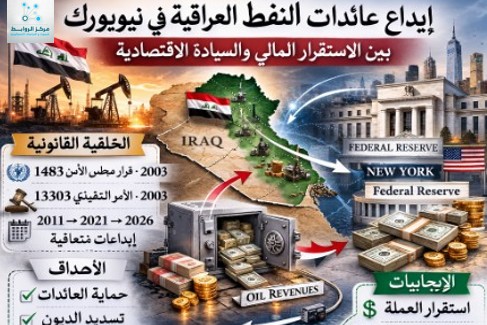
LEGAL AND ECONOMIC BACKGROUND
After the US invasion of Iraq in 2003, the UN Security Council issued Resolution 1483, which aimed to protect Iraq’s funds derived from oil sales and state assets from creditor claims and lawsuits, in light of the accumulation of huge debts dating back to the era of the previous regime. In this context, US Executive Order No. 13303 was issued, which granted wide legal immunity to Iraqi oil revenues deposited in the United States, and was later renewed and amended in proportion to the developments of the debt file.
Economically, Iraq was in a very fragile situation. External debt, the collapse of financial institutions and the absence of international confidence have all made this mechanism a necessary tool for reintegrating Iraq into the global financial system and securing a regular flow of dollars needed to import and finance the general budget.
INDIRECT ECONOMIC BENEFITS
This arrangement contributed to several economic gains. It boosted international confidence in the management of Iraqi oil revenues, helped stabilize the exchange rate, and reduced the risk of seizure of Iraqi funds abroad. It also provided a more attractive environment for international oil companies, which operate within a legal framework that limits their exposure to prosecutions related to oil activity in Iraq.
From a macro-financial perspective, this system has formed a safety valve against external shocks, whether caused by fluctuations in oil prices or from legal disputes with creditors, which has helped the state maintain a minimum of financial stability in very difficult periods.
COST OF SOVEREIGNTY AND EXTERNAL ACCREDITATION
On the other hand, these benefits cannot be separated from their sovereign cost. Oil constitutes about ninety percent of the Iraqi state’s revenues, and depositing these revenues outside the country gave the United States real influence over the joints of the Iraqi economy. This has been clearly highlighted in sensitive political stations, when Iraqi sovereign decisions have been linked to access to or restriction of these funds.
This situation reflects a classic economic dilemma facing rendier countries emerging from conflict, which is the trade-off between short-term financial stability and the construction of full economic sovereignty in the long term. The longer the reliance on external protection mechanisms, the more complicated the path of true financial independence.
INTERNATIONAL DIMENSION AND OVERLAP OF FILES
The oil revenue file intersects with other legal and political files, including maritime border disputes and the filing of coordinates with the United Nations under the Convention on the Law of the Sea. Successive Iraqi filings in 2011, 2021 and 2026 reflect gradual attempts to establish a legal situation that serves national interests, but at the same time they opened the door to objections from neighboring countries, which confirms that legal stability is not achieved by unilateral deposit, but by international consensus or arbitration.
FUTURE READING
From an analytical economic perspective, it can be said that the mechanism of depositing oil revenues in New York played its historic role in protecting Iraq during an exceptional transition period. However, its continuation of its current status raises fundamental questions about Iraq’s ability to build independent financial institutions, diversify its sources of income, and reduce its dependence on external arrangements.
The real challenge lies not in the immediate elimination of this mechanism, but in the development of a gradual strategy that moves Iraq from the logic of external protection to the logic of institutional sovereignty, where trust stems from the strength of the national financial system, not from the location of bank accounts.
CONCLUSION
Depositing Iraqi oil revenues in New York is not a technical or purely financial matter, but rather a reflection of a history of conflicts, debt, and economic reshaping. While this arrangement provided a measure of stability, it continues to be a reminder that economic sovereignty is measured not only by the volume of revenue, but also by the ability of a State to control it within an independent national legal and institutional system.
(It is also leverage the US has over Iraq to help combat corruption.)
MNT GOAT: Iraq Dinar Nearing FOREX Return? Budget Delays, Oil & Gas Law and the Two-Rate Debate Explained
Iraq Dinar Update: “Things Can Change on a Dime”
Mnt Goat’s latest commentary emphasizes urgency: “Things can change on a dime. Wait and watch.”
According to her view, multiple indicators suggest Iraq may be approaching a pivotal financial shift:
Parliament waiting on the federal budget
Anticipated movement on the Oil and Gas Law
Political reshuffling
Clarification on the Central Bank’s authority over exchange rates
Renewed discussion of a potential FOREX return
Let’s unpack each component carefully.
🏛 Parliament, Budget & Oil and Gas Law
Iraq’s legislative agenda remains central to monetary reform discussions.
1️⃣ The Federal Budget
Parliament is reportedly waiting for budget clarity. In Iraq, the annual budget defines:
Oil revenue projections
Spending allocations
Currency assumptions
Fiscal stability metrics
Budget finalization often precedes major economic adjustments.
2️⃣ The Oil and Gas Law
The long-awaited Hydrocarbon Law (HCL), commonly referred to as the Oil and Gas Law, would clarify:
Revenue sharing between Baghdad and regions
Authority over oil exports
Payment mechanisms to provinces
Long-term investor confidence
For years, this legislation has been viewed as foundational for broader economic reform.
🇮🇶 Political Landscape: Fading Iranian Influence?
Mnt Goat suggests that Iranian influence inside Iraq is weakening, with political momentum shifting.
Key figures mentioned:
Nouri al-Maliki – described by critics as politically weakened
Mohammed Shia' Al-Sudani – expected by supporters to solidify leadership
Regional power shifts often influence financial stability. However, monetary decisions ultimately fall under the authority of the central bank, not political factions alone.
🏦 CBI Independence & The “Two Rate” Confusion
One of the most important clarifications in this discussion involves the difference between:
The Program Rate
The FOREX Rate
The governing authority is the Central Bank of Iraq (CBI).
💵 What Is the Program Rate?
The “program rate” refers to the managed exchange rate Iraq currently uses domestically. It operates under a de facto peg structure — historically aligned closely to the U.S. dollar.
Key characteristics:
Controlled by the CBI
Adjusted administratively
Used for internal accounting and official transactions
Can technically be modified upward or downward
This does not automatically mean international tradability.
🌍 What Is the FOREX Rate?
A FOREX rate applies when a currency is:
Fully tradable on global currency markets
Actively exchanged internationally
Priced dynamically through supply and demand
Integrated into global banking systems
Mnt Goat emphasizes that returning to FOREX would require:
Re-pegging (potentially to a basket or new structure)
Removal of sole reliance on a dollar peg
Rollout of lower denominations
Structural reform completion
🍎 Apples and Oranges: Why These Rates Are Not the Same
A critical point:
There cannot be two official exchange rates simultaneously — one for inside Iraq and one for FOREX — under normal monetary practice.
When (and if) the dinar returns to FOREX:
The domestic program rate would transition to the internationally recognized rate
The temporary program structure would cease
One unified official rate would exist
This distinction is often misunderstood in dinar discussions.
💰 Why Lower Denominations Matter
If Iraq were to support a stronger exchange rate environment:
Smaller denomination notes would be necessary for daily transactions
Large “three-zero” notes would likely be phased gradually
Public purchasing power would need recalibration
Currency restructuring must align with practical economic function — not just exchange value.
🔎 Featured Snippets
What is the difference between Iraq’s program rate and FOREX rate?
The program rate is a domestically managed exchange rate set by the Central Bank of Iraq. A FOREX rate applies when the currency is fully tradable on international markets.
Can the Central Bank of Iraq change the rate anytime?
The CBI can adjust the domestic program rate. However, restoring full FOREX participation involves broader structural and international considerations.
Can Iraq have two official exchange rates?
No. A currency typically operates under one official exchange rate. When internationally tradable, the domestic rate aligns with the global rate.
📊 Signs Often Watched by Analysts
Observers monitoring a potential shift typically watch for:
Budget completion
Oil and Gas Law movement
Political stabilization
Banking compliance reforms
Lower denomination announcements
Official CBI policy statements
Until confirmed by official channels, all expectations remain speculative.
❓ Q&A Section
Q: Is Iraq officially returning to FOREX?
No official announcement has been made confirming a FOREX return.
Q: Does adjusting the program rate equal a revaluation?
Not necessarily. A domestic rate adjustment is different from restoring full international tradability.
Q: Why is the Oil and Gas Law important?
It provides long-term revenue clarity and investor confidence — key elements in economic reform.
Q: Is political change required before monetary reform?
Political stability helps, but currency policy decisions are made by the Central Bank of Iraq.
📌 Key Takeaways
Budget and Oil & Gas Law remain central
Political shifts may influence reform momentum
The program rate and FOREX rate are fundamentally different
Only one official rate can exist at a time
No confirmed date for FOREX return has been announced
As Mnt Goat says: “Wait and watch.”
Major financial transitions often appear sudden — but they are usually built on years of structural groundwork.
🔥 Trending Hashtags
#IraqiDinar #FOREXUpdate #MonetaryReform #IraqBudget #OilAndGasLaw #CBI #CurrencyNews #IQDUpdate #GlobalFinance #DinarCommunity
📲 Follow for Ongoing Iraq Dinar Coverage
🌐 Blog: https://dinarevaluation.blogspot.com/
📲 Telegram: https://t.me/DINAREVALUATION
📘 Facebook: https://www.facebook.com/profile.php?id=100064023274131
🐦 Twitter (X): https://x.com/DinaresGurus
📺 YouTube: https://www.youtube.com/@DINARREVALUATION
Mnt Goat
I assure you things can change on a dime. Wait and watch! There are already too many signs we are very near. Parliament is waiting for the budget and will soon address the Oil and Gas Law.
..Iranian influence over Iraq is fading as many are now believing (as we already do) that Maliki is a ‘sinking ship’...it is just a matter of time before al-Sudani is sworn in to form his cabinet as the next prime minister.
...my CBI contact...said we would hear all kinds of comments about the independence of the CBI and how they can adjust the rate anytime they want. Yes this may be true but...Some don’t even realize there are two types of rates, one is the program rate and the other the FOREX rate...the ‘program’ rate tied to the de facto peg can be changed upwards or downwards by the CBI any time. This does not mean allowing the dinar back on FOREX..
When the dinar goes back to FOREX it will be re-pegged and off the sole peg to the dollar and the program rate will go away. The newer lower denominations would have to first be rolled out. We are talking apples and oranges when we talk about these two rate types...The dinar can only have one ‘official’ rate. There is no such thing as an in-country rate and then a FOREX rate at the same time...When the dinar does go back to FOREX, the in-country rate (program rate) will change to the FOREX rate.
Analysis: The Role of Iraq’s Sovereign Wealth Structure and Its Potential Impact on Dinar Stability
🔗📢 FOLLOW & JOIN OUR COMMUNITY 📌 TELEGRAM: https://t.me/DINAREVALUATION 📌 X (TWITTER): https://x.com/DinarWatchTeam 📌 BLUESKY: ...

-
Bank appointment for Currency EXCHANGE Instructions/Checklist Bank Name_________________________________________ Bank 800#____________...
-
🔥 Chase Bank Reveals Official Dinar Exchange Process – What You MUST Know! 💰🛡️ A game-changing update is here for Iraqi dinar holders! C...
-
🚨 WEEKLY GCR UPDATE – August 3-15, 2025 🚨 Sun, Aug 3: Wolverine confirms 💸 “Money has been deposited into paymasters’ accounts. Everyt...