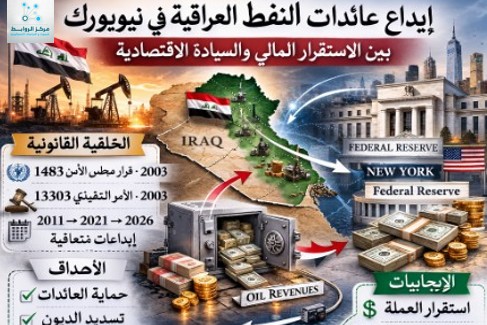
DEPOSITING IRAQI OIL REVENUES IN NEW YORK BETWEEN FINANCIAL STABILITY AND ECONOMIC SOVEREIGNTY
(Mnt Goat: We can see now why the US Treasury does not release these funds to Iraq to invest in their own Sovereign Funds, managed by the CBI. Yes, it is this issue of Iranian control again, decisively shown by the nomination of Maliki for the prime minister position. He raided the CBI once before and he can do it again.)
The mechanism for depositing Iraqi oil revenues in accounts with the US Federal Reserve in New York is one of the most complex financial arrangements in the history of modern Iraq. Since 2003, this mechanism is no longer just a technical measure to protect funds, but has become a central element affecting economic sovereignty, financial stability and political relations of Iraq with international powers.
LEGAL AND ECONOMIC BACKGROUND
After the US invasion of Iraq in 2003, the UN Security Council issued Resolution 1483, which aimed to protect Iraq’s funds derived from oil sales and state assets from creditor claims and lawsuits, in light of the accumulation of huge debts dating back to the era of the previous regime. In this context, US Executive Order No. 13303 was issued, which granted wide legal immunity to Iraqi oil revenues deposited in the United States, and was later renewed and amended in proportion to the developments of the debt file.
Economically, Iraq was in a very fragile situation. External debt, the collapse of financial institutions and the absence of international confidence have all made this mechanism a necessary tool for reintegrating Iraq into the global financial system and securing a regular flow of dollars needed to import and finance the general budget.
INDIRECT ECONOMIC BENEFITS
This arrangement contributed to several economic gains. It boosted international confidence in the management of Iraqi oil revenues, helped stabilize the exchange rate, and reduced the risk of seizure of Iraqi funds abroad. It also provided a more attractive environment for international oil companies, which operate within a legal framework that limits their exposure to prosecutions related to oil activity in Iraq.
From a macro-financial perspective, this system has formed a safety valve against external shocks, whether caused by fluctuations in oil prices or from legal disputes with creditors, which has helped the state maintain a minimum of financial stability in very difficult periods.
COST OF SOVEREIGNTY AND EXTERNAL ACCREDITATION
On the other hand, these benefits cannot be separated from their sovereign cost. Oil constitutes about ninety percent of the Iraqi state’s revenues, and depositing these revenues outside the country gave the United States real influence over the joints of the Iraqi economy. This has been clearly highlighted in sensitive political stations, when Iraqi sovereign decisions have been linked to access to or restriction of these funds.
This situation reflects a classic economic dilemma facing rendier countries emerging from conflict, which is the trade-off between short-term financial stability and the construction of full economic sovereignty in the long term. The longer the reliance on external protection mechanisms, the more complicated the path of true financial independence.
INTERNATIONAL DIMENSION AND OVERLAP OF FILES
The oil revenue file intersects with other legal and political files, including maritime border disputes and the filing of coordinates with the United Nations under the Convention on the Law of the Sea. Successive Iraqi filings in 2011, 2021 and 2026 reflect gradual attempts to establish a legal situation that serves national interests, but at the same time they opened the door to objections from neighboring countries, which confirms that legal stability is not achieved by unilateral deposit, but by international consensus or arbitration.
FUTURE READING
From an analytical economic perspective, it can be said that the mechanism of depositing oil revenues in New York played its historic role in protecting Iraq during an exceptional transition period. However, its continuation of its current status raises fundamental questions about Iraq’s ability to build independent financial institutions, diversify its sources of income, and reduce its dependence on external arrangements.
The real challenge lies not in the immediate elimination of this mechanism, but in the development of a gradual strategy that moves Iraq from the logic of external protection to the logic of institutional sovereignty, where trust stems from the strength of the national financial system, not from the location of bank accounts.
CONCLUSION
Depositing Iraqi oil revenues in New York is not a technical or purely financial matter, but rather a reflection of a history of conflicts, debt, and economic reshaping. While this arrangement provided a measure of stability, it continues to be a reminder that economic sovereignty is measured not only by the volume of revenue, but also by the ability of a State to control it within an independent national legal and institutional system.
(It is also leverage the US has over Iraq to help combat corruption.)