Friday, February 27, 2026
DEPOSITING IRAQI OIL REVENUES IN NEW YORK BETWEEN FINANCIAL STABILITY AND ECONOMIC SOVEREIGNTY
DEPOSITING IRAQI OIL REVENUES IN NEW YORK BETWEEN FINANCIAL STABILITY AND ECONOMIC SOVEREIGNTY
(Mnt Goat: We can see now why the US Treasury does not release these funds to Iraq to invest in their own Sovereign Funds, managed by the CBI. Yes, it is this issue of Iranian control again, decisively shown by the nomination of Maliki for the prime minister position. He raided the CBI once before and he can do it again.)
The mechanism for depositing Iraqi oil revenues in accounts with the US Federal Reserve in New York is one of the most complex financial arrangements in the history of modern Iraq. Since 2003, this mechanism is no longer just a technical measure to protect funds, but has become a central element affecting economic sovereignty, financial stability and political relations of Iraq with international powers.
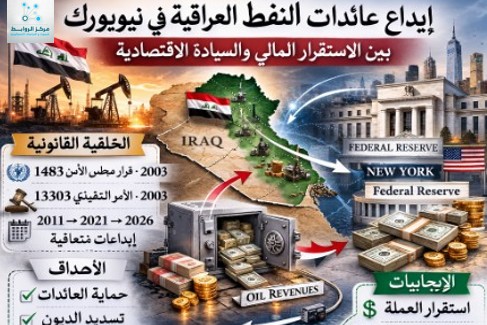
LEGAL AND ECONOMIC BACKGROUND
After the US invasion of Iraq in 2003, the UN Security Council issued Resolution 1483, which aimed to protect Iraq’s funds derived from oil sales and state assets from creditor claims and lawsuits, in light of the accumulation of huge debts dating back to the era of the previous regime. In this context, US Executive Order No. 13303 was issued, which granted wide legal immunity to Iraqi oil revenues deposited in the United States, and was later renewed and amended in proportion to the developments of the debt file.
Economically, Iraq was in a very fragile situation. External debt, the collapse of financial institutions and the absence of international confidence have all made this mechanism a necessary tool for reintegrating Iraq into the global financial system and securing a regular flow of dollars needed to import and finance the general budget.
INDIRECT ECONOMIC BENEFITS
This arrangement contributed to several economic gains. It boosted international confidence in the management of Iraqi oil revenues, helped stabilize the exchange rate, and reduced the risk of seizure of Iraqi funds abroad. It also provided a more attractive environment for international oil companies, which operate within a legal framework that limits their exposure to prosecutions related to oil activity in Iraq.
From a macro-financial perspective, this system has formed a safety valve against external shocks, whether caused by fluctuations in oil prices or from legal disputes with creditors, which has helped the state maintain a minimum of financial stability in very difficult periods.
COST OF SOVEREIGNTY AND EXTERNAL ACCREDITATION
On the other hand, these benefits cannot be separated from their sovereign cost. Oil constitutes about ninety percent of the Iraqi state’s revenues, and depositing these revenues outside the country gave the United States real influence over the joints of the Iraqi economy. This has been clearly highlighted in sensitive political stations, when Iraqi sovereign decisions have been linked to access to or restriction of these funds.
This situation reflects a classic economic dilemma facing rendier countries emerging from conflict, which is the trade-off between short-term financial stability and the construction of full economic sovereignty in the long term. The longer the reliance on external protection mechanisms, the more complicated the path of true financial independence.
INTERNATIONAL DIMENSION AND OVERLAP OF FILES
The oil revenue file intersects with other legal and political files, including maritime border disputes and the filing of coordinates with the United Nations under the Convention on the Law of the Sea. Successive Iraqi filings in 2011, 2021 and 2026 reflect gradual attempts to establish a legal situation that serves national interests, but at the same time they opened the door to objections from neighboring countries, which confirms that legal stability is not achieved by unilateral deposit, but by international consensus or arbitration.
FUTURE READING
From an analytical economic perspective, it can be said that the mechanism of depositing oil revenues in New York played its historic role in protecting Iraq during an exceptional transition period. However, its continuation of its current status raises fundamental questions about Iraq’s ability to build independent financial institutions, diversify its sources of income, and reduce its dependence on external arrangements.
The real challenge lies not in the immediate elimination of this mechanism, but in the development of a gradual strategy that moves Iraq from the logic of external protection to the logic of institutional sovereignty, where trust stems from the strength of the national financial system, not from the location of bank accounts.
CONCLUSION
Depositing Iraqi oil revenues in New York is not a technical or purely financial matter, but rather a reflection of a history of conflicts, debt, and economic reshaping. While this arrangement provided a measure of stability, it continues to be a reminder that economic sovereignty is measured not only by the volume of revenue, but also by the ability of a State to control it within an independent national legal and institutional system.
(It is also leverage the US has over Iraq to help combat corruption.)
MNT GOAT: Iraq Dinar Nearing FOREX Return? Budget Delays, Oil & Gas Law and the Two-Rate Debate Explained
Iraq Dinar Update: “Things Can Change on a Dime”
Mnt Goat’s latest commentary emphasizes urgency: “Things can change on a dime. Wait and watch.”
According to her view, multiple indicators suggest Iraq may be approaching a pivotal financial shift:
Parliament waiting on the federal budget
Anticipated movement on the Oil and Gas Law
Political reshuffling
Clarification on the Central Bank’s authority over exchange rates
Renewed discussion of a potential FOREX return
Let’s unpack each component carefully.
🏛 Parliament, Budget & Oil and Gas Law
Iraq’s legislative agenda remains central to monetary reform discussions.
1️⃣ The Federal Budget
Parliament is reportedly waiting for budget clarity. In Iraq, the annual budget defines:
Oil revenue projections
Spending allocations
Currency assumptions
Fiscal stability metrics
Budget finalization often precedes major economic adjustments.
2️⃣ The Oil and Gas Law
The long-awaited Hydrocarbon Law (HCL), commonly referred to as the Oil and Gas Law, would clarify:
Revenue sharing between Baghdad and regions
Authority over oil exports
Payment mechanisms to provinces
Long-term investor confidence
For years, this legislation has been viewed as foundational for broader economic reform.
🇮🇶 Political Landscape: Fading Iranian Influence?
Mnt Goat suggests that Iranian influence inside Iraq is weakening, with political momentum shifting.
Key figures mentioned:
Nouri al-Maliki – described by critics as politically weakened
Mohammed Shia' Al-Sudani – expected by supporters to solidify leadership
Regional power shifts often influence financial stability. However, monetary decisions ultimately fall under the authority of the central bank, not political factions alone.
🏦 CBI Independence & The “Two Rate” Confusion
One of the most important clarifications in this discussion involves the difference between:
The Program Rate
The FOREX Rate
The governing authority is the Central Bank of Iraq (CBI).
💵 What Is the Program Rate?
The “program rate” refers to the managed exchange rate Iraq currently uses domestically. It operates under a de facto peg structure — historically aligned closely to the U.S. dollar.
Key characteristics:
Controlled by the CBI
Adjusted administratively
Used for internal accounting and official transactions
Can technically be modified upward or downward
This does not automatically mean international tradability.
🌍 What Is the FOREX Rate?
A FOREX rate applies when a currency is:
Fully tradable on global currency markets
Actively exchanged internationally
Priced dynamically through supply and demand
Integrated into global banking systems
Mnt Goat emphasizes that returning to FOREX would require:
Re-pegging (potentially to a basket or new structure)
Removal of sole reliance on a dollar peg
Rollout of lower denominations
Structural reform completion
🍎 Apples and Oranges: Why These Rates Are Not the Same
A critical point:
There cannot be two official exchange rates simultaneously — one for inside Iraq and one for FOREX — under normal monetary practice.
When (and if) the dinar returns to FOREX:
The domestic program rate would transition to the internationally recognized rate
The temporary program structure would cease
One unified official rate would exist
This distinction is often misunderstood in dinar discussions.
💰 Why Lower Denominations Matter
If Iraq were to support a stronger exchange rate environment:
Smaller denomination notes would be necessary for daily transactions
Large “three-zero” notes would likely be phased gradually
Public purchasing power would need recalibration
Currency restructuring must align with practical economic function — not just exchange value.
🔎 Featured Snippets
What is the difference between Iraq’s program rate and FOREX rate?
The program rate is a domestically managed exchange rate set by the Central Bank of Iraq. A FOREX rate applies when the currency is fully tradable on international markets.
Can the Central Bank of Iraq change the rate anytime?
The CBI can adjust the domestic program rate. However, restoring full FOREX participation involves broader structural and international considerations.
Can Iraq have two official exchange rates?
No. A currency typically operates under one official exchange rate. When internationally tradable, the domestic rate aligns with the global rate.
📊 Signs Often Watched by Analysts
Observers monitoring a potential shift typically watch for:
Budget completion
Oil and Gas Law movement
Political stabilization
Banking compliance reforms
Lower denomination announcements
Official CBI policy statements
Until confirmed by official channels, all expectations remain speculative.
❓ Q&A Section
Q: Is Iraq officially returning to FOREX?
No official announcement has been made confirming a FOREX return.
Q: Does adjusting the program rate equal a revaluation?
Not necessarily. A domestic rate adjustment is different from restoring full international tradability.
Q: Why is the Oil and Gas Law important?
It provides long-term revenue clarity and investor confidence — key elements in economic reform.
Q: Is political change required before monetary reform?
Political stability helps, but currency policy decisions are made by the Central Bank of Iraq.
📌 Key Takeaways
Budget and Oil & Gas Law remain central
Political shifts may influence reform momentum
The program rate and FOREX rate are fundamentally different
Only one official rate can exist at a time
No confirmed date for FOREX return has been announced
As Mnt Goat says: “Wait and watch.”
Major financial transitions often appear sudden — but they are usually built on years of structural groundwork.
🔥 Trending Hashtags
#IraqiDinar #FOREXUpdate #MonetaryReform #IraqBudget #OilAndGasLaw #CBI #CurrencyNews #IQDUpdate #GlobalFinance #DinarCommunity
📲 Follow for Ongoing Iraq Dinar Coverage
🌐 Blog: https://dinarevaluation.blogspot.com/
📲 Telegram: https://t.me/DINAREVALUATION
📘 Facebook: https://www.facebook.com/profile.php?id=100064023274131
🐦 Twitter (X): https://x.com/DinaresGurus
📺 YouTube: https://www.youtube.com/@DINARREVALUATION
Mnt Goat
I assure you things can change on a dime. Wait and watch! There are already too many signs we are very near. Parliament is waiting for the budget and will soon address the Oil and Gas Law.
..Iranian influence over Iraq is fading as many are now believing (as we already do) that Maliki is a ‘sinking ship’...it is just a matter of time before al-Sudani is sworn in to form his cabinet as the next prime minister.
...my CBI contact...said we would hear all kinds of comments about the independence of the CBI and how they can adjust the rate anytime they want. Yes this may be true but...Some don’t even realize there are two types of rates, one is the program rate and the other the FOREX rate...the ‘program’ rate tied to the de facto peg can be changed upwards or downwards by the CBI any time. This does not mean allowing the dinar back on FOREX..
When the dinar goes back to FOREX it will be re-pegged and off the sole peg to the dollar and the program rate will go away. The newer lower denominations would have to first be rolled out. We are talking apples and oranges when we talk about these two rate types...The dinar can only have one ‘official’ rate. There is no such thing as an in-country rate and then a FOREX rate at the same time...When the dinar does go back to FOREX, the in-country rate (program rate) will change to the FOREX rate.
THE CENTRAL BANK OF IRAQ ISSUES 9 RECOMMENDATIONS TO BANKS TO PREVENT FRAUD USING ARTIFICIAL INTELLIGENCE
THE CENTRAL BANK OF IRAQ ISSUES 9 RECOMMENDATIONS TO BANKS TO PREVENT FRAUD USING ARTIFICIAL INTELLIGENCE.
The Central Bank of Iraq warned licensed banks against forgery and fraud operations carried out through artificial intelligence technologies, and issued 9 recommendations in this regard, including biometric auditing of transactions and preventing data leakage abroad.
On February 22, 2026, the Central Bank of Iraq sent a letter to all licensed banks regarding artificial intelligence technology and its use in forging documents, indicating that developments in this technology have made it possible to forge documents, images, signatures, and official seals with very high quality, making them difficult to distinguish.
The Central Bank has provided several recommendations to banks to implement in order to avoid falling victim to fraud via artificial intelligence in their banking transactions.
1.One such method is to require banks to use technology based on biometric screening and automated document verification in banking transactions.
2.The recommendations also included the use of technology for detecting audio and video forgery (deepfakes) when scrutinizing photos, videos, and telephone communications to identify bank customers.
3.The Central Bank called for taking into account the risks of customer data being leaked abroad, and relying on local solutions to ensure full control over biometric data.
4.It also stressed the need to verify the authenticity of documents submitted electronically through official channels.
5.Among other recommendations is the need to sign agreements with the entities that supply banks with devices, ensuring that information is not disclosed and that its security is maintained.
6.The measures also included relying on quick response (QR) codes to verify the authenticity of documents sent from other parties, in addition to conducting periodic tests to simulate methods of combating fraud based on artificial intelligence.
FRANK26 :U.S. Pressure, Bank Bans & The Path Toward a New Exchange Rate
Iraq Monetary Reform Intensifies: Bank Bans & Foreign Influence Crackdown
Recent commentary from Frank26 highlights growing developments surrounding Iraq’s financial sector — specifically the expanding list of banks and companies reportedly banned from operating inside Iraq.
According to his perspective, these removals are tied to long-standing concerns about Iranian influence inside Iraq’s banking system and alleged financial corruption that has drained resources for years.
Let’s examine what this could mean within the broader context of Iraq’s monetary reform.
🏦 Why Are Banks Being Banned in Iraq?
In recent years, Iraqi authorities — working alongside U.S. oversight — have scrutinized private banks suspected of:
Dollar smuggling
Sanctions evasion
Illicit transfers to sanctioned entities
Non-compliance with international banking standards
The oversight environment intensified under pressure from the U.S. Department of the Treasury, particularly through enforcement mechanisms tied to global dollar-clearing systems.
Because Iraq relies heavily on U.S. dollar transactions for oil revenue settlements, compliance with U.S. regulations is critical.
🇮🇷 Iranian Influence & Financial System Reforms
For years, analysts have noted concerns about Iranian-linked financial networks operating inside Iraq. While Iraq maintains complex political and economic ties with Iran, U.S. sanctions enforcement has aimed to prevent illicit cross-border dollar flows.
The key regulatory gatekeeper in Iraq is the Central Bank of Iraq (CBI), which has increasingly:
Restricted non-compliant banks
Suspended dollar access for violators
Integrated SWIFT monitoring systems
Tightened foreign currency auction rules
These measures align with broader monetary reform efforts designed to modernize Iraq’s banking infrastructure.
💵 Is the U.S. Forcing Financial Cleanup Before a Rate Change?
Frank26 suggests the United States is demanding problematic institutions be shut down before:
A new exchange rate is introduced
Lower denomination notes are issued
Full monetary reform is activated
While there has been no official confirmation linking these enforcement actions directly to a revaluation, it is true that major currency reforms typically require:
Clean banking channels
Transparent compliance systems
Reduced corruption risk
Strong anti-money laundering controls
The U.S. holds leverage due to Iraq’s dependence on access to the Federal Reserve’s dollar settlement system.
💱 What About Lower Denominations?
Speculation continues around the potential release of “lower notes” — smaller denominations intended to support a stronger exchange rate environment.
Historically, the Central Bank of Iraq has discussed:
Currency restructuring
Deleting zeros from nominal value
Transitioning toward electronic payments
Enhancing public confidence in the dinar
However, no official timeline has been announced regarding lower denomination distribution tied to a rate adjustment.
🔎 Featured Snippets
Why is Iraq banning certain banks?
Iraq has banned some banks due to compliance violations, suspected sanctions evasion, and failure to meet international financial standards.
Is the United States influencing Iraq’s banking reforms?
The U.S. plays a role in oversight due to Iraq’s reliance on dollar-clearing systems regulated by the U.S. Treasury.
Are bank bans connected to a dinar revaluation?
There is no official confirmation linking bank bans directly to a revaluation, but financial system reform is often necessary before major currency adjustments.
📊 Why Financial Cleanup Matters Before Monetary Reform
If Iraq intends to:
Introduce a stronger exchange rate
Increase foreign investment
Expand global trade participation
Strengthen dinar credibility
Then eliminating corruption vulnerabilities would be a logical prerequisite.
A currency cannot gain international trust without a stable and transparent banking system.
❓ Q&A Section
Q: Has a new exchange rate been announced?
No. The Central Bank of Iraq has not announced a revaluation.
Q: Is the U.S. directly controlling Iraq’s currency?
No. Iraq is a sovereign nation. However, U.S. regulatory control over dollar settlements gives it significant influence.
Q: Are lower denomination notes confirmed?
There have been discussions in past reform plans, but no official release tied to a revaluation has been confirmed.
Q: Why is banking reform seen as positive by investors?
Because stronger compliance reduces corruption risk and supports international financial integration.
📈 Key Takeaways
Bank and company bans are increasing
U.S. oversight pressure remains strong
Compliance reform is accelerating
No official RV date has been declared
Monetary reform requires financial system stability
The removal of non-compliant institutions may represent structural strengthening — whether or not it immediately precedes a rate change.
🔥 Hashtags
#IraqiDinar #MonetaryReform #IraqBanking #CurrencyUpdate #IQDNews #CentralBank #ForexNews #USForeignPolicy #MiddleEastFinance #DinarCommunity
📲 Stay Connected for More Updates
🌐 Blog: https://dinarevaluation.blogspot.com/
📲 Telegram: https://t.me/DINAREVALUATION
📘 Facebook: https://www.facebook.com/profile.php?id=100064023274131
🐦 Twitter (X): https://x.com/DinaresGurus
📺 YouTube: https://www.youtube.com/@DINARREVALUATION
Frank26
As I look at this [updated] list of banks and companies that have been banned from doing business in Iraq it gives me a warm feeling because [Iraqi] banks are infected with Iranian influence that has been stealing money for decades...Everybody that is against your monetary reform is being removed, being eradicated.
It is the United States that is doing this...We are demanding all these places be shut down before you have the new exchange rate, before you get your lower notes...It's exciting.
🚨🇮🇶 IRAQ’S GLOBAL ECONOMIC TRANSITION: WTO MEMBERSHIP AND THE FUTURE OF THE DINAR 💱🌍
IRAQI NEWS Iraq is stepping up efforts to join the World Trade Organization, with the new administration pushing forward a process official...

-
A groundbreaking and irreversible shift is occurring in the global financial system as it rapidly transitions to a gold-backed structure. T...
-
Bank appointment for Currency EXCHANGE Instructions/Checklist Bank Name_________________________________________ Bank 800#____________...
-
Confirmed on Live TV – Announced Exchange Rate: $6.02! – Take Advantage!🔊 Highlights Summary Here are reports on the officially confirmed...