IRAQ FACES ITS TOUGHEST TEST YET: US THREATS TO CUT OFF OIL REVENUES PLUNGE THE COUNTRY INTO A COMPLEX CRISIS.
Abbas al-Jubouri, head of the Al-Rafid Center for Political and Strategic Studies, warned on Sunday (January 25, 2026) of serious repercussions that the Iraqi state may face if political forces proceed with including armed factions in the next government formation, in light of clear American threats to cut off or restrict the revenues of Iraqi oil sales deposited in the United States.
Al-Jubouri told Baghdad Today that “activating this threat is not just a symbolic or political measure, but rather a very dangerous economic pressure tool, given that Iraq relies primarily on the American financial system to pass its oil revenues, which makes the national economy vulnerable to severe shocks that may affect salaries, service projects, cash reserves, as well as the stability of the dinar exchange rate.”
Can parliament block Nouri al-Maliki from becoming prime minister? Yes. Beyond political nominations, Iraq’s parliament must ratify the prime minister. Deep divisions, veto threats, Kurdish opposition, and U.S. sanctions pressure over Iranian militias make a third Maliki term highly unstable and unlikely.
Introduction: The Circus Isn’t Over Yet
Just remember:
👉 The circus is not over until the fat lady sings.
Despite headlines suggesting inevitability, there are multiple layers of resistance building against Nouri al-Maliki becoming Iraq’s next prime minister — and many observers are overlooking one critical factor:
Parliament still has to ratify the nominee.
And that may be where this entire plan collapses.
The Overlooked Element: Parliament’s Power to Veto
Many focus on nominations and political blocs, but the Iraqi constitution is clear:
“SHARP DISAGREEMENTS WITHIN THE HALBOUSI COALITION OVER THE VETO OF A THIRD TERM FOR MALIKI”
we learn that Maliki’s path faces serious resistance even inside alliances previously considered supportive.
Deep Divisions Inside the Halbousi Alliance
According to informed sources:
“There are deep disagreements within the leadership of the Halbousi Alliance due to what some have termed a ‘veto’ on a third term for Nouri al-Maliki.”
Another key revelation states:
“Important figures within the Halbousi Alliance were dissatisfied with the statement issued by the National Political Council, which implicitly vetoed a third term for Maliki.”
This tells us one thing clearly:
👉 Support for Maliki is far from unified.
The Real Question: What Will the United States Do?
Now comes the wildcard.
How will U.S. President Donald Trump respond if Maliki is officially announced?
Will Washington oppose it openly? Will pressure escalate quietly behind the scenes? Or is there something unfolding that we don’t yet see?
One thing is certain: The U.S. does not want a weak, Iran-influenced Iraqi government.
Timing Matters: Trump Wants Progress — Not Delays
President Trump has been clear in his strategic posture toward Iraq:
Move Iraq forward
Stabilize governance
Reduce Iranian influence
Enable economic normalization
He does not have unlimited time.
With only a limited term remaining, Washington wants results, not regression.
A Maliki return would almost certainly be seen as a setback, not progress.
Why a Maliki Government Would Delay Reinstatement
Let’s be honest:
Maliki = instability
Instability = no U.S. approval
No U.S. approval = no reinstatement
No matter what other “intel gurus” claim, the U.S. will not sign off on reinstatement without a stable government.
And stability means:
No armed militias in government
No Iranian dominance
No rigged parliament
The Bigger Issue: Iranian Militias Inside Parliament
Here’s where things get even more serious.
In the article:
“US, IN CONTROL OF OIL DOLLARS, HEAPS PRESSURE ON IRAQ OVER IRANIAN INFLUENCE”
we learn that the U.S. explicitly warned Iraqi leaders months before the election:
No armed groups in the new government.
That message could not have been clearer.
The Reality: 58 Iran-Linked MPs Elected
Despite U.S. warnings, the recent election resulted in:
58 members of parliament linked to Iranian militia factions
One deputy speaker of parliament with similar affiliations
From Washington’s perspective, these individuals:
Undermine sovereignty
Serve Iranian interests
Threaten financial stability
U.S. officials reportedly stated:
“Engagement with the new government would be suspended if these members are represented.”
Why This Matters for the Dinar Reinstatement
The U.S. holds a powerful lever:
➡️ Over $100 billion in Iraqi oil revenues held in New York banks.
Oil sales remain dollar-denominated, even after UN sanctions were lifted in December 2022.
Ask yourself:
What happens if the U.S. restricts dollar access?
How does Iraq pay its budget?
How does it fund salaries, imports, and infrastructure?
This leverage is intentional — and effective.
Sovereignty vs Reality
The Coordination Framework argues:
“Iraq is a sovereign nation and can choose its leaders freely.”
But Washington’s response is blunt:
👉 Sovereignty does not exist when foreign militias control the system.
Iranian influence disqualifies the claim of independence.
End of discussion.
What This Means Going Forward
This election cycle is about far more than Maliki.
It is about:
Parliament integrity
Iranian militia infiltration
U.S. financial leverage
Iraq’s economic future
A puppet prime minister plus a compromised parliament equals disaster.
Checks and balances matter — and right now, they are under threat.
Q&A: Key Questions Answered
Can parliament veto Maliki’s nomination?
Yes. Parliament has full authority to reject a third term.
Is the Halbousi Alliance unified behind Maliki?
No. Deep internal disagreements exist.
Does the U.S. oppose Iranian militias in government?
Absolutely. This has been clearly communicated.
Would a Maliki government delay reinstatement?
Highly likely due to instability and U.S. opposition.
Does the U.S. still control Iraq’s oil revenue?
Yes. Over $100 billion remains under U.S. control in New York.
Final Thoughts
This is not over. Not even close.
If the Coordination Framework pushes Maliki forward, they may:
Expose their own corruption
Trigger U.S. retaliation
Collapse their political credibility
Sometimes pressure reveals truth.
So for now, we wait. We watch. And we let the drama unfold.
There is also yet another element that may block Maliki from becoming the next prime minister. Many overlook this element. Remember that Parliament also has to ratify the nominee when announced. So, in this next article titled “SHARP DISAGREEMENTS WITHIN THE HALBOUSI COALITION OVER THE VETO OF A THIRD TERM FOR MALIKI” we learn that parliament may not go along with Maliki for a third term and may use the power of veto on his nomination.
I quote from the article – “Informed sources revealed on Sunday the existence of deep disagreements within the leadership of the Halbousi Alliance due to what some have termed a “veto” on a third term for Nouri al-Maliki.” – “The source told Al-Maalouma that “important figures within the Halbousi Alliance were dissatisfied with the statement issued by the National Political Council, which implicitly vetoed a third term for Maliki, despite the support of the Alliance’s constituent forces for him as a candidate to form the next government.”
Just remember that the circus is not yet over until the fat lady sings….lol…lol..lol..
Now the surprise will be to see how the US president Donald Trump feels about this announcement of Nori al-Maliki as the next prime minister. Will he oppose it or is there something that we don’t know about. Is God going to use Maliki to wake up the Iraqi politicians as he did in the US using the Biden era? How bad could it get in the next four years? Will God let Iraq suffer for this time again? Will we have to wait another four (4) years and even what state will Iraq be in after four more years of Maliki?
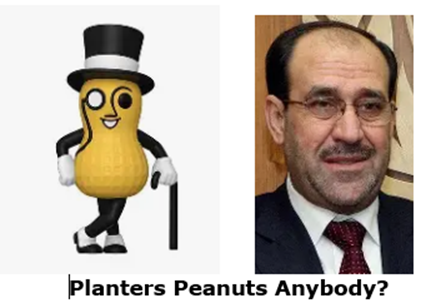
There is not much more I can say about this recent announcement about Maliki the peanut head guy as the nominee. We can see today through the news from Iraq that the Coordination Framework fully intends to nominate him for prime minister. This is where they are going to make their huge mistake and expose their own corruption. God works in strange ways. Let’s just sit tight and watch the drama play out. Like you, I feel this will be a set back in our timing of the reinstatement if this does occur. We all know president Trump wants to move Iraq along while he can and he only has another three years in office as president. He wants the reinstatement as bad as we do.
The election drama continues….
Oh… but wait there is more drama playing out in parliament too from this election cycle. There is much more than just the prime minister nominee to worry about.
So, there is also yet another issue lingering that needs to be addressed for this election cycle. It is just as important as the Maliki drama, if not more important. Having an Iranian pacifier as a puppet prime minister, than also a rigged parliament to vote his way on bills is not good for Iraq. They need checks and balances in the government. If we read the article titled “US, IN CONTROL OF OIL DOLLARS, HEAPS PRESSURE ON IRAQ OVER IRANIAN INFLUENCE” we learn more.
In this recent article we learn that the US has threatened senior Iraqi politicians with sanctions targeting the Iraqi state — including potentially its critical supply of oil revenue sourced via the Federal Reserve Bank of New York — should Iran-backed armed groups be included in the next government, four sources told Reuters. This threat was given months before the election. However Iraq did not pay much attention to it.
The US stance was simple “No armed groups in new government”. Can it get any clearer? So, in the newly elected representatives in parliament are there any members of armed militia groups? Let’s explore both sides to this story today. Who is on the right side and who is wrong?
So, YES there is many Iranian militia faction members from the recent November election cycle elected into office to replace other members in the chamber of parliament. In fact there is 58 members total to be exact , plus one deputy head of parliament. The US views all of these new members as linked to Iran. The fear is they will influence Iraqi politics to extent to benefit Iran rather than the people of Iraq. “The American line was basically that they would suspend engagement with the new government should any of those 58 MPs be represented.” No remember that the US is absolutely not going to signoff on the reinstatement of the dinar unless there is a STABLE government in place. Do you think this is a stable government? I don’t care with what any of these other intel gurus are telling you. They are full of sh-t! Oh… their secret sources have been so accurate with their stupid lies of every day and every weekend RV scenarios. How can anyone even believe their crap any more. You have to be an idiot just like them to follow them.
But I am showing you today evidence and facts and trying to help you understand that there is much more to it to the US plans to shut down this Iranian influence. It gets complicated real fast but not really if you try to clarify it and understand it.
Remember the US has leverage over Iraq as they maintain control of over 100 billion dollars of Iraqi oil revenues in the banks in NYC. Oil is still mandated to be sold in US dollars even though we learned that the UN sanctions have been lifted since December 2022. So, I guess maintaining this leverage of not releasing these funds to Iraq was a good choice by the US? Can you imagine if the US were to cut of all dollars to Iraq? How would Iraq pay its bills as in the budget?
So, the Iraqi Coordination Framework stance is that Iraq is an independent state. a sovereign nation and so they can do as they please electing officials in their government. But as we find this stance is not actually a correct stance, says the US administration. It is not correct as there is Iran influence and this does not meet the requirement of “sovereignty” and “independence”. Sorry Iraq!!!!
Another blow to the constitution: The failure to elect a president brings back the scenario of coldly disregarding constitutional requirements.
The constitutional process in Iraq has suffered another setback with the postponement of the presidential election session, despite the country nearing the end of the constitutional deadline. This comes at a time when Parliament was expected to resolve this sovereign issue, amidst escalating political disputes, particularly within the Kurdish political bloc, and conflicting interpretations regarding adherence to constitutional timelines.
In a move that has raised widespread questions, the parliamentary session designated for electing the president did not convene, even though the constitutional deadline is in its final stages. This has revived fears of a repeat of past instances where deadlines were exceeded.
The Parliament's media office announced the postponement of the presidential election session in a brief statement, without specifying a new date. Some members of Parliament stated that the postponement was due to the lack of necessary political consensus to hold the session, which has opened the door to various interpretations regarding the future of the process and the possibility of circumventing constitutional deadlines.
A Kurdish request for postponement: According to official documents, the Kurdistan Democratic Party (KDP) submitted a request to postpone the session due to ongoing disagreements within the Kurdish political bloc regarding the presidential candidate.
The lack of a final consensus that would allow for a decisive election session prompted the postponement to avoid the session's failure or its holding without results.
The core of the crisis lies in the continued division between the two main Kurdish parties. The KDP has put forward its candidate, Fuad Hussein, while the Patriotic Union of Kurdistan (PUK) insists on its candidate, Nizar Amidi. Political mediation efforts have thus far failed to unify positions or agree on a compromise candidate, leaving the presidency hostage to the Kurdish-Kurdish dispute and its repercussions on the power balance in Baghdad
Political analyst Ali Nasser, familiar with the issue of exceeding deadlines, stated that “adherence to constitutional deadlines has not been consistent in past sessions, as we have witnessed, on more than one occasion, exceeding these deadlines, sometimes by several months.”
Nasser added to Iraq Observer that “what distinguishes the current phase from its predecessors is the clear emphasis by the head of the Supreme Judicial Council, Faiq Zaidan, on the necessity of adhering to important constitutional deadlines, even though the Iraqi constitution does not explicitly stipulate penalties for exceeding these deadlines.”
Nasser explained that “divisions within the Kurdish political bloc have directly impacted the selection of the president, given the lack of a unified candidate from the two main parties,” noting that “these divisions coincided with the nomination of Nouri al-Maliki for the premiership, which has added a new layer of complexity to the political landscape.”
He added that “the agreements were supposed to be decided first within the Kurdish house, before moving on to discussing them with the Coordination Framework as the representative of the largest bloc, but the recent meetings, whether between the Coordination Framework and the Democratic Party, or with the Patriotic Union, did not result in setting clear deadlines or agreeing on final names.”
In this context, constitutional experts explain that Article (72/First/B) of the Constitution set the deadline for electing the President of the Republic at thirty days from the date of the first meeting of the new House of Representatives. Since the House held its first session on December 29, 2025, the last day of the constitutional deadline is January 29, 2026.
They emphasize that the calculation of the period begins from the date of the meeting, not from the date of the vote, and that any interpretation to the contrary leads to an unjustified extension of a deadline explicitly stipulated in the constitution, noting that the procedural deadlines for nomination, objection and judicial resolution are part of this deadline and not added to it.
With open scenarios and the country entering the final days of the constitutional deadline, fears are growing that the continuation of political disputes will lead to a new postponement, which may open the door to another jump over deadlines, not only in the election of the President of the Republic, but also with regard to the appointment of the next Prime Minister, in a scene that indicates the weakness of political consensus, and the difficulty of managing constitutional entitlements within their specified timeframes. link
Could Nouri al-Maliki delay the RV? Yes. A return of Nouri al-Maliki as prime minister would likely stall reforms, investor confidence, and monetary progress. However, strong opposition from Kurds, MPs, and voters makes his return increasingly unlikely.
Introduction: Buckle Up — Iraq Is Heading Into a Volatile Week
Oh boy… oh boy.
If you’ve been waiting for fireworks in Iraq, this week may deliver.
This is shaping up to be a pivotal political moment, not just for Iraq’s government formation — but for the future timing of the RV itself.
So buckle down, relax, and let’s walk through what’s really happening.
STATUS OF THE RV: Why Leadership Matters
Let’s be very clear:
If Nouri al-Maliki somehow regains power as prime minister, we could be in for a long, frustrating wait for the RV.
This peanut head guy Nori al-Maliki is desperate for power. If he should get into power again as the prime minister we are in for a long wait for the RV. Note in today’s Newsletter how he can get blocked and probably will. He owns almost all the news media stations in Iraq and so go figure why we are seeing such favorable headlines about him. But the average citizens don’t want him and showed it at the ballot box, then there are the Kurds who will have a large say in his nomination, if it is even true that he was nominated. This is itself may be more propaganda from his own news stations. Then there are the parliament members (MPs) who would have to ratify the selection and the majority already said they would deny him the position.
Oh boy, oh boy have I got news for you today! Buckle down, relax and let’s get to it. The proverbial ‘fireworks’ are about to begin in Iraq.
This week will be a pivotal week in Iraq. They are supposed to announce their candidate for president. As we know the new president then announces the nominee for prime minister that will then be tasks to form his cabinet (the news government).
We had news from Iraq that the Coordinate Framework intends to nominate Nori al-Maliki for prime minister. They want to push the announcement also to this week. However, there is going to be a catch from Kurdistan and I don’t think the Kurds are going to be so easy in letting Maliki have a third term based on his disastrous prior two terms. So, basically the Kurds are now saying not so fast…..
Oh there is still hope this Maliki stuff is not yet a done deal in two important articles. In the first article titled “ZEBARI ON MALIKI’S NOMINATION AND THE PRESIDENTIAL ELECTION DATE: THE COMING DAYS ARE FULL OF SURPRISES” from Sunday’s news in this article we find that Hoshyar Zebari, a leader in the Kurdistan Democratic Party, said that nominating Nouri al-Maliki as a candidate for prime minister and setting a date for the session to elect the president of the republic “does not mean that the determination of the three presidencies and the formation of the government has been decided,” noting that the coming days are “full of surprises and twists.”
This last set of sentences above are very important. Pay attention!
Then later yet another article follows titled “SUDANI’S CHANCES ARE IMPROVING AGAIN… NEW INFORMATION REVEALED BY MP AL-LUWAIZI”. In this bit of news we learn that MP Abdul Rahman Al-Luwaizi, from the Reconstruction and Development bloc, said that what is being circulated regarding an official concession or political marketing to hand over the premiership to the leader of the State of Law Coalition, Nouri Al-Maliki, is “untrue in word and deed,” stressing that the political reality indicates a different course in managing the nomination file. So what should we believe? We must stick to the facts about Maliki and keep asking what the hell are they thinking to even consider this idiot again to run the government. Heck more like “run-down” the government than run it.
I don’t know about you but when I read this these couple articles along with knowing how negative the Kurds are towards Maliki, this to me means they are going to exert maximum pressure to ensure Maliki is not the next prime minister. I have to keep going back to the thoughts of – what the hell are the Iraqi thinking of nominating Maliki in the first place? Have they really gone that far left. This is even more than just going to the far left, it's ‘stupid’ and defies all common sense. It is like Joe Biden having a second term as the US president. It simply does not make any sense.
Iraqi Dinar Weakens Amid Washington’s Political Pressure; Gold Surpasses $5,100/oz
The Iraqi dinar weakened to 151,500 per $100 amid U.S. political pressure, while global gold prices hit a historic record, surpassing $5,100 per ounce due to geopolitical risks.
The Iraqi dinar experienced a sharp decline in value against the U.S. dollar on Monday, fueled by a convergence of tightened electronic transfer regulations and escalating diplomatic pressure from Washington regarding the composition of Iraq’s next government.
The domestic currency volatility coincided with a historic surge in global commodities markets, where the price of gold surpassed $5,100 per ounce for the first time in recorded history, signaling a period of acute economic and geopolitical uncertainty.
Kaifi Mohammed, the spokesperson for the currency exchange market in the Kurdistan Region, stated on Monday, Jan. 26, 2026, that market stability has been directly undermined by a series of technical and political interventions.
According to Mohammed, the exchange rate for $100 reached 151,500 Iraqi dinars by midday, but he cautioned that the rate is unlikely to remain stable at its current level. Market projections suggest the currency could weaken further to 153,000 dinars per $100 in the coming hours as demand for foreign currency outstrips available supply.
Mohammed identified three primary catalysts for the dinar’s depreciation. He noted that procedures on the official currency transfer platform have been significantly tightened, creating a bottleneck that prevents merchants from obtaining the dollars necessary to conduct international trade.
This administrative friction is compounded by a hardening U.S. policy toward Baghdad. Washington has reportedly intensified its demands for the removal of militias from state decision-making centers, a move that has introduced a high degree of unpredictability into the local financial system.
Furthermore, Mohammed pointed to a broader shift in U.S. foreign policy under the Trump administration, which he characterized as increasingly transactional. He noted that Washington appears to be linking regional security and protection to direct financial payments, a stance that market participants view as a business-centric approach to geopolitics.
This perceived shift has led to increased anxiety among Iraqi merchants who, burdened by existing financial obligations and debts, have been forced to purchase dollars at prevailing market rates regardless of the cost, thereby driving the price higher.
The domestic currency strain is unfolding against the backdrop of an unprecedented rally in the global gold market. At the start of trading on the London Stock Exchange on Monday morning, the price of an ounce of gold breached the $5,000 threshold for the first time.
The metal’s ascent continued rapidly, rising by 2 percent to reach $5,093 before eventually settling above the $5,100 mark. Financial analysts noted that the speed of the increase is significant; gold first broke the $2,000 barrier in January 2024, and has more than doubled in value in the two years since.
Economic experts cited by market observers attribute the record-breaking gold prices to three main drivers: a sharp increase in geopolitical risks across multiple global regions, sustained and large-scale bullion purchases by central banks, and market expectations that the U.S. Federal Reserve will continue to lower interest rates.
The convergence of these factors has reinforced gold's status as a primary haven for investors seeking to hedge against currency devaluations and political instability.
The local and global economic fluctuations are deeply intertwined with the deteriorating diplomatic relationship between Baghdad and Washington.
Abbas Jibouri, head of the Baghdad-based Rafid Center for Political and Strategic Studies, warned on Sunday that Iraq has reached a "dangerous crossroads."
Jibouri noted that U.S. threats to restrict Iraq’s access to its own oil revenues—which are deposited in the Federal Reserve Bank of New York—represent a potent economic pressure tool that could trigger a systemic "salary shock" and broad financial sanctions.
Because oil revenues account for more than 90 percent of Iraq’s state income, any disruption to the flow of dollars from the United States would have immediate and devastating consequences for public sector salaries and infrastructure projects.
Jibouri argued that the United States is increasingly viewing Iraqi governance through a security lens, particularly concerning the participation of armed groups in the next cabinet. He warned that any steps toward "legalizing weapons outside the framework of the state" could prompt Washington to freeze assets or impose severe banking restrictions.
This assessment is supported by recent reports from the Associated Press, which indicated that the United States has begun a strategy that observers describe as "economic suffocation" or "dollar starvation."
According to the report, Washington is leveraging its recent access to Venezuelan oil to manage global energy markets. By reintroducing Venezuelan exports to the world stage, the U.S. administration believes it can mitigate price spikes even if Iraqi exports are disrupted by financial sanctions.
This suggests that the U.S. is now positioned to impose comprehensive sanctions on the Iraqi government itself rather than just targeting specific individuals or institutions.
The threat of economic isolation looms large as Iraqi political forces deliberate the formation of the next government. U.S. officials have explicitly warned that the inclusion of armed factions opposed by Washington in the next cabinet would likely trigger a suspension of dollar transactions.
Despite these repeated warnings, several groups and individuals the U.S. deems problematic have already secured, or are expected to secure, senior positions in the government.
Jibouri urged Iraqi political leaders to recognize that economic stability is now inseparable from political and security stability.
He argued that the only solution to the looming crisis is for Baghdad to adopt a governance model that consolidates the monopoly of force under state institutions and reassures international partners that the government will remain independent of external regional influences.
Failure to achieve this balance, he warned, would place the heaviest burden on ordinary Iraqi citizens, who are already feeling the impact of the dinar’s fall and the rising cost of living.
As of late Monday, merchants in Erbil and Baghdad remained in a state of high alert, monitoring the currency exchanges for further signs of depreciation.
The historic high in gold prices serves as a global indicator of the same fears driving the local market: a world defined by intensifying power rivalries and a diminishing reliance on traditional rules of international cooperation. link