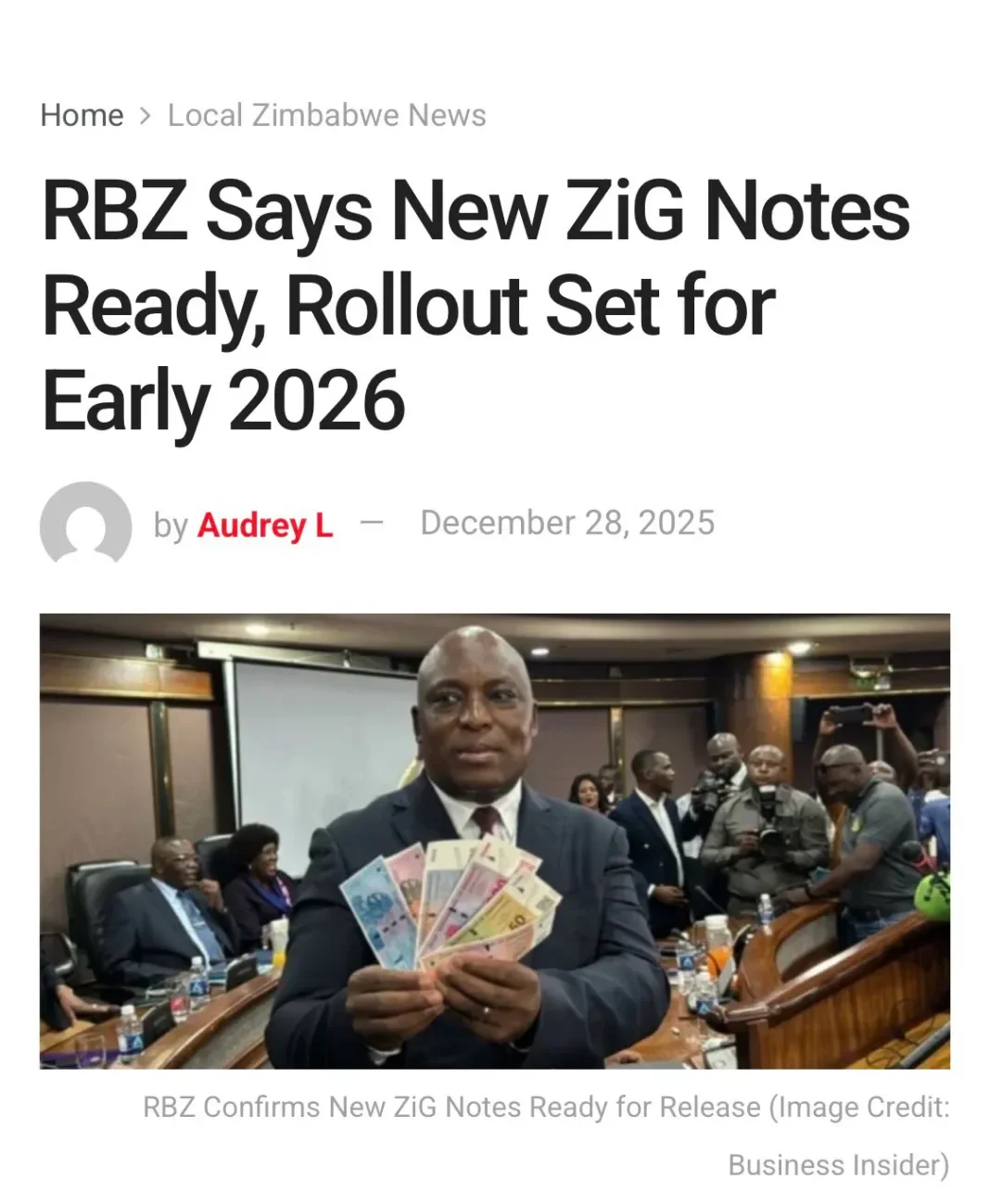
Confirmed New ZIG Notes Ready for Circulation Q1 2026
ZIM RV: CONFIRMED NEW ZIG NOTES READY FOR CIRCULATION Q1 2026
The Reserve Bank of Zimbabwe (RBZ) has confirmed that newly designed ZiG banknotes are ready for circulation, with distribution set to take place through banks and authorised outlets once rollout begins.
RBZ Governor Dr John Mushayavanhu said preparations are at an advanced stage, but stressed that the introduction of the new notes will be carefully managed to safeguard price and exchange rate stability.
Speaking in an interview, Dr Mushayavanhu said the release of the new ZiG notes will follow a phased approach guided by economic conditions and actual demand for cash.
He explained that circulation is expected to begin within the first quarter of 2026, allowing authorities to closely monitor market conditions and ensure a smooth transition.
No Expansion of Money Supply
The central bank governor assured the public that the introduction of physical ZiG notes will not increase the amount of money in circulation. Instead, banks will receive cash in exchange for their existing electronic balances held at the RBZ.
This approach, he said, is designed to maintain monetary discipline while improving convenience for cash users.
Public Awareness Campaign to Support Transition
To ensure public confidence, the RBZ plans to roll out a nationwide awareness campaign highlighting the new notes’ security features, durability and the safeguards in place to preserve currency stability.
Introduction: Why This Frank26 Report Is Gaining Attention
Recent boots-on-the-ground commentary from Frank26 and Firefly has sparked renewed discussion about Iraq’s international status, monetary reform, and potential changes tied to border pricing and exchange rates.
According to the report, Iraqi media is increasingly open about the country’s global reintegration, the future withdrawal of United Nations oversight, and the implementation of new economic systems starting January 1st.
While these insights are not official government announcements, they reflect growing public awareness inside Iraqabout where the country is headed.
International Acceptance: Iraq’s Path Toward Full Sovereignty
Firefly’s Observation
Iraqi television reportedly discussed Iraq’s international acceptance by 2026
International acceptance is not symbolic—it affects:
Trade agreements
Banking relationships
Currency credibility
Once fully sovereign, Iraq no longer requires certain external controls, which leads directly into the next major point.
The United Nations and Iraqi Sovereignty
Key Statement
“We will have the United Nations out of our country because we are a sovereign nation now.”
This aligns with long-standing expectations that UN involvement is temporary, tied to post-conflict obligations.
Implications
Stronger political independence
Increased control over financial policy
Improved investor confidence
A sovereign nation has greater flexibility to manage its monetary and economic systems.
The 1310 Exchange Rate: A Longstanding Barrier
Frank26’s Core Claim
“The international world welcomes everything from Iraq except 1310.”
The 1310 rate has long been viewed as:
A program rate
An internal accounting mechanism
A limitation for international trade
As long as it remains, full global integration remains incomplete.
New Border Prices Starting January 1st
Firefly’s Report
Iraqi television reportedly stated that:
New prices will be implemented at Iraq’s borders on January 1st
Reform systems are going live
Customs and tariffs will reflect updated structures
Why Border Pricing Is Critical
Border pricing is directly linked to:
Currency valuation
Trade competitiveness
Exchange rate mechanics
You cannot realistically introduce new international pricing while maintaining an outdated program rate.
Does This Mean the End of 1310?
Frank26’s Interpretation
“That means you have a new exchange rate on the first… because on the 31st you cancel 1310.”
From this perspective:
December 31st marks the end of the old system
January 1st begins monetary transition
A rate change would align with reform implementation
This view frames the process as logical sequencing, not speculation.
Featured Snippet
Why is the 1310 exchange rate considered a problem for Iraq? The 1310 rate limits Iraq’s ability to trade internationally and integrate with global markets. Many analysts believe it must be removed before new border prices and full monetary reform can take effect.
How This Fits Into Iraq’s Monetary Reform Process
When viewed together, the elements form a structured narrative:
✔ International acceptance ✔ Sovereignty and UN withdrawal ✔ New border pricing systems ✔ Removal of legacy exchange mechanisms
Rather than a single event, this suggests a coordinated transition toward global norms.
Important Context and Caution
These statements reflect media discussion and personal interpretation
No official exchange rate announcement has been published
Timing and implementation remain subject to change
Monetary reform is often phased and managed carefully
Q: Is Iraq officially internationally accepted already?
A: Iraq is progressing toward full acceptance, with public discussion suggesting growing confidence, but formal milestones are still unfolding.
Q: Why are border prices so important?
A: Border prices must align with currency value for accurate trade and customs operations.
Q: Does canceling 1310 guarantee a new rate?
A: Not guaranteed, but many analysts believe it is a necessary step toward adjustment.
Q: Is January 1st confirmed?
A: It is referenced in media commentary, but not yet officially confirmed.
Key Takeaways
Iraqi media is openly discussing global integration
Sovereignty and UN withdrawal are central themes
New border prices suggest systemic reform
The 1310 rate is widely viewed as incompatible with international trade
Conclusion: A Transition Worth Watching Closely
The Frank26 boots-on-the-ground report reflects growing transparency inside Iraq regarding its economic future. While no single statement confirms a currency change, the alignment of sovereignty, border pricing, and reform systems suggests meaningful movement.
For observers, the focus should remain on verified developments, not dates alone.
FIREFLY:Television was talking about our international acceptance into the world in 2026. It's all over the place. Everyone knows what's going on with our international status and where we're going with our monetary reform...We will have the United Nations out of our country because we are a sovereign nation now.
FRANK: The international world welcomes everything from Iraq except 1310.
FIREFLY: Television said today there will be brand new prices at the border of Iraq on January 1st as the reform systems go into effect...
FRANK: That means you have a new exchange rate on the first IMO because on the day before, on the 31st you cancel 1310...
Banking system upgrades have aligned Iraq with international compliance standards
Payment rails and settlement mechanisms have been modernized and tested
Foreign reserve management has improved, supporting monetary credibility
Oil revenue continues to anchor fiscal capacity and balance-of-payments strength
Political coordination remains the primary variable influencing execution timing
Gradual reform sequencing is favored over abrupt currency actions
Why It Matters
Iraq’s position illustrates a core truth of financial resets: technical readiness does not equal political readiness. The systems can be prepared, tested, and compliant, but execution depends on governance stability and coordinated policy decisions. Iraq’s measured approach reduces the risk of disruption while preserving the option to act when conditions align.
Why It Matters to Foreign Currency Holders
For foreign currency holders, Iraq represents a case where infrastructure readiness precedes visible change. This creates extended periods of anticipation followed by decisive movement. Watching political alignment, regulatory clarity, and fiscal coordination matters more than tracking technical milestones already achieved.
Implications for the Global Reset
Pillar: Infrastructure First, Policy Follows Systems are built quietly before public currency actions occur.
Pillar: Timing Protects Stability Deliberate sequencing reduces volatility during transition.
This is not just politics — it’s global finance restructuring before our eyes.
Introduction: Moving Beyond Speculation About the Iraqi Dinar
For years, the Iraqi dinar has been surrounded by speculation, rumors, and unrealistic expectations. However, a growing number of analysts now emphasize that currency appreciation is not speculation—it is a process tied to concrete economic and political reforms.
This article breaks down seven essential factors that Iraq must fulfill before the dinar can reflect its true market value. Once these conditions are met, appreciation becomes an economic outcome, not a guess or gamble.
At present, this phase should be understood not as speculation, but as a waiting period while foundational reforms are completed.
Understanding Currency Appreciation vs. “Revaluation”
One of the most important clarifications is terminology.
Once Iraq meets global standards, international investors and markets will influence the dinar’s value, not secret decisions or fixed dates.
The Seven Critical Factors for Iraqi Dinar Appreciation
1. Reducing Excess Dinars in Circulation
Iraq has already begun reducing the surplus supply of dinars.
Why this matters:
Controls inflation
Strengthens purchasing power
Stabilizes monetary policy
This step is fundamental for any currency to gain value.
2. Strengthening the Banking System
The Central Bank of Iraq (CBI) is actively reinforcing banks to align with global financial systems.
Key improvements include:
Compliance with international banking standards
Enhanced transparency
Increased trust from foreign institutions
Without strong banks, global integration is impossible.
3. Stabilizing the Government
Political and religious internal conflicts remain one of the largest obstacles.
Stability is essential for:
Investor confidence
Long-term economic planning
Sustainable growth
Until internal conflicts are resolved, monetary progress will remain limited.
4. Growing and Diversifying the Economy
Iraq is expanding beyond oil dependency.
Key developments include:
New manufacturing sectors
Infrastructure expansion
The Development Road Project, viewed as a potential economic game-changer
The International Monetary Fund (IMF) has been clear:
Long-term stability must come from diversified income sources—not oil alone.
5. Building Foreign and Gold Reserves
Iraq has started accumulating significant reserves.
Current highlights:
Over $100 million held in U.S. Federal Reserve banks
Substantial gold reserves
Reserves act as:
Economic insurance
A signal of financial strength
Support for currency credibility
6. Following Global Financial Rules (The Biggest Delay)
This remains the main obstacle.
Challenges include:
Cultural and religious resistance to interest-based finance
Skepticism toward forex markets, viewed by some as gambling
Despite progress, full compliance with global financial regulations is still incomplete.
7. Currency Adjustment Through Market Forces
Only after all previous conditions are met can currency adjustment occur.
This phase will likely involve:
Floating mechanisms
Market-driven valuation
Influence from global investors
At this point, appreciation becomes inevitable, not speculative.
Timeline Overview: Progress by Factor
Factor
Status
Notes
Reducing Excess Dinars
Underway
Documented progress
Strengthening Banks
Active
Supported by CBI actions
Stabilizing Government
In progress
Major conflicts remain
Growing Economy
Ongoing
Manufacturing & development projects
Building Reserves
Started
USD & gold reserves growing
Following Global Rules
Main obstacle
Cultural & religious resistance
Currency Adjustment
Pending
Requires all boxes checked
Featured Snippet
What must happen before the Iraqi dinar can appreciate? The Iraqi dinar can only appreciate after seven key factors are fulfilled, including reducing excess currency, strengthening banks, stabilizing government, growing and diversifying the economy, building reserves, following global financial rules, and allowing market-driven currency adjustment.
Important Clarifications for Dinar Holders
The future value of the Iraqi dinar is uncertain
No fixed rate or date is guaranteed
Potential values may range widely, from fractions of a cent to higher levels
Appreciation depends on global markets, not internal promises
Those holding large amounts of dinar may benefit significantly only with patience and strategic financial planning.
Q&A: Iraqi Dinar Appreciation Explained
Q: Is the Iraqi dinar a speculative gamble?
A: Not if approached as a long-term process tied to economic reforms rather than hype.
Q: Will appreciation happen overnight?
A: Highly unlikely. Gradual adjustment is far more realistic.
Q: Who decides the dinar’s value?
A: Global markets and investors, once Iraq meets international standards.
Q: What is the biggest delay right now?
A: Full compliance with global financial rules due to cultural and religious resistance.
Core Insights Summary
Dinar appreciation is process-driven, not rumor-based
Iraq has made real progress but still faces major hurdles
Political stability and global compliance are decisive
Timing and final value remain uncertain
Conclusion: From Speculation to Economic Reality
The Iraqi dinar’s future is not about secret rates or sudden events. It is about methodical reform, stability, and global integration. Once all seven critical factors are fulfilled, appreciation will no longer be a theory—it will be a market-driven outcome.
Until then, informed patience remains the most realistic strategy.
HANTOUSH: INTERNATIONAL FINANCING DIFFICULTIES AND EXCHANGE RATE CHALLENGES THREATEN THE STABILITY OF THE IRAQI ECONOMY
Economic and banking expert Mustafa Hantoush confirmed on Thursday that Iraqi companies and the private sector are facing significant difficulties in obtaining international loans to finance major projects due to Iraq’s low credit rating and the high costs of guarantees and interest rates on foreign loans.
Hantoush added, in a statement to Al-Maalouma, that “the Iraqi banking system is going through a difficult period, with the possibility of several banks exiting the market, which limits the ability of domestic financing to cover major projects.” He pointed out that “international financing depends heavily on sovereign guarantees provided by the state, which remain limited in Iraq.”
He noted that “the cost of external financing has risen significantly, with interest rates increasing from 5% to approximately 8-9% due to the risks associated with Iraq’s credit rating, placing additional burdens on Iraqi investors.”
Regarding the dollar exchange rate, which has reached 2,000 dinars, Hantoush affirmed that “Iraq is experiencing relative monetary stability, and the Central Bank has no intention of changing the exchange rate at present, despite speculation about the incoming government’s intentions in this regard.” He warned that any “exchange rate adjustment without addressing the root causes of the country’s financial problems would be a half-measure, potentially leading to widespread negative consequences, including increased poverty rates and a decline in the value of salaries, thus exacerbating the suffering of large segments of the population.”
He explained that “Iraq possesses substantial resources in the form of government assets estimated at hundreds of billions of dollars, in addition to vast tracts of land and real estate, but the weakness in combating corruption and activating tax collection hinders the effective
utilization of these resources.” He pointed out that “seriously confronting corruption and activating domestic revenues could reduce the need to adjust the exchange rate or resort to temporary solutions that could harm the economy and society.”
He also noted the existence of “huge amounts of cash held in homes, estimated at 70 to 80 trillion dinars, which have contributed to speculation in the real estate market and an unjustified rise in prices, necessitating a sound monetary policy to control the markets.” He concluded by emphasizing that “the continuation of the current situation without genuine reforms will lead to a deterioration of economic and social conditions, with increased poverty rates and greater pressure on salaries and market liquidity.”