Wednesday, June 18, 2025

Iraq Warns Of Possible Oil Price Surge To $300 Per Barrel

 Iraq Warns Of Possible Oil Price Surge To $300 Per Barrel

 
  Iraq Amr Salem June 15, 2025   Oil tankers and Iranian speedboats in the Strait of Hormuz. 
Baghdad (IraqiNews.com) – The Iraqi Minister of Foreign Affairs, Fuad Hussein, warned on Saturday that the Strait of Hormuz might be closed due to the Israel-Iran confrontation, causing   the global market to lose millions of barrels of oil per day and a  price increase of between $200 and $300 per barrel.
 
Hussein’s remarks took place during his phone conversation with the German Minister of Foreign Affairs, Johann Wadephul, during which he mentioned that if military operations between Iran and Israel continue, the   global market will lose approximately five million barrels per day produced by Iraq and the Gulf States, according to a statement issued by the Iraqi Foreign Ministry.
 
The Iraqi foreign minister stressed that the Israel-Iran confrontation
     will cause an unexpected spike in oil prices,
     aggravating the worldwide inflation issue and
     harming the economy of both oil producers and importers, particularly Iraq.
 
During different phone calls with foreign ministers in the region as part of Iraq’s diplomatic effort to address the rapid developments in the Middle East,
 
Hussein emphasized the gravity of Israel’s military assault on Iran, as well as the serious violation of international law and neighboring countries’ sovereignty, most notably Iraq.
 
Hussein urged the international community to reject the Israeli violations, emphasizing that continued military escalation does not serve regional stability but instead threatens to spark a large-scale conflict with serious security and economic consequences for the region and the world.https://www.iraqinews.com/iraq/iraq-warns-of-possible-oil-price-surge-to-300-per-barrel/ 


TIDBIT FROM WALKINGSTICK

 Walkingstick  

The ESX and the ISX when they go live they're going to be with the new exchange rate. I believe they're jumping the gun and getting involved because it's no secret...

You're talking about a whole stock exchange that wants to join the Iraqi stock exchange...It shows that Abu Dhabi knows about the monetary reform of the Iraqi dinar because everyone IMO knows a new exchange rate for the Iraqi dinar is coming. 

 There is no more BS...lies...guessing...exaggerations ...questions. 

 It is the truth of the monetary reform that is reflected in this relationship that we're seeing with the stock markets.  It is a powerful indicator IMO of a new exchange rate. 

Tuesday, June 17, 2025

MNT GOAT: there will be many groupings of currencies to create new pegs!! @DINARREVALUATION #iqd


Baghdad Begins Steps To Reform The Tax And Customs System

 Baghdad Begins Steps To Reform The Tax And Customs System.

 
Economic 06/16/2025  Baghdad: Dania Haider   As part of ongoing efforts to enhance economic stability and     develop non-oil resources, relevant institutions have begun taking practical steps to reform the customs and tax system to keep pace with development requirements.
 
The amendment of customs prices is part of this comprehensive reform vision. With the aim of protecting national products and supporting local industrial sectors, while simultaneously taking into account citizens' living conditions and exempting essential goods from any additional burdens.

• Developing non-oil revenues is a necessity.
 
Academic and public finance expert Dr. Ahmed Hithal told Al-Sabah that "given the high reliance on oil to finance the gross domestic product (GDP), exceeding 65%,and to cover the general budget by up to 92%,  efforts to develop non-oil revenues become an urgent strategic necessity that contributes to achieving economic stability."  

He pointed out that  "increasing customs duties as a revenue-boosting tool could contribute to this trend, provided it is designed within a comprehensive economic vision that takes into account the nature of the Iraqi market and current production conditions, ensuring the achievement of objectives without negatively impacting trade flows."  

He added,  "Theoretically, increasing customs duties could increase non-oil revenues, but this impact depends on  market flexibility,  import volume, and   importers' ability to comply with payment."

He continued, "According to the Laffer Curve,  achieving optimal tax and duty rates is essential to avoid any adverse effects, such as  traders' reluctance to import,  customs evasion, or  increased smuggling through informal ports.
 
This makes  improving collection efficiency and   expanding the customs basea more effective option than simply raising rates."  

Hathal emphasized that  "successful tax reform is not measured solely by raising rates,  but rather by achieving fairness and efficiency in collection,  so that low-income groups do not bear additional burdens through higher prices of imported goods.
 
This is where the importance of automating the customs system through the ASYCUDA program becomes clear.
 
This represents a fundamental step in  enhancing transparency,  reducing evasion and corruption, and  expanding the tax base,   ensuring social justice through a fair and equitable distribution of burdens."  

He added,  The successful implementation of the ASYCUDA system, which contributed to increasing customs revenues by more than 50% without the need for price increases, reflects the significant potential to enhance the efficiency of the state's financial management.
 
This achievement also represents a promising starting point for implementing a broader package of economic and customs reforms aimed at building a financial system that supports local production and diversifies sources of income away from excessive reliance on indirect taxes."  

He noted that  "the recent customs amendments,  while a positive step toward convergence with global standards, achieving their full impact requires in-depth study that takes into account the economic differences between Iraq and neighboring countries, as well as the need to develop a flexible and comprehensive customs policy that keeps pace with national income levels and enhances local production." 

 He concluded by emphasizing that "maximizing non-oil revenues should be based on  improving collection efficiency,  reducing tax evasion, and  expanding the tax base through automation and effective governance, in addition to  stimulating productive sectors,  to achieve balanced development that  ensures economic justice and  enhances long-term financial stability."
 
• Keeping pace with global economic developments
 
Economic expert Dr. Ikram Abdel Aziz explained to Al-Sabah that "the decision, which is based on adopting new customs price lists for goods and commodities,  came in implementation of Cabinet Resolution No. 270 of 2025, which entered into force as of June 1, 2025." 

She explained that  this decision represents an important step towards keeping pace with real global customs prices, while maintaining the percentages specified in the Customs Tariff Law as they are. She added that
 
this step carries within it many considerations that support modern financial trends and serve customs declarations and invoices submitted to banks for financial transfer purposes. Dr. Ikram emphasized that
 
the customs price increase did not include goods directly related to citizens' basic needs,
such as food and other essential goods, in line with the state's policy of caring for social segments.
 
Regarding increasing revenues, the expert explained that  "maximizing revenues through customs duties depends on the mechanisms for determining duties, which are linked to the course of fiscal policy and its directions, taking into account the social and economic dimensions resulting from them.
 
This is in addition to the role of monitoring procedures and the sound management of border crossings in ensuring the achievement of the desired returns, thus contributing to enhancing the state's revenues without harming the economic security of society." 

She pointed out that "tax reform represents an important and successful step towards enhancing revenues and achieving social justice, especially in light of the heavy reliance on oil revenues, which constitute approximately 90% of budget funding, while tax revenues currently do not exceed 2% of GDP, a modest rate compared to international standards. In this context, she stressed the importance of "providing a reliable database that includes all entities and individuals working in various economic activities,  given that the success of tax reform depends primarily on documenting actual incomes." 

She also emphasized the need to raise exemption limits for the poorest segments to protect them from any negative impacts that may result from the reforms. 

Dr. Ikram added,   "Tax reform is extremely important,  but it should not impose a heavy burden on taxpayers.
 
It aims to enhance citizen confidence in tax institutions and encourage voluntary compliance." She also emphasized the  need to "implement good governance in the management of tax revenues to ensure increased productivity of public spending,  which contributes to achieving justice and accelerating the pace of development and economic growth."
 
In the context of comprehensive economic reforms, Dr. Ikram explained that  these reforms represent part of the state's direction within the framework of the government's economic reform program,  where work is underway on eight tax-related reform packages,  alongside other reform tracks encompassing various productive and service sectors of the national economy."
 
• Support the national product
 
For his part, economic expert Dr. Duraid Al-Anzi believes that "customs duties should be imposed according to a specific mechanism, based on gradually escalating taxes on foreign goods until they are removed from the Iraqi market, in exchange for supporting domestic products to enable them to access foreign markets."  

Al-Anzi emphasized "the importance of tax reform, which should focus on imposing taxes in a balanced manner on both foreign and domestic goods, taking into account the  size of local production and  its ability to meet market needs.
 
Imposing broad taxes could lead to higher prices in local markets,  which would negatively impact citizens." He also noted that "60 to 70 percent of industrial products could be manufactured locally if full support was provided."
 
• Gradual and controlled reforms
 
The Prime Minister's Financial Advisor, Dr. Mazhar Mohammed Saleh, told Al-Sabah that  "customs authorities play a crucial role in protecting the economy within the framework of fiscal policy,
particularly in  supporting domestic production, without restricting trade flows, but rather by  directing them toward the most effective and important commodities in economic development activity." 

He added that  "raising tariffs or customs duties does not necessarily mean restricting imports or closing markets, but can be used as a regulatory tool aimed at reducing the problems of  commodity dumping and   protecting local industries, in addition to enhancing the state's general revenues."  

Saleh explained that "the overall economic objectives of amending customs tariffs are to create a fair competitive environment that does not prevent the entry of foreign products or impede free trade.
 
Higher customs tariffs can be imposed on luxury or non-essential goods,
while maintaining low or zero tariffs on basic goods and raw materials used in the production process."  

He pointed out that  "such policies contribute to   encouraging local production and   rationalizing luxury consumptionwithout compromising basic commercial activitywhile seeking to direct imports toward what achieves the greatest benefit and productivity for the national economy as a whole."  

Saleh emphasized that "what is most important in this context is that the adjustment of customs duty rates be gradual, allowing markets to adapt to the changes,  while ensuring that duties are applied precisely and selectively rather than across the board."
 
He concluded his remarks by emphasizing that "raising customs tariffs,  if done rationally, transparently, and with good governance,does not conflict with free market principles.
 
Rather, it is consistent with smart policies that regulate trade and support economic development,
without imposing arbitrary restrictions on the movement of goods entering Iraqi markets."  https://alsabaah.iq/116001-.html 

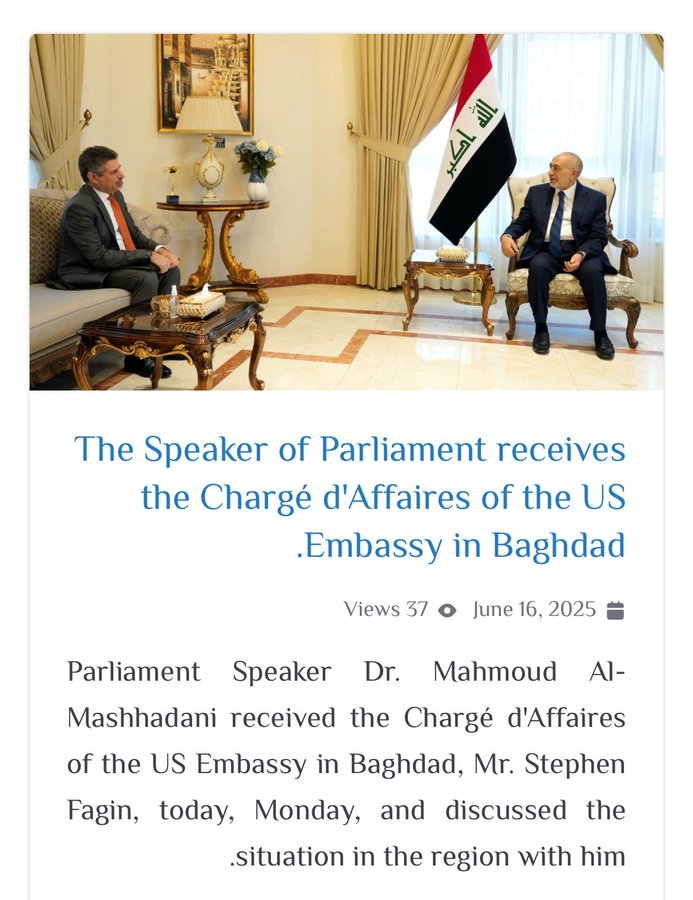
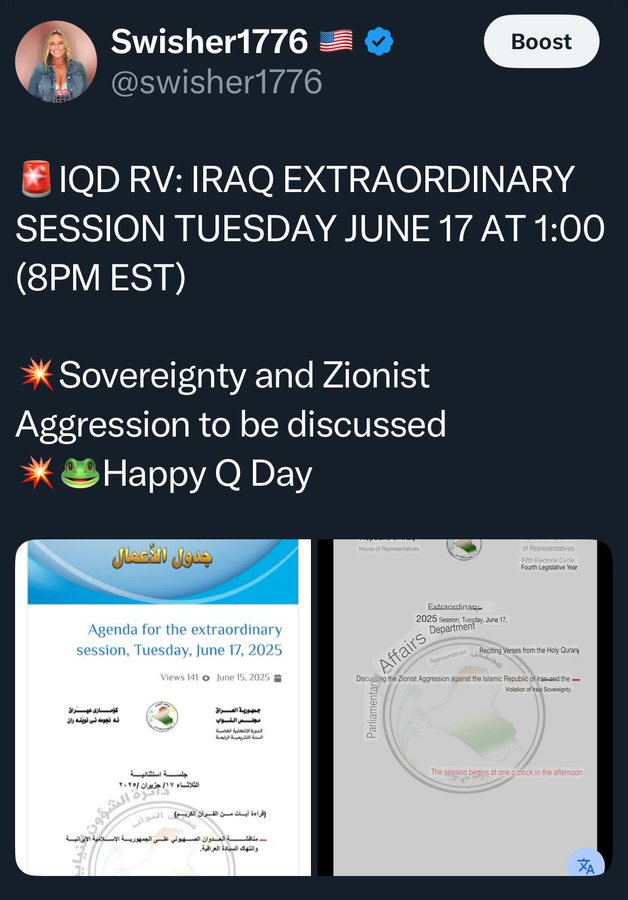
🚨IQD RV: THE SPEAKER OF PARLIAMENT RECEIVES THE CHARGÉ D’AFFAIRES OF THE US EMBASSY IN BAGHDAD

 🚨IQD RV: THE SPEAKER OF PARLIAMENT RECEIVES THE CHARGÉ D’AFFAIRES OF THE US EMBASSY IN BAGHDAD 

💥🐸a day before the Extraordinary Session 6/17 Parliament Speaker Dr. Mahmoud Al-Mashhadani received the Chargé d'Affaires of the US Embassy in Baghdad, Mr. Stephen Fagin, today, Monday, and discussed the situation in the region with him. During the meeting, they discussed bilateral relations between Iraq and the United States and ways to strengthen them to serve the interests of both countries. The meeting also discussed developments in the region, the Zionist attacks on the Islamic Republic of Iran, and their repercussions on neighboring countries, which are heading in an undesirable direction. President Al-Mashhadani stressed that the attacks on the Islamic Republic are condemned. The Iranian people are our neighbors, and we share geographical and Islamic ties with them. Our position is to demand an end to the war. We do not accept harm to any neighbor of Iraq, and we aspire to good neighborliness with all. President Al-Mashhadani stressed that our goal is to protect Iraq, its people, and its stability, and to stay away from conflict. We reject any violation of our sovereignty, whether on land or in the sky, or its use to attack our neighbors. For his part, the Chargé d'Affaires thanked President al-Mashhadani for making the time for the meeting, stressing that Iraq is one of the best democracies in the region, and that we are keen to establish the best relations with it. He added that Iraq has serious and ongoing security cooperation with the Iraqi security forces, and that economic and investment cooperation continues between us. He stated that the US government understands the nature of the relationship and the commonalities between Iraq and Iran, which are natural ties, and is determined to resolve the nuclear issue through a return to negotiations, which is what President Trump is calling for. Emphasizing that the United States government is not contributing to any form of attack on Iran, nor is it providing any support. We are only working to save American lives, and we hope Iran will do the same so that things do not get worse. The meeting also discussed the electoral process and the ongoing preparations for holding it on time. In conclusion, both sides emphasized maintaining communication and exchanging views on issues of mutual interest to achieve the best possible results. Media Office of the Speaker of the House of Representatives June 16, 2025
Image
Image
Last edited

EXCERPTS FROM MARKZ: WE ARE CLOSE! @DINARREVALUATION #iraqidinarinvesto...

Building Smart Cities Is A Qualitative Leap In The Capital's Reality

 Building Smart Cities Is A Qualitative Leap In The Capital's Reality

June 14, 2025   Governorates - Al-Zaman correspondents   Baghdad Mayor Ammar Musa affirmed the need to move forward with implementing a vision he described as comprehensive, to bring about a qualitative shift in the capital's reality. 

This came during his participation in the Iraqi Cities Conference, noting that the Baghdad Municipality has adopted the development of smart services in the city's infrastructure. In a speech during the conference, which was organized by the Federation of Iraqi Chambers of Commerce, in cooperation with the International Chamber of Commerce, and with the participation of the Arab Smart Cities Forum, Musa said, as followed by (Al-Zaman) yesterday, that "Baghdad is committed to urban development paths and sustainable city concepts."

Signing Ceremony

The Mayor of Baghdad sponsored the signing ceremony of the infrastructure contract for 11,000 housing units in the New Sadr City project, in line with the government program's directions. Yesterday's statement referred to (the signing of the infrastructure implementation contract for the construction of 11,000 housing units in the New Sadr City project), indicating that (the signing of the contract comes after successive stages of implementing this project). 

The statement added that (more than 30 specialized companies were attracted, and a solid Chinese company with extensive experience in implementing infrastructure was selected), noting that (the Projects Department of the Baghdad Municipality and the Chinese company signed the contract as part of the first step to launch housing projects, within the framework of increasing the number of housing units and expanding them towards the outskirts, with the aim of addressing the housing problem).

Baghdad Municipality is planning to build 20 pedestrian bridges in the capital, distributed among densely populated areas. Baghdad Municipality spokesperson, Uday Al-Jandil, said in a statement yesterday that "the Projects Department will soon implement a plan to maintain 10 pedestrian bridges, 7 of which are in Rusafa and 3 in Karkh," indicating that "maintenance work will begin in the coming days, pursuant to the formation of a specialized committee to determine maintenance needs, which have been referred to a specialized company for rehabilitation and reconstruction." 

For its part, the Ministry of Planning discussed the challenges facing the Social Fund for Development projects in Sulaymaniyah Governorate, with the participation of representatives of the World Bank and relevant authorities, to discuss the administrative and technical challenges hindering the implementation of its projects, and to expedite contracting and procurement procedures.

Sulaymaniyah Deputy Governor for Technical Affairs, Ahmed Ali Ahmed, emphasized the importance of the Social Fund for Development in supporting local development efforts, expressing his hope to find solutions to the multiple challenges that he emphasized affect the speed and efficiency of project implementation in Sulaymaniyah, including administrative procedures, technical and financial conditions, as well as economic and environmental conditions. 

In turn, the Director of the Social Fund for Development, Hazem Ahmed Saleh, explained that the meeting comes as part of the Fund's commitment to implementing projects and improving services by developing real solutions that expedite work and reactivate stalled contracts. Sabah Jundi Mansour, the Fund's supervisor, stated that the service projects implemented in various areas play an effective role in improving infrastructure.

 In a related development, the Baghdad Water Directorate, affiliated with the Ministry of Construction and Housing, is moving towards establishing additional complexes to improve distribution among the population. 

“The maximum energy we produce is in line with the global standard for water consumption per person, which ranges between 250 and 300 liters per day per person, and the amount may increase to 350 liters per citizen per day,” said the director general of the directorate, Hekmat Abdul Majeed Hamid, in a statement followed by Al-Zaman yesterday. 

He pointed out that “the amount of water produced is distributed among the population, but the challenge lies in the fairness of distribution and the difference in population densities between the Karkh and Rusafa areas.”

In Najaf, Governor Yousef Gnawi laid the foundation stone for a project to build a 3,000 cubic meter water complex in the city of Al-Mundhir and Al-Ridha, at the site of the Al-Mundhir district water complex. Gnawi said in a speech during the ceremony yesterday that "the project comes within the ongoing efforts to strengthen the water infrastructure in the governorate and improve the level of water services provided to residents," adding that "it contributes to supporting the water system in the region and meeting the needs of citizens and residential complexes located within the aforementioned geographical area."

Warsi Gnawi and the head of the provincial council, Hussein Al-Issawi, laid the foundation stone for the project to establish a training stadium and develop the Kufa Sports Club stadium. 

During the ceremony, Gnawi stressed, “The Najaf administration is keen to advance the sports sector by establishing and rehabilitating stadiums and sports facilities,” noting that “these projects constitute part of supporting the sports and youth movement and strengthening its role in society.” 

He continued, “The project includes the establishment of a modern training stadium with high technical specifications, in addition to rehabilitating the front facade of the Kufa Sports Club stadium, to a level befitting Najaf sports and its history,” as he put it.

Security Duties

Karbala Police Directorate Media Officer Colonel Engineer Ihsan Youssef Al-Asadi confirmed that "the External Road Protection Department in the Directorate carried out a number of security duties to enhance security and provide protection for pilgrims arriving in Karbala, in accordance with the directives of Governor Nassif Al-Khattabi."

Al-Asadi explained to Al-Zaman correspondent yesterday that "these measures or duties included securing the three external axes as well as setting up temporary checkpoints, which contributed to the arrest of a number of violators, in addition to securing the pilgrims' cities and organizing the passage of pilgrims in cooperation with traffic checkpoints within the framework of the joint effort to protect lives and property." 

Youssef pointed out that "the security forces were able to provide first aid to a number of people injured as a result of a traffic accident, which reflects the concern of these security forces for the humanitarian aspect in addition to the security tasks assigned to them." Al-Asadi stressed the continuation of these security measures to ensure the safety of pilgrims and citizens alike."  LINK

🌍 Breaking: A Global Shift Is Taking Shape

 🌍  Breaking: A Global Shift Is Taking Shape A powerful convergence of  geopolitical tension, financial transformation, and strategic reali...