Sunday, June 8, 2025

FRANK26: "YOU ASK ME KTFA, WHAT'S THE HOLD UP?... SECURITY & STABILITY MUST BE SUPREME!!!"

 KTFA

FRANK26: "YOU ASK ME KTFA, WHAT'S THE HOLD UP?... SECURITY & STABILITY MUST BE SUPREME!!!".......F26

U.S. Treasury Sanctions Iranian Shadow Banking Network Laundering Billions for Regime’s Nuclear and Terrorist Agenda
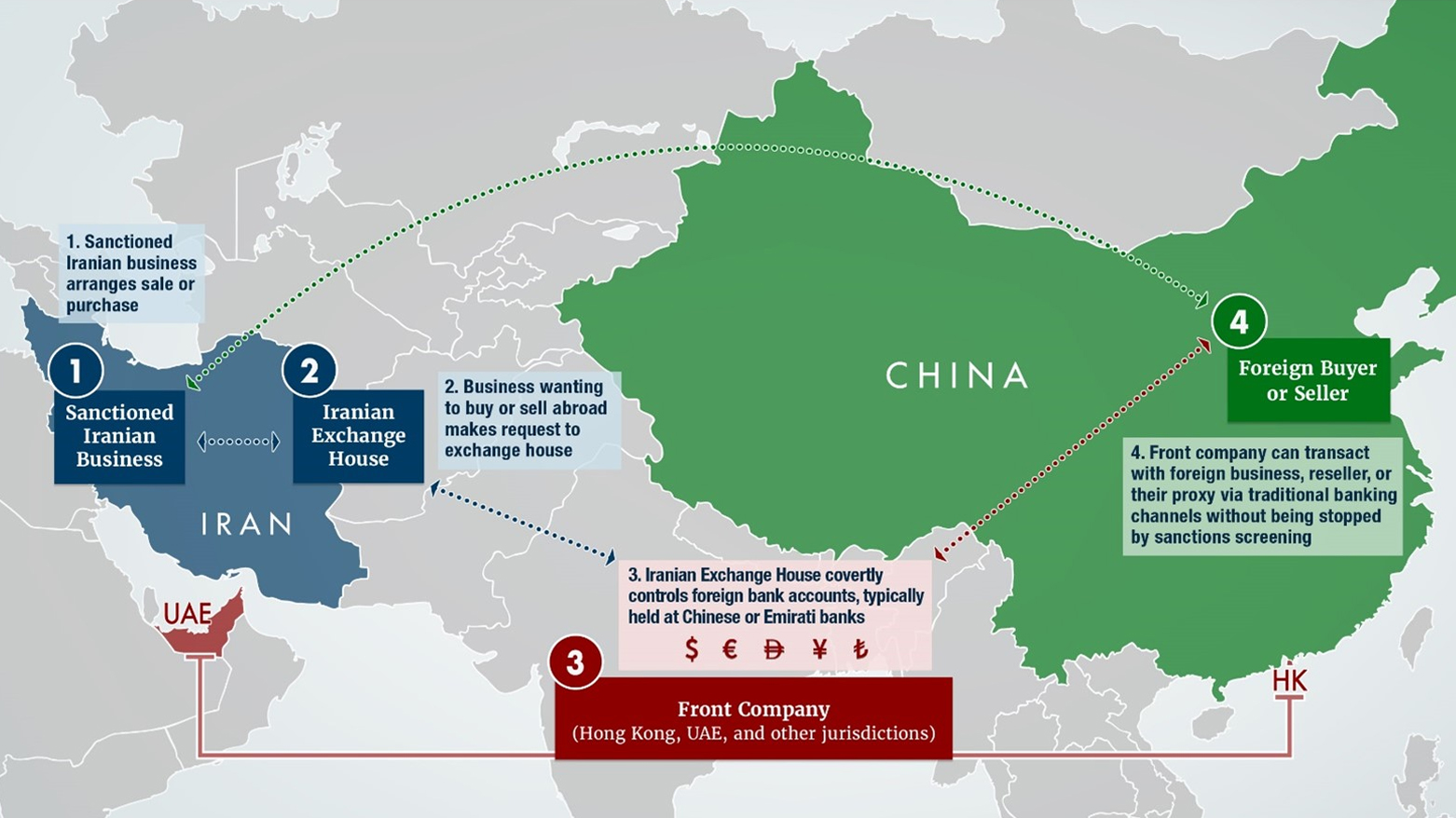
A map showing Iran’s shadow banking networks, including facilitators like the Zarringhalam brothers, help sanctioned Iranian entities access global finance and support exports.. (Photo: U.S. Department of the Treasury)

6/6/2025

By Ahora Qadi 

ERBIL - 

In a sweeping action aimed at disrupting the financial lifelines of the Iranian regime, the United States Department of the Treasury has designated more than 30 individuals and entities involved in a vast shadow banking network that has laundered billions of dollars for Tehran’s oil, petrochemical, and weapons programs. The announcement marks the first sanctions package targeting Iran’s clandestine banking infrastructure under the current administration’s enhanced pressure strategy.

According to the Treasury’s Office of Foreign Assets Control (OFAC), the network—centered around Iranian nationals Mansour, Nasser, and Fazlolah Zarringhalam—used a system of front companies in the United Arab Emirates and Hong Kong to move illicit oil revenues and fund operations linked to Iran’s missile and nuclear development, as well as support for regional terrorist proxies.

"Iran’s shadow banking system is a critical lifeline for the regime through which it accesses the proceeds from its oil sales, moves money, and funds its destabilizing activities," said Secretary of the Treasury Scott Bessent in a statement. "Treasury will continue to leverage all available tools to target the critical nodes in this network and disrupt its operations, which enrich the regime’s elite and encourage corruption at the expense of the people of Iran." (AND THE PEOPLE OF IRAQ -F26)

A Corrupt Parallel System Undermining Global Sanctions

The shadow banking architecture allows sanctioned Iranian military entities and regime officials to access the international financial system by masking transactions through Iranian exchange houses and offshore shell companies. OFAC emphasized that the system operates as a "parallel banking system" designed to evade regulatory oversight and exploit weak jurisdictions to facilitate the flow of illicit funds.

Whistleblowers inside Iran have reported massive embezzlement and widespread corruption tied to this financial structure, underscoring the regime’s use of these mechanisms to enrich elites while the broader population suffers economic hardship.

The Zarringhalam Family at the Core of Illicit Financing

The Zarringhalam brothers orchestrated this vast laundering operation, enabling sanctioned actors to receive payments from the sale of petroleum and other commodities. OFAC has also sanctioned their family’s holdings, including Zarrin Tehran Investment Company and Kimia Sadr Pasargad Company—both active in Iran’s oil, gas, and construction sectors.

Among those designated are Mitra Zarringhalam, CEO of Zarrin Tehran Investment Company; Parvis Soltanizadeh, a board member at Kimia Sadr Pasargad; Hossein Shetaban and Farahnaz Meshkat, senior figures in the Berelian and GCM Exchanges; and Pouria Zarringhalam, a construction executive. Their affiliations demonstrate the regime’s ability to infiltrate and exploit diverse sectors of the Iranian economy through family-run enterprises.
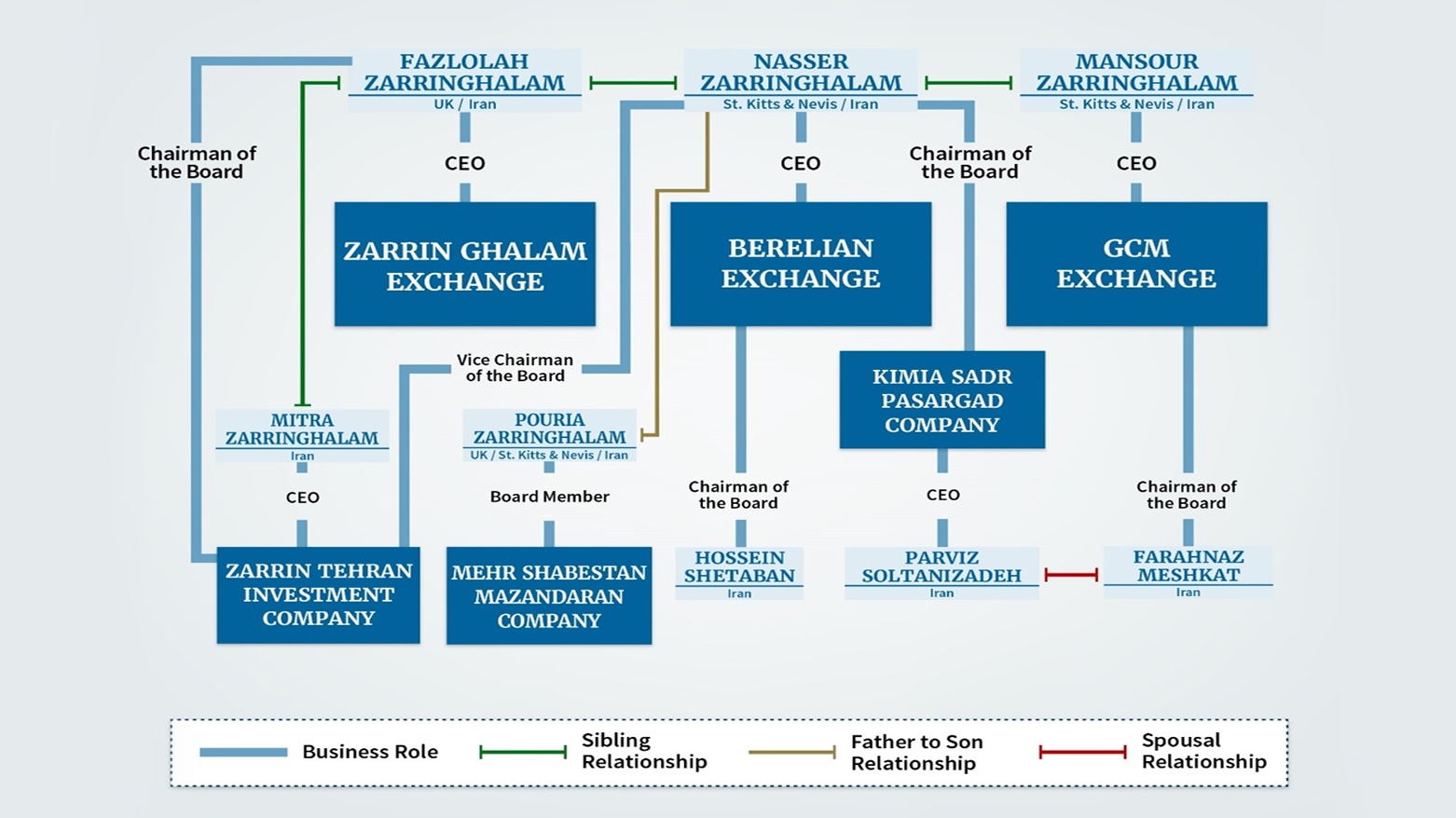
A  diagram showing the affiliated companies that are connected to the main entities, also with their own Chairmen and CEOs. (Photo: U.S. Department of the Treasury)

Sanctions Enforcement and Legal Implications

The action is taken under Executive Orders 13902 and 13846, which authorize targeting Iran’s financial, petroleum, and petrochemical sectors. As a result, all U.S.-linked property and interests belonging to the sanctioned individuals and entities are now blocked, and American persons are prohibited from engaging in any transactions with them.

Treasury’s Financial Crimes Enforcement Network (FinCEN) has also issued an updated advisory to help financial institutions detect suspicious activity linked to Iranian oil smuggling and weapons procurement operations. The advisory outlines typologies and red flags to mitigate risk exposure for banks and firms operating globally.

OFAC reiterated that violations of these sanctions—whether by U.S. or foreign entities—may result in civil or criminal penalties. The department also clarified that its sanctions are ultimately intended to pressure behavioral change, not merely to punish.

This sanctions package is the latest demonstration of Washington’s intent to dismantle Iran’s economic scaffolding that underpins its destabilizing regional agenda. It comes as the administration accelerates a maximum pressure campaign designed to curb Tehran’s ambitions and support for proxy forces amid rising regional tensions.

LINK

###########

Press Releases
 

Treasury Sanctions Iranian Network Laundering Billions for Regime Through Shadow Banking Scheme

SNIPPET: 

June 6, 2025

Updated FinCEN Advisory Highlights Iranian Oil Smuggling, Shadow Banking, and Weapons Procurement Typologies

WASHINGTON — Today, the Department of the Treasury’s Office of Foreign Assets Control (OFAC) is designating over 30 individuals and entities tied to Iranian brothers Mansour, Nasser, and Fazlolah Zarringhalam, who have collectively laundered billions of dollars through the international financial system via Iranian exchange houses and foreign front companies under their control as part of Iran’s “shadow banking” network.  The regime leverages this network to evade sanctions and move money from its oil and petrochemical sales, which help the regime fund its nuclear and missile programs and support its terrorist proxies.  Concurrently, Treasury’s Financial Crimes Enforcement Network (FinCEN) is issuing an updated Advisory to assist financial institutions in identifying, preventing, and reporting suspicious activity connected with Iranian illicit financial activity, including oil smuggling, shadow banking, and weapons procurement. 


SNIPPET: 

UAE FRONT COMPANIES

OFAC is also designating five UAE-based front companies that are either owned by, or operate in support of, the Zarringhalam network.  Wide Vision General Trading L.L.C and J.S Serenity FZE have been used by Mansour and GCM Exchange for coordinating shadow banking transactions.  In 2023, J.S Serenity Trading FZE was used by Mansour to coordinate a brokerage agreement with U.S.-designated Sepehr Energy Jahan Nama Pars Company, a front company for Iran’s Armed Forces General Staff and its oil sales activities. 

Moderate General Trading L.L.C, Ace Petrochem FZE, and Golden Pen General Trading L.L.C have each been used by Nasser and Berelian Exchange as front companies to help sanctioned Iranian entities engage in international financial transactions.  For over a decade, Nasser has used Moderate General Trading L.L.C to conduct financial transactions worth millions of dollars on behalf of NIOC and NITC.  In 2022, both Ace Petrochem FZE and Moderate General Trading L.L.C were listed in correspondence from Berelian Exchange confirming payments with NITC.  Ace Petrochem FZE has also been used by PGPICC as a third-party account in payments to obscure the destination of funds and evade sanctions. 


https://home.treasury.gov/news.....ses/sb0159

🚀 The Iraqi Dinar Revaluation (IQD RV): A Global Game-Changer on the Horizon? 🚀

 🚀 The Iraqi Dinar Revaluation (IQD RV): A Global Game-Changer on the Horizon? 🚀

Momentum is rapidly building around the anticipated revaluation of the Iraqi Dinar (IQD), with a wave of investor enthusiasm flooding X. 

This surge is fueled by growing speculation that Iraq may soon lead a broader global currency reset. Central to the narrative is the belief that the IQD could achieve a 1:1 valuation with the U.S. dollar—a milestone not seen since before the Gulf War.

 A convergence of Iraq’s economic stabilization, strategic reforms, and international agreements is driving this collective optimism and signaling that a monumental shift could be on the horizon.


The economic fundamentals behind this anticipation are notably strong. Iraq's vast oil reserves, comprising nearly 12% of the world's total, provide a robust anchor for a strengthened currency.

 Since February 2023, the Central Bank of Iraq (CBI) has taken deliberate steps toward monetary reform, including a 10% revaluation and efforts to modernize the country’s financial systems. Additionally, 

Iraq’s significant cash reserves remain largely outside the formal banking system—suggesting untapped liquidity that, once mobilized, could drive currency appreciation and broader economic participation.


Adding to the buzz is the notion that Iraq may be at the forefront of a global currency revaluation, often referred to as the “first basket.” 

This idea is supported by the multitude of international memoranda signed by Iraq in energy, trade, and infrastructure—many of which reportedly use a higher, unofficial IQD exchange rate.

 The involvement of institutions like the IMF and World Bank, coupled with Iraq’s renewed bid to join the WTO, reflect deepening global confidence in Iraq’s economic potential. These signals are interpreted by many as evidence that an upward revaluation is not only plausible but imminent.


Political shifts are also contributing to the fervor, particularly the potential return of Donald Trump to the U.S. presidency. Many IQD investors view Trump’s energy policies and stance on Middle Eastern sovereignty as aligning perfectly with Iraq’s ambitions.

 His previous administration’s focus on curbing Iranian influence and boosting regional stability through U.S. presence is believed to create a favorable backdrop for currency reform. With anti-corruption measures gaining traction under Prime Minister Al-Sudani, and U.S. forces helping stabilize the region, many believe the path is being cleared for a revaluation free from political interference.


Finally, the numerical landscape paints a compelling portrait: a current exchange rate of 1,310 IQD per USD, a $97 billion reserve buffer, and a record of international trade deals all point to an economy in the midst of transformation. Investors believe this is more than just speculation—it’s a rare financial moment rooted in strategy, reform, and global alignment. As investor sentiment soars, many consider themselves uniquely fortunate to be part of what could be a historic financial realignment.


MARKZ: THE REDEMPTION CENTERS ARE ACTIVE!! @DINARREVALUATION #iraqidinar...

MP: The results of the Baghdad Development Summit on Iraq will be revealed soon.

  MP: The results of the Baghdad Development Summit on Iraq will be revealed soon. 

Member of Parliament Mohammed Al-Ziyadi confirmed today, Saturday, June 7, 2025, that the results of the Baghdad Summit, which witnessed effective Arab participation, will appear soon.

Al-Ziyadi told Baghdad Today, "Iraq does not want to make the results 'ink on paper' like the previous Arab summits, but rather wants to translate those results into reality, especially economic and developmental issues, and for this reason they will be translated soon, especially in Iraq."

He added, "Iraq has become a fertile economic and developmental land at various levels, and there is a strong regional and international will to enter the Iraqi arena for investment and economic activity, which will strengthen its economic and financial position in the coming period."

On May 17, the capital, Baghdad, hosted the Arab League Summit and the fifth Arab Economic and Social Development Summit.

In its closing statement, the development summit affirmed its firm commitment to supporting joint Arab development action, strengthening Arab solidarity, and achieving economic and social integration among Arab countries.

The Development Summit approved the Arab Food Security Strategy for the period (2025-2035), calling for the mobilization of energies and resources to implement it, ensuring the achievement of Arab food security to confront current and future challenges.

She stressed the importance of developing the Greater Arab Free Trade Area and fulfilling the requirements for establishing the Arab Customs Union, calling for the removal of all obstacles to achieving this strategic goal.  link

TIDBIT FROM SANDY INGRAM

 Sandy Ingram  

The implications of [the Iran] negotiations extend beyond Iran and Israel...

A successful deal could lead to regional stability potentially boosting Iraq's economy and security...

Iraq's government must...foster positive relations with both the US and Iran.  The value of the Iraqi dinar is also susceptible to the outcomes of these negations ;

 A successful agreement...could stabilize oil markets benefiting oil dependent economies like Iraq.  This stability might strengthen the IQD...

 However renewed sanctions or military conflict could disrupt oil exports and regional trade exerting downward pressure on the IQD...The stakes remain high.  

Iraq is getting closer to membership in the World Trade Organization!! #iqd # #iraqidinar #iraq


Ammar Al-Mashat: Iraq needs to create a more attractive investment environment.

 Ammar Al-Mashat: Iraq needs to create a more attractive investment environment.

Economic expert Ammar Al-Mashat stressed the need to create a more attractive investment environment in Iraq.

Al-Mashat said the country requires a large-scale effort capable of absorbing global and international efforts, noting that, at the same time, specialized international companies are looking to work within Iraq.

 He pointed out that the private sector has begun providing all the equipment required for work in all sectors, and this is credited to the efforts of the national private sector.

He pointed out that agents of international companies specializing in heavy equipment in Baghdad provide all the requirements of investment companies.  link


🚨 POST-EXCHANGE WEALTH MANAGEMENT BLUEPRINT (IQD Scenario Planning Guide)

🚨  POST-EXCHANGE WEALTH MANAGEMENT BLUEPRINT (IQD Scenario Planning Guide) 💡  Key Financial Strategies (Beyond Basic Exchange Planning) 1....