Friday, April 18, 2025

SANDY INGRAM : Iraq Breaking News: Three CBI Announcements #iqd, 18 FEB

 SANDY INGRAM : Iraq Breaking News: Three CBI Announcements #iqd

Summary

In the first quarter of 2025, the Central Bank of Iraq (CBI) made several significant announcements aimed at modernizing the financial landscape of the country.

 Among these changes, a notable new feature enables direct transfers between debit cards, allowing individuals to transact with a limit of 400,000 Iraqi dinars per transfer and a monthly limit of 2 million dinars. This initiative reflects the CBI’s commitment to enhancing electronic payment systems across Iraq.

In a further effort to improve trade relations and streamline currency transactions, the CBI expanded foreign currency transfer options for local banks. The addition of the Jordanian dinar and Saudi riyal to its currency portfolio, as well as permitting Iraqi banks to engage in trade with Turkey using the euro, highlights the bank’s strategy to diversify financing and provide more efficient international transaction processes.

Perhaps the most crucial announcement concerns the successful transition to direct foreign currency transfers by Iraqi banks through international correspondent banks, rather than relying on a centralized electronic platform. 

This pivotal change enhances the separation of the central bank’s functions from commercial banking, aligning Iraqi financial operations more closely with global standards.

These updates signify not just improvements in the efficiency and security of Iraq’s banking network, but also reflect a robust plan to fortify the financial stability and global standing of the Iraqi economy.

 The CBI’s initiatives have garnered international support, further strengthening the role of Iraqi banks in global transactions. Moving forward, the CBI will continue to bolster the balances of Iraqi banks with correspondent entities in various currencies.

This summary encapsulates the CBI’s ongoing efforts and the implications for investors and the banking sector in Iraq, thereby showcasing a dynamic shift towards a more robust digital economy.

Highlights

  • 💳 Direct Debit Card Transfers: New feature allowing transfers between debit cards with limits set for convenience.
  • 💸 Expanded Currency Options: Introduction of the Jordanian dinar and Saudi riyal for foreign transactions.
  • 🌍 Trading Efficiency: Iraqi banks can now trade with Turkey using the euro, enhancing trade relations.
  • 🔄 Direct Foreign Transfers: Transition to handling foreign currency transfers directly through banks is a major operational upgrade.
  • 📈 International Banking Standards: Shift aligns Iraqi banking practices with global financial standards, improving credibility.
  • 🔒 Enhanced Security: Improved security for foreign transactions thanks to the new banking infrastructure.
  • 📊 Increased Financial Stability: CBI’s initiatives are seen as a significant step towards enhancing Iraq’s financial stability and attractiveness to international investors.

Key Insights

  • 📅 Shift to Modern Banking Practices: The CBI’s move to allow direct transfers between debit cards reflects a broader trend in banking towards digital transactions. This initiative could lead to an increase in consumer trust in electronic payment systems, potentially boosting economic activity as individuals and businesses become more willing to engage in electronic transactions.

  • 💱 Diversified Currency Options: By expanding the list of transferable currencies, particularly with the Jordanian dinar and Saudi riyal, the CBI is not only facilitating smoother trading operations but also promoting regional economic collaboration. This can strengthen Iraq’s economic ties with its neighbors, reducing dependency on more volatile currencies.

  • 🗂 Direct Transaction Protocols: The transition to direct currency transfers represents a significant operational redesign. By moving away from a centralized electronic platform, the CBI increases the efficiency of transactions, potentially leading to quicker processing times, reduced costs, and enhanced flexibility for local banks as they engage in international trade.

  • 📈 Enhanced Roles of Commercial Banks: The separation of roles between the CBI and commercial banks is an essential feature of the new system, ensuring that banks can operate more autonomously in handling foreign transactions. This change provides commercial banks with increased responsibilities and potentially greater profits as they expand their services.

  • 🌐 International Support and Credibility: The CBI’s initiatives are backed by international support, which is crucial for Iraq’s ongoing economic recovery. Building trust with international stakeholders will enhance Iraq’s credibility in global markets, making it easier to attract foreign investment and foster economic growth.

  • 💪 Future of Iraqi Banking: With planned enhancements in correspondent banking relationships and the introduction of new currencies for trade, Iraq’s banking sector is poised for considerable growth. This resilience indicates that Iraqi banks will likely play a more prominent role in the context of international finance, thus improving their competitiveness.

  • 🎓 Educational Initiatives: The call for membership to gain further insights into these developments underscores the importance of educating investors and stakeholders about the rapidly changing financial landscape. Providing resources on topics like tax strategies and investments can empower citizens and investors to make informed decisions in the evolving market.

The announcements from the Central Bank of Iraq not only indicate a shift towards modernizing Iraq’s financial operations but also reflect an emphasis on building a more integrated and efficient banking system that aligns with global practices. These changes can have far-reaching implications, making it a pivotal moment for the Iraqi economy as it navigates its path toward recovery and growth.

WALKINGSTICK: "Aki's bank is for the exchange of the three zero notes" ‪@DINARREVALUATION‬ #iqd


Iraq “officially” reassures energy companies in the Kurdistan Region and pledges to pay their dues, 18 APTIL

 Iraq “officially” reassures energy companies in the Kurdistan Region and pledges to pay their dues

Shafaq News / Deputy Prime Minister for Energy Affairs, Iraqi Oil Minister Hayyan Abdul Ghani, revealed on Wednesday the details of the oil file between Baghdad and Erbil, stressing the amendment of the budget law to ensure the payment of the dues of companies operating in the Kurdistan Region, and provide official guarantees to them.

Abdul Ghani said in a speech during his participation in the 9th Sulaymaniyah Forum, followed by Shafaq News Agency, that “the federal government held negotiations with the region that resulted in the amendment of the budget law in order to cover the wages of companies operating in Kurdistan, and the law has already been amended to achieve this purpose.”

He added, “They reassured the producing companies in the region by obtaining an official letter signed exclusively by the Minister of Finance, including a pledge to pay the dues of those companies, which restored confidence and removed fears.”

Abdul Ghani continued, “The amount of oil produced in the Kurdistan Region is deducted from Iraq’s share within OPEC, and we were forced to reduce federal production so as not to affect Iraq’s total share, but this reflected negatively on exports.

He stressed that the visit of the Federal Prime Minister to the Kurdistan Region and his meeting with officials there, “had a great impact on accelerating the pace of negotiations between the two sides and achieving recent understandings.”

These statements come in light of a reminous effort to unify the oil policy between Baghdad and Erbil, amid challenges related to export and international obligations, at a time when the government hopes to consolidate trust with companies and ensure the stability of production and export.

https://www.shafaq.com/ar/اقتصـاد/العراق-يطم-ن-رسميا-شركات-الطاقة-في-قليم-كوردستان-ويتعهد-بتسديد-مستحقاتها


ADAM STEPHENS UPDATE, 18 APRIL

 ADAM STEPHENS

Hi Everyone...  


We are on the doorstep of an amazing leap into a new future for yourself, your families, and for humanity. 


Many have asked me what's going on.


 Here's the deal... almost all of my contacts have gone silent. Others are saying they want to not say a word. 


Last week I shared that I'm going to respect their silence out of protection and caution for them and their long awaited blessings. 


What we can see is a lot of movement in Iraq and tons of articles being put out into the open air... why... To communicate to us that the RV is here. It's about to happen. 


I've been paying close attention to Swisher1776 on X... and on some others there who are tearing apart the posts and translating information. 


There is not much we can grab other than to know that notifications are all that's left.

REDEMPTION CENTERS ARE ACTIVE!! ‪@DINARREVALUATION‬ #iraqidinarinvestor #iraqidinar #iraq


Nechirvan Barzani calls on Al-Sudani to activate the Article 140 Committee and thanks him for his efforts regarding Halabja, 18 APRIL

  Nechirvan Barzani calls on Al-Sudani to activate the Article 140 Committee and thanks him for his efforts regarding Halabja

Kurdistan Region President Nechirvan Barzani called on Prime Minister Mohammed Shia al-Sudani on Wednesday to activate Article 140 of the Constitution regarding the disputed areas between Erbil and Baghdad, while praising his role in establishing Halabja Governorate.

In a speech delivered at the ninth Sulaymaniyah Forum, Nechirvan Barzani said, "In the Kurdistan Region, regarding our relations with the federal government in Baghdad, we affirm our unwavering commitment to the Iraqi constitution as a framework for regulating this relationship. We believe that the constitution, with its principles of federalism, pluralism, and partnership, is the true guarantor of the rights of all components of Iraq without discrimination."

He added, "The recent period has witnessed remarkable progress in resolving the issues between Erbil and Baghdad, thanks to the commendable efforts of Prime Minister Mohammed Shia al-Sudani, which deserve our appreciation." He added, "Al-Sudani's vision of strengthening commonalities and reducing differences is the correct vision for a solution, and I emphasize here the urgent implementation of the property restitution law and the activation of the committee to implement Article 140 of the Iraqi Constitution."

Nechirvan Barzani stressed that "we will continue constructive dialogue with the federal government to reach permanent solutions to all problems in a way that serves the interests of Iraq, with all its components , and guarantees and secures the constitutional rights and entitlements of all."

He stressed that "the Kurdistan Parliament must be activated in light of the current circumstances and challenges in the region. Therefore, the primary task of the Kurdistan Democratic Party, the Patriotic Union of Kurdistan, and the winning parties in the Kurdistan Parliament elections is to expedite the formation of the new government cabinet for the Kurdistan Region, and for it to be a government that responds to the aspirations of the citizens and is capable of dealing appropriately with developments and challenges."  link


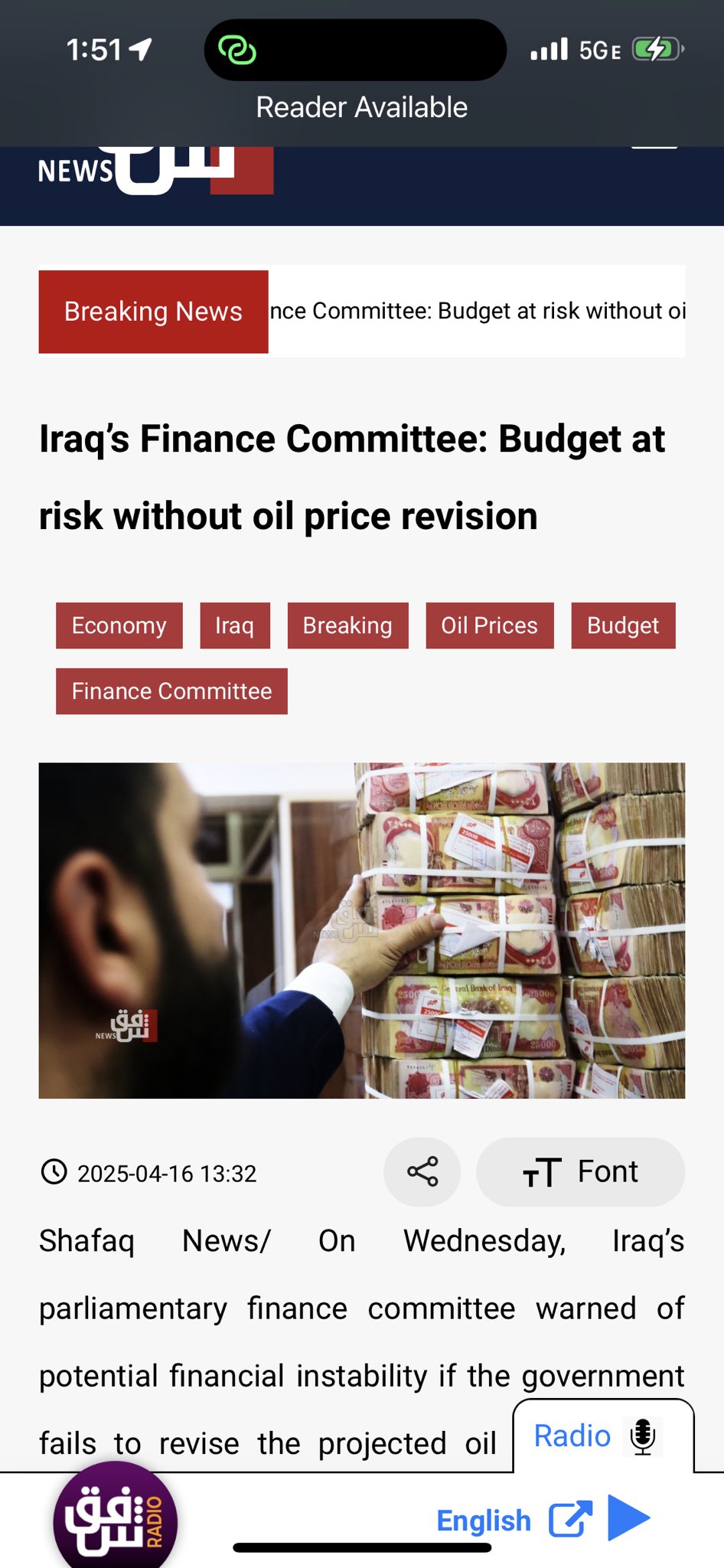
🚨IQD RV🚨: IRAQ FINANCE COMMITTEE: BUDGET AT RISK WITHOUT OIL PRICE REVISION !!, 18 APRIL

🚨IQD RV🚨

IRAQ FINANCE COMMITTEE: BUDGET

AT RISK WITHOUT OIL PRICE REVISION 
💥 Iraq may face revenue shortfalls if budget assumptions are not adjusted
💥 potential financial instability if the government fails to revise the projected oil price in the federal budget
💥 “It is still unclear whether the government has adjusted the oil price assumption in the budget.” Shafaq News/ On Wednesday, Iraq’s parliamentary finance committee warned of potential financial instability if the government fails to revise the projected oil price in the federal budget amid falling global crude prices. Committee member Jamal Kocher told Shafaq News that the 2023–2025 budget law set the oil price at $70 per barrel, while global prices at the time exceeded that figure, noting, “It is still unclear whether the government has adjusted the oil price assumption in the budget.” “Iraq’s operational budget amounts to 90 trillion dinars (around $68.7 billion) and if oil prices drop below $60 per barrel without corrective action, the country could face a financial crisis,” he pointed out. Regarding the status of the 2025 budget tables, Kocher said they are still pending in the Council of Ministers and no date has been set for submitting them to parliament. Earlier, Prime Minister Mohammed Shia al-Sudani’s economic adviser, Mudhhir Mohammed Salih, told Shafaq News that the delay stems from revisions involving extraction and transportation costs for oil from the Kurdistan Region. Iraq’s economy is heavily dependent on oil exports, with petroleum revenues accounting for over 90% of the federal budget. In 2023, Iraq passed an unprecedented three-year budget (2023–2025) based on an average oil price of $70 per barrel and a daily export target of 3.5 million barrels. However, global oil prices have dropped significantly in early 2025, raising concerns that Iraq may face revenue shortfalls if budget assumptions are not adjusted.
Image

BRUCE: Major Developments, Iran Peace Signals & Possible Notifications Timeline

🚨  RV Intel Update: What’s Happening Right Now? In the latest Big Call update from Bruce (March 26, 2026), several  high-impact development...