😊Then in another article titled “CALLS FOR “LIBERATING IRAQ” IN WASHINGTON: THE TRUMP ADMINISTRATION’S VISION AND ESCALATION WITH IRAN”.
Recently we learned about the Trump tariffs in the news and he called this “Liberation Day” for America. Now we find out more on just what president Trump’s policy is towards Iraq and Iraq too is going to have its “liberation”.
I told you if we are just patient, it will all come out and so here is more of it now in the news. The article tells us that former Iraqi diplomat Ghazi Faisal confirmed on Saturday (April 5, 2025) that calls for the “liberation of Iraq” issued by US officials in Washington reflect the vision of the administration of US President Donald Trump for dealing with the situation in Iraq.
If this isn’t a WOW! WOW! WOW! article I don’t know what is….lol..
lol.. lol.. Liberating Iraq from what?
From or course Iran and also the associated corruption of the Obama/Biden era policies and forcing Iraq to be accountable and more importantly supporting them when they do. Remember too the Obama/Biden era politicians still must be held accountable for these illegal early exchanges of Iraqi dinar held in late 2012-early 2013. This also will be part of the liberation process for Iraq.
In a statement to Baghdad Today that “Republican Representative Wilson’s statements regarding the ‘liberation of Iraq’ project do not come out of nowhere, but rather represent the Trump administration’s strategy toward Iran, which the United States considers a ‘terrorist state’ and the world’s foremost sponsor of terrorism.”
He added, “The armed factions loyal to Iran have transformed into a parallel force to the official state in Iraq, strategically allied with the Iranian Revolutionary Guard.”
He pointed out that “calls to ‘liberate Iraq’ could be a prelude to decisions and actions that Washington may take in the coming period, given the ongoing escalation between the United States and Iran, as all options remain open.”
JPMORGAN STRENGTHENS COOPERATION WITH IRAQ BY INCREASING CORRESPONDENT ACCOUNTS AND PROJECT FINANCING
JPMorgan Chase announced its readiness to expand cooperation with Iraq by increasing the number of correspondent accounts opened for Iraqi banks, in addition to financing a number of important investment projects.
Al-Sudani’s media office stated in a statement received by {Euphrates News} that “Prime Minister Mohammed Shia al-Sudani received a delegation from JPMorgan Chase, headed by the bank’s Deputy Director, Daniel Zelikow, on the sidelines of the Iraqi Banking Sector Reform Conference held in Baghdad.”
He added, “During the meeting, they discussed enhancing cooperation in the financial and banking fields, and the bank’s participation in financing various investment projects. They also discussed mechanisms for securing credits and financial transfersand ensuring their delivery to those entitled to them in Europe and the United States. This will contribute to improving services provided to Iraqi traders and importers.”
He stressed “the importance of expanding the scope of partnership between Iraqi banks and JP Morgan,” noting “the government’s readiness to provide all forms of support to strengthen this relationship.”
I have to say that the pace of change and reform for the U.S. is overflowing now into Iraq as the new U.S. leadership takes shape on foreign policy.
How many times have I said over this past decade that Nori Al Maliki and his gang of Iranian thugs must be dealt with? How many times have I said these Iranian backed militia stationed in Iraq must be dealt with?
It is now almost indescribable my feelings as to what is going on in Iraq and all the wonderful changes happening that we prayed so hard for and so long.
So, let’s get into the news for this period.
No, the IQD did not move to FOREX as TNT Tony and other idiot “gurus” told their listeners would happen on this past Monday.
Yes, this was for the thousandth time already they told them this. You would think maybe they might question their sanity and their sources telling these ridiculous stories?
In the news this period there seems to be two main themes based around:
1.the decline of Iranian influence in Iraq and
2.a new chapter in the Iraqi-American partnership with Iraq.
Let’s now take a look at the articles to back up each of these two main topics and what this is all going to mean for our coming reinstatement of the Iraqi dinar back to FOREX.
😊Starting with the article titled “IRAN-BACKED MILITIAS IN IRAQ ARE READY TO DISARM FOLLOWING TRUMP’S THREATS” we find that several of the Iran-backed militia groups operating in Iraq are set to demilitarize for the first time to avoid conflict with the US following President Trump’s threats to Tehran’s proxies. Ten senior commanders and Iraqi officials urged the capital to begin the process of disarming and disbanding the militias operating in Iraq to avoid the worst-case scenario with the US.
“Trump is ready to take the war with us to worse levels, we know that, and we want to avoid such a bad scenario,” a commander of Kataeb Hezbollah, the most powerful Shiite militia operating in Iraq, told Reuters.
Do you know just how good this news really is? If you have been following my Newsletter blog all along you should realize we have been waiting for this kind of news since these Iranian militia from the Kud forces first entered Iraq in 2014 to fight ISIS. I always declared that these forces would be trouble and wondered why in hell Iraq chose them over U.S. forces. But if you know anything about the past, They did so because the U.S. forces in 2011 under Obama had already pulled out and the U.S. Iraq would have to negotiate yet another status of forces agreement for U.S. troops to come back in. Was this all a setup and intentional? This all will soon be exposed.
The U.S. forces did come back into Iraq, but it was way after the Iranian militias had already taken hold in Iraq. Not a good situation and Iraq has been paying the price since. We have then witnessed the Iranian influence in the government, especially parliament and all the corruption and funneling of funds to Iran. Do you think the U.S. is going to approve the reinstatement of the IQD in this situation?
As listeners of the news we kept asking when will Nori al-Maliki get what is coming to him for all his crimes against the state and humanity too. He seemed untouchable and his influence, although limited today, still exists. We witnessed eight (8) years of his “do nothing” lame administration. Even today we still see small articles from his gang trying to bring descent to the policies of Al-Sudani. Oh, but he is sly and careful not to ruffle too many feathers too much these days because he knows his days are numbered. Well in today’s new we find this justice with Nori Al-Maliki is coming much sooner than most think.
If this isn’t a WOW! WOW! WOW! article I don’t what is….lol.. lol.. lol..
THE IMPACT OF NEW US POLICIES ON THE NATIONAL ECONOMY
For two months, the world has been witnessing new economic decisions by the US administration and political, security, and economic tensions. The latest concerns the increase in tariffs on US imports from some countries, particularly the European Union, China, and oil-producing and exporting countries.
Of course, the primary objective of these economic decisions is purely political.
In light of a realistic analysis of international economic, political, and security developments and their expected impact on the Iraqi economy, and with a close eye on the challenges and crises experienced by the national economy, influenced by the economic crises suffered by major economies,
the strategic conflicts between the US, China, European countries, and emerging economies such as India, Brazil, and the BRICS countries, the bias of some countries toward the US strategy to lead the world economically, and other countries toward the strategy of China and some emerging countries to establish a new international economic pole to confront US hegemony. One of the most prominent outcomes of this conflict is the global energy and food crisis, which has persisted for more than a decade and continues to plague countries with weak,
poor, and rentier economies, preventing them from making a structural and comprehensive transition to emerging economies capable of withstanding and overcoming the effects of global economic conflicts. Since mid-June 2014 and the first quarter of 2020, the Iraqi economy has faced complex and cumulative challenges due to changes in the global economy, including the slowdown in global economic growth due to the US-China conflict,
the COVID-19 pandemic, the fight against terrorism, the decline in global oil prices, which reached a decline rate exceeding 70%, and the economic recession. Most countries around the world have been affected by these repercussions, which have had a profound impact on the Iraqi economy. What concerns us is the results of these repercussions and the expected impacts and implications for the economic reality in Iraq in the coming years and until 2030.
In light of the study and analysis, the following can be expected at the level of the global economic system and its implications for Iraq:
First, growth rates in the global economy are expected to decline significantly, affecting the US economy and the economies of the European Union countries, China, and Russia, but at varying rates. Stagflation will prevail in most countries of the world, and this will be reflected in a slowdown in GDP growth by rates ranging between 4-10% in oil-producing and non-oil-producing Arab countries,
especially after the countries of the geographic region faced new challenges due to the Zionist aggression on Gaza and the West Bank. The West, Lebanon, Syria, Yemen, and American threats to Iran have created a new complex situation that will have negative repercussions on the national economy.
Second, the new global economic order we expect to emerge in the coming years will inevitably take shape and will be under the clear economic and financial leadership of the United States, China, and other powers. The Silk Road will be implemented to include the countries through which it was planned to pass, to revive their economies, and it will actually be completed. It is also expected that the path to development will be completed, and Iraq and the countries participating in the project will play a significant role, with positive economic repercussions.
Third, the philosophy of economic management will most likely shift from the capitalist market economy to the social market economy currently adopted as a disciplinary ideology, as in China and some other countries around the world.
These are only early predictions, and the Arab economy will likely be subordinate to the new, larger and more economically powerful pole.
So, what is required of economic decision-makers in Iraq in the face of these developments and changes expected to sweep the world? I see, with a penetrating analytical view of the current economic reality, that we urgently need radical and comprehensive economic change and reform based on the following key pillars:
First: Reshaping the national income resources map by reducing reliance on oil as the primary resource and activating other resources in the coming years to bring them to 30% of the total general budget resources.
Second: Radical and comprehensive change in agricultural, industrial, trade, oil, energy, and water policies by relying on local resources to ensure food and water security, encouraging, protecting, and supporting local production, and developing programs and strategies to protect consumers.
Third: Supporting, developing, and stimulating the private sector, leveraging its capabilities, potential, capital, and investments in building the national economy, and involving it in economic decision-making and economic management.
Fourth: Developing clear strategies for coordination between monetary and fiscal policies, formulating clear financial policies, and re-establishingfoundations for preparing and presenting annual general budgets based on programs, not items. Reducing the budget deficit to the legally specified percentage of GDP, as well as reducing domestic borrowing to a minimum and avoiding any external borrowing.
Fifth: Completing the new methodology adopted by the Central Bank for banking reform and development and digital transformation in all digital fields, with a focus on implementing the Central Bank’s strategy, establishing the financial center, and using artificial intelligence in analyzing, ensuring transparency and accuracy of data for sound economic planning purposes and overcoming the challenges of instability in the financial and monetary systems. This means developing coordinated and balanced plans to overcome the challenges of monetary policy, the challenges of the deficit in non-oil revenue, the deficit in the balance of payments and the trade balance, and the percentage of contribution of productive sectors (the real economy) to the gross domestic product.
“Increasing numbers of national and international network operators want to offer services in Iraq as part of the vibrant local digital ecosystem growing around the exchangeremarkable growth
provides low-latency interconnection, enhanced network security, and scalable connectivit
crucial hub for regional digital transformation
powered by DE-CIX has grown to 28 networks, including major global players such as Meta, Akamai, and Tencent
redefining connectivity standards in Iraq
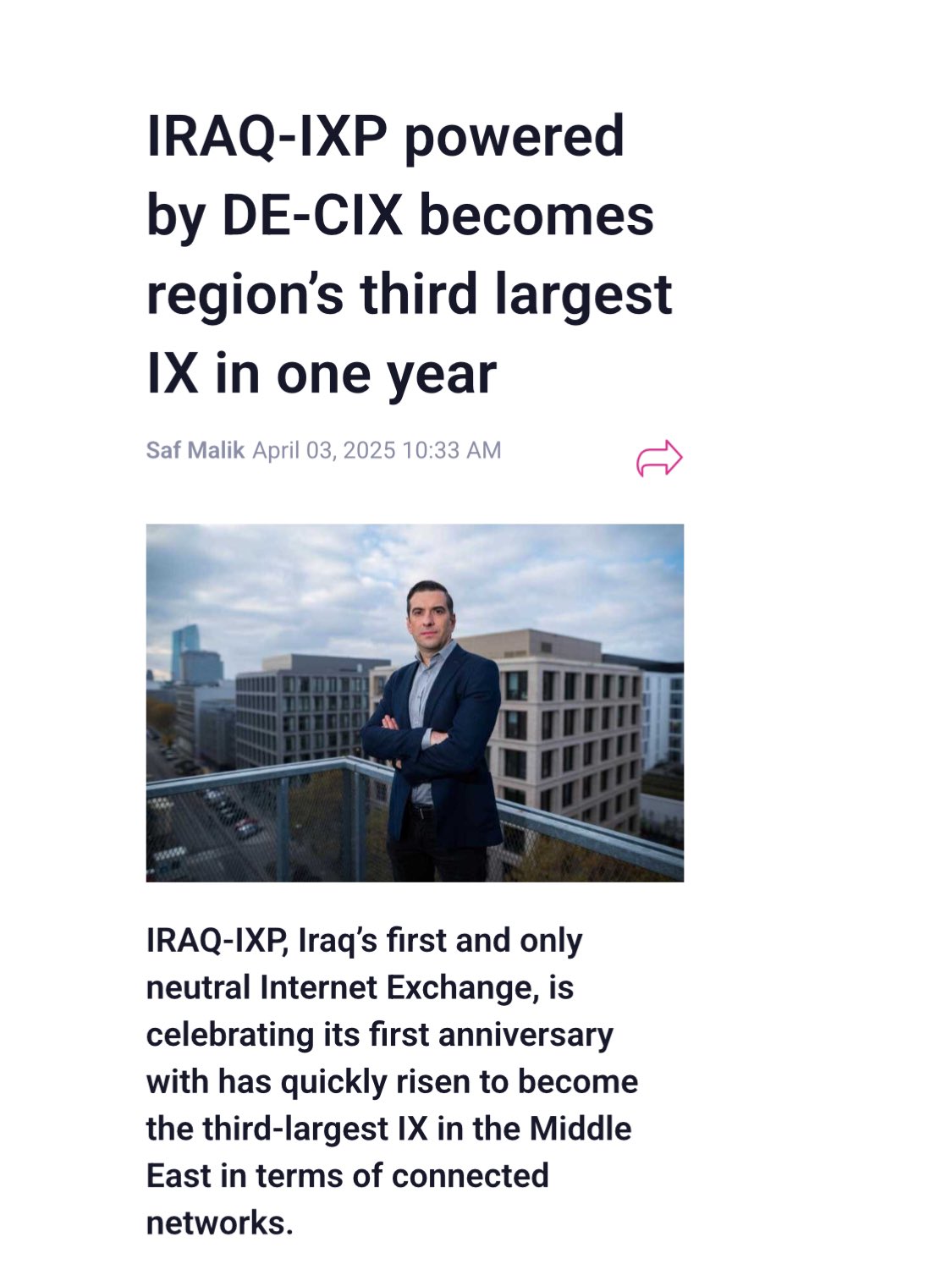
IRAQ-IXP, Iraq’s first and only neutral Internet Exchange, is celebrating its first anniversary with has quickly risen to become the third-largest IX in the Middle East in terms of connected networks.
In just one year, IRAQ-IXP powered by DE-CIX has grown to 28 networks, including major global players such as Meta, Akamai, and Tencent.
Peak traffic has soared to nearly 180 Gigabits per second (Gbit/s), a 150% increase since January 2025, underscoring Iraq’s increasing role in the regional digital landscape.

Hosted at the Iraq Connectivity Gateway (ICG) in Baghdad, IRAQ-IXP operates under the DE-CIX as a Service (DaaS) model, built on DE-CIX’s award-winning infrastructure.
The exchange provides low-latency interconnection, enhanced network security, and scalable connectivity, serving as a crucial hub for regional digital transformation.
The exchange’s remarkable growth reflects the increasing demand for high-speed and reliable connectivity in Iraq and beyond.
“We are delighted by the strong growth of IRAQ-IXP powered by DE-CIX in its first year of operations,” said Ivo Ivanov, CEO of DE-CIX.
“Increasing numbers of national and international network operators want to offer services in Iraq as part of the vibrant local digital ecosystem growing around the exchange.
“Already the third-largest IX in the Middle East and growing rapidly, IRAQ-IXP is meeting Iraq’s demand for higher-speed, more stable, and better-quality Internet connectivity.”
Ahmed Rakwi, CEO of IRAQ-IXP, highlighted the exchange’s broader vision: “From the beginning, our vision was clear — to position Iraq as a digital hub for the region.
“Reaching the milestone of becoming the third-largest Internet Exchange in the Middle East within just one year is not only a reflection of our ambition, but also of the trust placed in us by global and local networks. Powered by DE-CIX, IRAQ-IXP is redefining connectivity standards in Iraq, and this is just the beginning.”

DE-CIX has been active in the Middle East for over a decade, now operating Internet Exchanges in Iraq, Jordan, Qatar, the UAE, and Turkey.
IRAQ-IXP powered by DE-CIX follows in the footsteps of other successful DE-CIX-operated exchanges, such as UAE-IX in Dubai.