Thursday, April 10, 2025
Wednesday, April 9, 2025
THE IMPACT OF NEW US POLICIES ON THE NATIONAL ECONOMY, 10 APRIL
THE IMPACT OF NEW US POLICIES ON THE NATIONAL ECONOMY
For two months, the world has been witnessing new economic decisions by the US administration and political, security, and economic tensions. The latest concerns the increase in tariffs on US imports from some countries, particularly the European Union, China, and oil-producing and exporting countries.
Of course, the primary objective of these economic decisions is purely political.
In light of a realistic analysis of international economic, political, and security developments and their expected impact on the Iraqi economy, and with a close eye on the challenges and crises experienced by the national economy, influenced by the economic crises suffered by major economies,
the strategic conflicts between the US, China, European countries, and emerging economies such as India, Brazil, and the BRICS countries, the bias of some countries toward the US strategy to lead the world economically, and other countries toward the strategy of China and some emerging countries to establish a new international economic pole to confront US hegemony. One of the most prominent outcomes of this conflict is the global energy and food crisis, which has persisted for more than a decade and continues to plague countries with weak,
poor, and rentier economies, preventing them from making a structural and comprehensive transition to emerging economies capable of withstanding and overcoming the effects of global economic conflicts. Since mid-June 2014 and the first quarter of 2020, the Iraqi economy has faced complex and cumulative challenges due to changes in the global economy, including the slowdown in global economic growth due to the US-China conflict,
the COVID-19 pandemic, the fight against terrorism, the decline in global oil prices, which reached a decline rate exceeding 70%, and the economic recession. Most countries around the world have been affected by these repercussions, which have had a profound impact on the Iraqi economy. What concerns us is the results of these repercussions and the expected impacts and implications for the economic reality in Iraq in the coming years and until 2030.
In light of the study and analysis, the following can be expected at the level of the global economic system and its implications for Iraq:
First, growth rates in the global economy are expected to decline significantly, affecting the US economy and the economies of the European Union countries, China, and Russia, but at varying rates. Stagflation will prevail in most countries of the world, and this will be reflected in a slowdown in GDP growth by rates ranging between 4-10% in oil-producing and non-oil-producing Arab countries,
especially after the countries of the geographic region faced new challenges due to the Zionist aggression on Gaza and the West Bank. The West, Lebanon, Syria, Yemen, and American threats to Iran have created a new complex situation that will have negative repercussions on the national economy.
Second, the new global economic order we expect to emerge in the coming years will inevitably take shape and will be under the clear economic and financial leadership of the United States, China, and other powers. The Silk Road will be implemented to include the countries through which it was planned to pass, to revive their economies, and it will actually be completed. It is also expected that the path to development will be completed, and Iraq and the countries participating in the project will play a significant role, with positive economic repercussions.
Third, the philosophy of economic management will most likely shift from the capitalist market economy to the social market economy currently adopted as a disciplinary ideology, as in China and some other countries around the world.
These are only early predictions, and the Arab economy will likely be subordinate to the new, larger and more economically powerful pole.
So, what is required of economic decision-makers in Iraq in the face of these developments and changes expected to sweep the world? I see, with a penetrating analytical view of the current economic reality, that we urgently need radical and comprehensive economic change and reform based on the following key pillars:
First: Reshaping the national income resources map by reducing reliance on oil as the primary resource and activating other resources in the coming years to bring them to 30% of the total general budget resources.
Second: Radical and comprehensive change in agricultural, industrial, trade, oil, energy, and water policies by relying on local resources to ensure food and water security, encouraging, protecting, and supporting local production, and developing programs and strategies to protect consumers.
Third: Supporting, developing, and stimulating the private sector, leveraging its capabilities, potential, capital, and investments in building the national economy, and involving it in economic decision-making and economic management.
Fourth: Developing clear strategies for coordination between monetary and fiscal policies, formulating clear financial policies, and re-establishingfoundations for preparing and presenting annual general budgets based on programs, not items. Reducing the budget deficit to the legally specified percentage of GDP, as well as reducing domestic borrowing to a minimum and avoiding any external borrowing.
Fifth: Completing the new methodology adopted by the Central Bank for banking reform and development and digital transformation in all digital fields, with a focus on implementing the Central Bank’s strategy, establishing the financial center, and using artificial intelligence in analyzing, ensuring transparency and accuracy of data for sound economic planning purposes and overcoming the challenges of instability in the financial and monetary systems. This means developing coordinated and balanced plans to overcome the challenges of monetary policy, the challenges of the deficit in non-oil revenue, the deficit in the balance of payments and the trade balance, and the percentage of contribution of productive sectors (the real economy) to the gross domestic product.
🚨IRAQ-IXP EXCHANGE: IRAQ-IXP, Iraq’s first and only neutral Internet Exchange, is celebrating its first anniversary, 10 APRIL
 IRAQ-IXP EXCHANGE
 “Increasing numbers of national and international network operators want to offer services in Iraq as part of the vibrant local digital ecosystem growing around the exchange
 remarkable growth
provides low-latency interconnection, enhanced network security, and scalable connectivit
crucial hub for regional digital transformation
powered by DE-CIX has grown to 28 networks, including major global players such as Meta, Akamai, and Tencent
redefining connectivity standards in Iraq
IRAQ-IXP, Iraq’s first and only neutral Internet Exchange, is celebrating its first anniversary with has quickly risen to become the third-largest IX in the Middle East in terms of connected networks.
In just one year, IRAQ-IXP powered by DE-CIX has grown to 28 networks, including major global players such as Meta, Akamai, and Tencent.
Peak traffic has soared to nearly 180 Gigabits per second (Gbit/s), a 150% increase since January 2025, underscoring Iraq’s increasing role in the regional digital landscape.

Hosted at the Iraq Connectivity Gateway (ICG) in Baghdad, IRAQ-IXP operates under the DE-CIX as a Service (DaaS) model, built on DE-CIX’s award-winning infrastructure.
The exchange provides low-latency interconnection, enhanced network security, and scalable connectivity, serving as a crucial hub for regional digital transformation.
The exchange’s remarkable growth reflects the increasing demand for high-speed and reliable connectivity in Iraq and beyond.
“We are delighted by the strong growth of IRAQ-IXP powered by DE-CIX in its first year of operations,” said Ivo Ivanov, CEO of DE-CIX.
“Increasing numbers of national and international network operators want to offer services in Iraq as part of the vibrant local digital ecosystem growing around the exchange.
“Already the third-largest IX in the Middle East and growing rapidly, IRAQ-IXP is meeting Iraq’s demand for higher-speed, more stable, and better-quality Internet connectivity.”
Ahmed Rakwi, CEO of IRAQ-IXP, highlighted the exchange’s broader vision: “From the beginning, our vision was clear — to position Iraq as a digital hub for the region.
“Reaching the milestone of becoming the third-largest Internet Exchange in the Middle East within just one year is not only a reflection of our ambition, but also of the trust placed in us by global and local networks. Powered by DE-CIX, IRAQ-IXP is redefining connectivity standards in Iraq, and this is just the beginning.”

DE-CIX has been active in the Middle East for over a decade, now operating Internet Exchanges in Iraq, Jordan, Qatar, the UAE, and Turkey.
IRAQ-IXP powered by DE-CIX follows in the footsteps of other successful DE-CIX-operated exchanges, such as UAE-IX in Dubai.
remarkable growth
provides low-latency interconnection, enhanced network security, and scalable connectivit
crucial hub for regional digital transformation
powered by DE-CIX has grown to 28 networks, including major global players such as Meta, Akamai, and Tencent
redefining connectivity standards in Iraq
IRAQ-IXP, Iraq’s first and only neutral Internet Exchange, is celebrating its first anniversary with has quickly risen to become the third-largest IX in the Middle East in terms of connected networks.
In just one year, IRAQ-IXP powered by DE-CIX has grown to 28 networks, including major global players such as Meta, Akamai, and Tencent.
Peak traffic has soared to nearly 180 Gigabits per second (Gbit/s), a 150% increase since January 2025, underscoring Iraq’s increasing role in the regional digital landscape.

Hosted at the Iraq Connectivity Gateway (ICG) in Baghdad, IRAQ-IXP operates under the DE-CIX as a Service (DaaS) model, built on DE-CIX’s award-winning infrastructure.
The exchange provides low-latency interconnection, enhanced network security, and scalable connectivity, serving as a crucial hub for regional digital transformation.
The exchange’s remarkable growth reflects the increasing demand for high-speed and reliable connectivity in Iraq and beyond.
“We are delighted by the strong growth of IRAQ-IXP powered by DE-CIX in its first year of operations,” said Ivo Ivanov, CEO of DE-CIX.
“Increasing numbers of national and international network operators want to offer services in Iraq as part of the vibrant local digital ecosystem growing around the exchange.
“Already the third-largest IX in the Middle East and growing rapidly, IRAQ-IXP is meeting Iraq’s demand for higher-speed, more stable, and better-quality Internet connectivity.”
Ahmed Rakwi, CEO of IRAQ-IXP, highlighted the exchange’s broader vision: “From the beginning, our vision was clear — to position Iraq as a digital hub for the region.
“Reaching the milestone of becoming the third-largest Internet Exchange in the Middle East within just one year is not only a reflection of our ambition, but also of the trust placed in us by global and local networks. Powered by DE-CIX, IRAQ-IXP is redefining connectivity standards in Iraq, and this is just the beginning.”

DE-CIX has been active in the Middle East for over a decade, now operating Internet Exchanges in Iraq, Jordan, Qatar, the UAE, and Turkey.
IRAQ-IXP powered by DE-CIX follows in the footsteps of other successful DE-CIX-operated exchanges, such as UAE-IX in Dubai.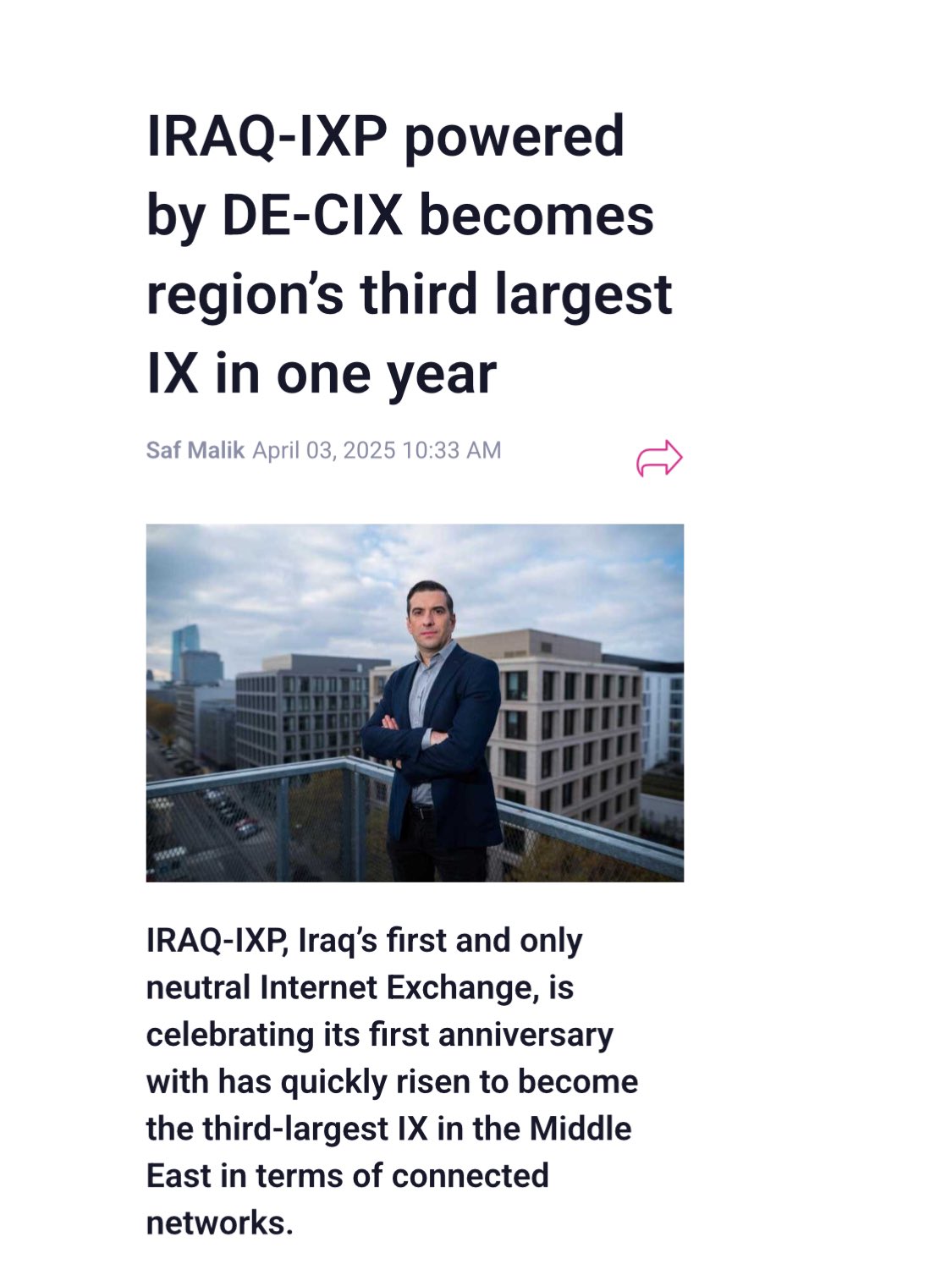
ECONOMIST: CUSTOMS TARIFFS PORTEND A GLOBAL RECESSION AND IRAQ WILL BE HARMED BY THE DROP IN OIL PRICES., 10 APRIL
ECONOMIST: CUSTOMS TARIFFS PORTEND A GLOBAL RECESSION AND IRAQ WILL BE HARMED BY THE DROP IN OIL PRICES.
Economic expert Abdul Rahman Al Mashhadani confirmed that the United States’ imposition of customs tariffs on goods and commodities will have indirect effects on Iraq, even though the price increase will have a direct impact on the American market.
Al-Mashhadani explained to Al-Furat News Agency that “this policy will cause an increase in inflation rates within the United States, which will negatively impact American citizens with a general rise in prices depending on the importance of commodities.”
He explained that the indirect impact is the possibility of a global economic recession resulting from a decline in the volume of American, European and Canadian exports to European markets, due to reduced investments and the disruption of commercial activity due to the size of the American market.
Al-Mashhadani warned that “this recession will affect global industry, reducing demand for oil and leading to a decline in its global prices, which will indirectly harm the Iraqi economy, which depends heavily on oil revenues.”
Two days ago, US President Donald Trump announced the imposition of countervailing tariffs on most countries around the world, with rates ranging from 10% to 49%, including Iraq.
Trump designated April 2 as “Liberation Day.”
TIDBIT FROM MARKZ, 10 APRIL
MarkZ
[via PDK]
In Iraq: “The speaker of the House of Representatives, Dr. Mashadani receives the charge at the US Embassy”
in other words Mr. Rubenstien from the American Chamber of Commerce and delegation has arrived.
They will have large scale meetings to bring billions of dollars of investments to Iraq. These are international business people looking for international business opportunities.
They would not be there unless Iraq was about to rise. And that means a potential for new rates.
Comment: Rueters, news Anchors and economists are now talking about revaluations and exchange rates etc…. Main stream is now talking about what we have been talking about for years. MarkZ: They are …how many articles are we seeing talking about resets…financial resets…talking about moving to gold…wow…its big conversations in financial realms all over the world. They are all talking about the impending reset to commodities.
Subscribe to:
Posts (Atom)