Wednesday, April 2, 2025

Is Iraq's Ecosystem Investment-Ready?, 2 APRIL

 Is Iraq's Ecosystem Investment-Ready?

ECOSYSTEM OVERVIEW

The Iraqi startup ecosystem started with a bang this year. In Q1 of 2022, we witnessed an unprecedented $10.5M investment round (Baly) and $5M (TipTop). The excitement revolved not only around investment value but also around the investor profile.

Specifically, Baly's round was a testament to regional and international investor appetite in Iraq. The investors were diverse - from China (MSA Novo), UAE (March Holding), and Sweden (Vostok Ventures). Another interesting attribute is that both startups were early stage.

Unfortunately, the initial thrill of Q1 seemed to fizzle out by mid-year. The expected ripple effect of those two initial deals did not materialize. During Q2 of 2022, there was no publicly reported investment activity. The remainder of 2022's rounds were six-figure or less. With only one public round in 2022 (Nakhla), Euphrates Ventures seemed to have disappeared from the scene.

Although the dollar amounts of 2022 surpassed last year, 2021 displayed consistency in value, investor profile, and disbursement of funds across all four quarters. So, what happened to the investment buzz? Were Baly and TipTop just one-off anomalies?
BENCHMARKING AGAINST INVESTMENTS IN MENA

For a more holistic view, let us dig deeper and see how Iraq's investment trends stack up against MENA's. According to Wamda and Digital Digest's October 2022 report, the value of deals in the region witnessed a 331% year-on-year increase compared to October 2021. As of today and based on our conservative estimates, Iraq is on a similar positive trajectory. Iraq's year-on-year investment value increased by around three-quarters (72%) - mainly attributed to Baly's and TipTop's groundbreaking rounds. While seed and pre-seed activity witnessed a drop in the MENA region, the value and number of seed-stage rounds in Iraq remained relatively stable.

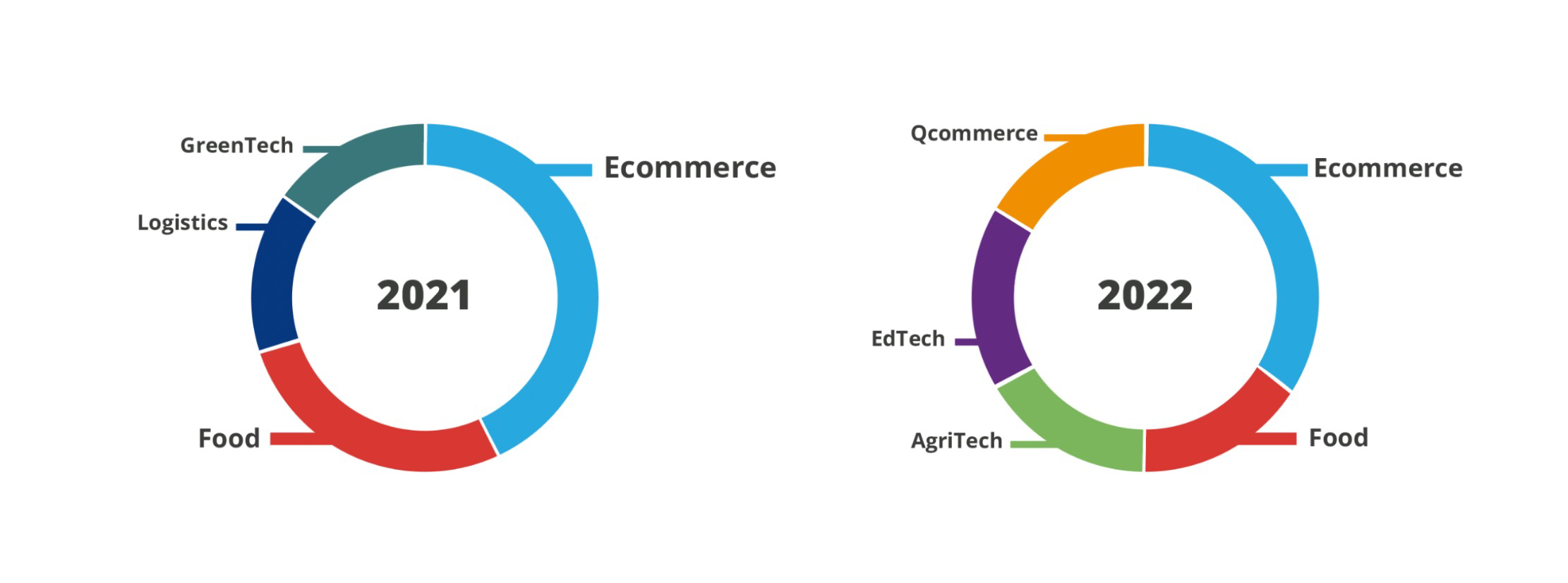
MENA investors poured money into two main industries - cleantech and fintech. Fintech startups received the most attention, with startups such as MoneyFellows($31M), Telda ($20M), and MaxAB ($40M). Meanwhile, cleantech startup, Yellow Door Energy, led the biggest raise with a mega-round of $400M. Iraq's investment landscape observed very divergent sectoral inclinations. Ecommerce continues to reign as king. Historically, cleantech in Iraq received its share of attention.

New contenders have sprouted, notably agritech (Nakhla) and edtech (IoT Kids). This sectoral interest is consistent with social and economic needs. Fintech, on the other hand, is still nascent. Mohammed Koperly from Al Nesoor Law firm attributes this to "complex ambiguous laws and regulations applying to banks, financial institutions, and insurance companies if they carry out such regulated activities." And that is why we notice a proliferation of wallet and prepaid solutions. Interestingly enough, ecommerce platforms are exploring new and innovative methods of circumventing the lack of fintech solutions, particularly startups such as OrderiiSimma, and ToolMart.

LOOKING FORWARD: SOLUTIONS AND NEXT STEPS

Last month, Five One Invest buckled down and organized a roundtable session to uncover the gaps facing investors...what were the missing pieces of the puzzle? The online roundtable invited fifteen international, regional, and local investors to discuss investment barriers and potential solutions.

The discussion uncovered four main steps to be taken to facilitate involvement in the Iraqi ecosystem:.

  • Addressing startups' investment readiness gaps such as basic accounting.

  • Contextualizing Iraq's ecosystem by providing a holistic overview of the investment and entrepreneurial landscape.

  • Presenting Iraq's startups at regional events (such as Step, Rise Up, Gitex, etc.).

  • Building trust among regional and local investors through investor networking, relationship building, and knowledge sharing.

  • Supporting the survival of later-stage startups by increasing the ticket size and de-risking through co-investment and the participation of larger investors.

Quite a few ecosystem players have taken measures to champion the ecosystem further. Earlier this year, Iraq Venture Partners (IVP) and Five One Invest launched a joint pilot investment readiness program. The joint pilot program provides startups tailored support through Five One Invest that addresses gaps before the IVP investment transpires. The type of support includes financial modeling, pitch deck readiness, due diligence, and customer experience evaluation. Other entities in the market run similar programs, such as The StationKapita, and Cross-Boundary. However, there is still space for development.

Within Iraq, there is no shortage of educational and informative content. Local players such as Iraqi Innovators, Kapita, and Five One Invest produce articles, reports, and content with in-depth analysis of the ecosystem landscape. Engaging the international and regional content houses, however, is what warrants attention. A few regional players, such as Wamda and Magnitt, report on Iraq's entrepreneurial scene, but it is still insufficient to attract regional attention.

These past two years have presented Iraq's startups with regional and international exposure. In 2021, Rabee Securities, a well-established Iraq-based securities brokerage firm, hosted five Iraqi startups (MiswagAlSaree3KESKIQ Cars, and Zaytoon) to represent at the Iraq Pavilion EXPO 2020. Earlier this year IQ Cars, an automotive marketplace app, flew out to Websummit, an annual technology conference in Portugal. Also, four startups, JobStudioOrderiiSTEMile, and Eduba ايدوبـــا, showcased and networked with regional investors during the MENA ICT Forum, a two-day forum focused on tech in the MENA. It is refreshing to see opportunities opening up, albeit slowly and far between.

The two other main challenges, developing relationships between regional and local investors and supporting later-stage startups through co-investment, remains tricky. But that is what we are here for...watch this space!

EXCERPTS FROM MARKZ, 2 APRIL

 EXCERPTS FROM MARKZ

Member: I think we wont see the RV until the budget is balanced…The RV will remove all the foreign debt once the budget is balanced

MZ: That might makes sense. Doge is necessary. They need to fix what is wrong in our government.

Member: The bible says “Don’t put new wine in an old wineskin.”

Member: Maybe things are already being fixed behind the scenes???

Member:  Hearing that Sudani will release the financial reform immediately after Eid. Eid al Fitr will be ending on Liberation Day. Is it possible we see the finish line late on the 2nd?

MZ: it is very possible we see it then. There was a lot of expectation for the weekend. It could be the second but no one knows the timing. Continue to make good decisions and be responsible. 

MZ: We absolutely know the system will reset. History shows up that resets are cyclical. They do break and they do reset. We are way past due for a reset. 

Member: TNT Posted that 1 and 5 and 10 lower Denomination were released

Member: Tomorrow marks the first day of a new quarter. Shabibi mentioned it starting on a quarter somewhere.

MZ: It would be easiest for them to start then. 

Member:  I heard a rumor all contracts in Iraq expire today!!!

MZ: I have not heard that from any of my sources. No one I know agrees with that. 


IQD: $10.21 – Public trade screens GO LIVE TONIGHT!! @DINARREVALUATION #iraqidinarinvestor #iraq


Tuesday, April 1, 2025

Trump 2.0 and Iraq's Dollar Accounts at the Fed, 2 APRIL

 Trump 2.0 and Iraq's Dollar Accounts at the Fed, 2 APRIL

The adage that ‘History never repeats itself, …’ is a relief of sorts for the government of Iraq (GoI) under the second Trump administration (T2), given the first Trump administration (T1)’s threats of sanctions that would ‘make Iranian sanctions seem somewhat tame’ (made in 2020 in response to parliament’s demands for the expulsion of US troops, itself in response to the American assassination of Iran’s top general in early 2020). However, the second part of the couplet – ‘…, but it does often rhyme’ – removes most of that relief, as T2 will likely reassess the reported agreement on the planned withdrawal of US forces; as well as the likely spillovers from the resurrection of the ‘maximum pressure campaign’ on Iran.

Despite the evolution of the US-Iraq relationship since then under the aegis of the Strategic Dialogue framework, the issue of US troop withdrawal will likely be entangled with the resuscitation of the ‘ideology of confrontation’ over Iran’s role in Iraq – this sees Iran as the true beneficiary, at the expense of the US, of the latter’s 2003 invasion of Iraq. This was evident with the revocation, without consultation with the GoI, of the waivers that allowed the imports of Iranian gas and electricity, whose obvious negative effect is the loss of around 31 percent of its power generation, while less obvious is the requirement to ‘ensure that the Iraqi financial system is not utilised by Iran for sanctions evasion or circumvention’. 

This requirement is not linked to the imports of Iranian gas and electricity as their payments are governed by a series of US waivers and exemptions requiring them be deposited into restricted accounts that can only be used for the purchase of non-sanctionable transactions. Nevertheless, it has consequences for Iraq’s banking system and the Central Bank of Iraq (CBI)’s US dollar auction that enables the country’s interactions with the outside world. This is in large part due to the host of misinformation, misconceptions and conspiracy theories that claim that the CBI’s banking system and dollar auction facilitate sanctions evasion and circumvention. Most of these were addressed by the author in a series of papers for the LSE Middle East Centre, ‘A Fistful of Dinars’,  ‘The Dinar, and the Conundrum over the Dollar and Iran’, and ‘Big Bad Wolf, or Is it?’ 

This piece complements these in providing an overview of Iraq’s oil revenue and the foreign reserves accounts held at the Federal Reserve Bank of New York (FRBNY), given T1’s other threat to Iraq in 2020 that it could lose access to these accounts.

Two Distinct but Linked Accounts

The two accounts are distinct, structurally different, but are linked. Both accounts start their lives with oil exports, whose revenues in dollars are deposited into what is termed the ‘Oil Proceeds Receipts Account’ held at FRBNY, and managed by CBI on behalf of Iraq as represented by the Ministry of Finance (MoF). These are then transferred into a second CBI managed account held at FRBNY, and then into MoF’s dollar account held at CBI – which is effectively Iraq’s oil revenue account and funds government expenditures. These two accounts are referred to as the DFI successor accounts, which replaced the Development Fund of Iraq (DFI) created by UN Security Council Resolution 1483, following the US invasion in 2003. The holdings of the oil revenue account vary depending on oil revenues, and budget expenditures, and were $2 billion as of the end of January 2025 (Figure 1). 

Figure 1: Ministry of Finance’s Oil Revenue Account (MoF Foreign Deposits since 2018)

The second account starts its life with the conversation of MoF’s dollars into Iraqi dinars by the CBI to fund the government’s domestic expenditures. This takes the form of the CBI buying dollars from MoF’s oil revenue account and selling the equivalent amount in dinars. The dollars that CBI buys from MoF become the nucleus of its foreign reserves held in its own account at FRBNY. Through the dollar auction, these reserves channel oil revenue-sourced dollars to meet the private sector’s dollar demands to pay for imports (see A Fistful of Dinars). The amounts of foreign reserves, like those in the oil revenue account, vary depending on oil revenues, and budget expenditures, and were $99 billion as of the end of January 2025 (Figure 2).

Figure 2: CBI Foreign Reserves Since 2018

While these reserves start their life at the CBI’s own account held at FRNBY, most are transferred into accounts at global central banks, major international banks, investments in bonds, and gold. As of the end of 2023, only 4.2% of total reserves were at the CBI’s account at FRNBY (Table 1). 

48.2%bonds and bills
71.4%bonds issued by international governments and international government banks
18.2%bonds issued by financial and international institutions
5.3%bonds issued by international banks and financial institutions
4.7%Sukuk issued by international Islamic banks
0.4%bills issued by international governments
26.2%Accounts with international banks
16.1%Accounts with global central banksand cash at held
59.4%Banque de France
26.1%FRBNY (equivalent to 4.2% of total reserves)
13.0%Bank of England
0.1%other global central banks
1.4%CBI vaults
8.5%Gold
97.0%Abroad
3.0%CBI Vaults
1.0%Others

Table 1: CBI Reserves

Thus, on the surface Iraq’s direct exposure to FRBNY is relatively small – oil revenue account, and CBI’s account at FRBNY – however, it is effectively much larger given that most of CBI’s accounts at global central banks, international banks, as well as the bonds are in dollars, and gold is priced in dollars. As such the foreign reserves’ dollar exposure was 90.2 percent at the end of 2023, and looks likely to remain at similar levels given the need to align these reserves with the country’s dollar-based revenues, as well as the depth, liquidity, and full convertibility of dollar assets. As a consequence, Iraq, like other holders of dollar assets, is subject to the rules of the global dollar system, and thus to any FRB imposed restrictions on transfers of funds – in particular access to foreign reserves for the payments of imports.

Figure 3: Cross-Border Transfers

However, the implementation of CBI’s November 2022 procedures for cross-border transfers and subsequent measures, have resolved most of the compromises of the past that could have led to FRB imposing restrictions on fund flows as a consequence of possible threats by T2. Indeed in 2024, most cross-border transfers were by Iraqi banks with correspondent banking relationships with major US banks, in which transactions are reviewed by an international risk agency nominated by the Federal reserve Bank (FRB), and these will become the norm upon the ending of the dollar auction in 2025 (grey lines in Figure 3).

However, the continued growth of private sector imports from Iran, estimated at $7.7 billion in 2024, implies that importers and exporters have arrived at new opaque payment structures to circumvent CBI’s November 2022 procedures. Such opaque structures, with all their resultant negatives, have become a necessity for these importers due to the isolation of Iran’s banking system from the rest of the world, even though such private sector trade is not subject to sanctions.

Oil and the Dollar Exposure

Irrespective of the diversity of Iraq’s oil export destinations, the dollar will always dominate its revenues as a function of its prevalence in physical oil markets; themselves interwoven with the much larger oil financial markets that are traded in dollars in global financial centres and which play a major role in determining the price of the oil that Iraq exports. All of this means that Iraq will continue to have a large exposure to the dollar, through both its dollar revenue account, and its foreign reserves. However, it needs to be aware of the extent and consequences of this exposure and become proactive in managing it and its relationship with the US Treasury and the FRB. On the other hand, the past strategy of burying one’s head in the sand and hoping for the best seems to have worked during all prior crises that the country faced!

ARIEL : Zimbabwe Currency Revaluation: The ZiG and Trillion-Note Breakdown

ARIEL

Zimbabwe Currency Revaluation: The ZiG and Trillion-Note Breakdown

1. The ZiG Currency: Gauging the Market

What’s Happening: Launched April 8, 2024, by the Reserve Bank of Zimbabwe (RBZ) at its Harare HQ on 80 Samora Machel Avenue, the Zimbabwe Gold (ZiG) is a gold-backed currency replacing the RTGS dollar. As of March 31, 2025, it trades at 13.56 ZiG per USD officially, per RBZ Governor John Mushayavanhu’s March 27 update, but the black market rate hovers at 25 ZiG per USD. The RBZ pegs it to 2.5 tons of gold (80,375 ounces) and $575 million in forex reserves, totaling $791 million in backing, per their 2024 annual report.

How It Works: Each ZiG note is tied to 0.031 grams of gold $87 per ounce at $2,700, or $2.70 per ZiG in intrinsic value. The RBZ’s printing 1 billion ZiG notes (13.56 billion USD officially, $2.7 billion in gold terms) to test market uptake. Daily forex trades at the Willing Buyer Willing Seller (WBWS) platform hit $10 million, per The Herald on March 25, 2025, with 60% in ZiG. Banks like CBZ on Jason Moyo Avenue, Harare, process digital ZiG via EcoCash wallets, cutting reliance on USD cash (70% of transactions in 2023).

Gauging Strategy: The RBZ’s using the ZiG to stabilize inflation 14.6% in January 2025, per ZimStat, driven by a 2024 drought slashing maize output 60% (1.1 million tons short). By March, inflation’s eased to 12%, but parallel rates signal distrust. The ZiG’s a trial balloon success could trigger a broader RV, including legacy notes.

Impact on RV: If the ZiG holds at 13.56 per USD through 2025, it proves Zimbabwe can anchor a currency. The RBZ’s $791 million backing could scale to $1 billion with gold buys Zimbabwe mined 35 tons in 2024, per Fidelity Printers data setting the stage for a trillion-note RV.

2. Legacy Trillion Notes: “Promise to Pay Bearer”

What’s Happening: The 2008-series Z$100 trillion notes (e.g., AA 4215246 serials) bear “I Promise to Pay the Bearer on Demand,” a legal IOU from the RBZ’s hyperinflation era (231 million percent in 2008, per IMF). Stashed by investors worldwide, these notes once worth $0.0000003 USD could revalue under a new gold-backed system, per RBZ hints in a March 2025 Financial Gazette interview with Deputy Governor Jesimen Chipika.

How It Works : Zimbabwe’s 2.5 tons of gold and $575 million in forex back the ZiG, but the RBZ’s $1 trillion in legacy liabilities (2008 notes) looms. A revaluation could redenominate them say, 1 new ZiG per 10 trillion old Z$ tying them to gold. At 0.031 grams per ZiG ($2.70), a $100 trillion note could fetch $270 (100 trillion ÷ 10 trillion × $2.70). A bolder RV at 5 cents per trillion note values it at $50 million USD.

Mechanics: The RBZ opens exchange windows think Harare’s RBZ Tower or Bulawayo’s ZB Bank on Fife Street swapping old notes for ZiG or USD at a fixed rate. With 10 billion Z$100 trillion notes circulating (estimated by collectors), a 5-cent RV needs $500 billion in reserves far beyond $791 million. A phased approach (e.g., 0.0005 cents initially) scales up as gold reserves grow to 5 tons ($13.5 billion) by 2027.

Impact on Value: At 5 cents per trillion, a $100 trillion note’s $50 million USD life-changing wealth. Even 0.0005 cents (1 new ZiG per 10 trillion Z$) nets $270 per note, a 900 million-fold jump from 2008’s $0.0000003.

3. Economic Drivers: Gold, Drought, and Global Ties

Gold Reserves: Zimbabwe’s 2024 gold output 35 tons from mines like Freda Rebecca in Bindura could hit 40 tons in 2025 ($108 billion at $2,700/ounce), per Mines Minister Winston Chitando’s March 15 forecast. A 5-ton reserve by 2026 backs a $13.5 billion currency base, enough for a modest trillion-note RV.

Drought Fallout: The 2024 El Niño drought cut GDP growth to 2% (from 5% in 2023), per World Bank’s 2025 Zimbabwe Economic Update. Food imports $1 billion in maize from South Africa drain reserves, but gold offsets this. A stronger ZiG at 10 per USD by Q4 2025 eases import costs, freeing cash for an RV.

Global Context: Trump’s tariff war (25% on imports, April 1, 2025) boosts Zimbabwe’s gold exports China’s Zijin Mining in Beijing buys 10 tons yearly. A gold-backed ZiG at 5 per USD draws forex, pushing trillion-note RV feasibility.

4. Revaluation Scenarios: Wealth Explosion

Scenario 1: 5 Cents per Trillion: A $100 trillion note hits $50 million USD $500 billion total for 10 billion notes. Zimbabwe needs $500 billion in reserves (50 years of GDP at $10 billion annually). Unlikely short-term, but gold scaling to 185 tons by 2030 ($500 billion) makes it viable.

Scenario 2: 0.0005 Cents (1 ZiG per 10 Trillion): More realistic $270 per $100 trillion note, needing $2.7 billion in reserves (covered by 2.5 tons gold + $575 million forex). A $1,000 stack (10 notes) nets $2,700 still life-altering for small holders.

Scenario 3: 0.00005 Cents (1 ZiG per 100 Trillion): Conservative $27 per note, $270 per 10-note stack, requiring $270 million (RBZ’s current reach). At 5 ZiG per USD by 2026, that’s $54 per note wealth for millions.

The Payoff: A $10,000 stash (100 × $100 trillion notes, $100 cost in 2008) at 5 cents nets $5 billion unreal but possible long-term. At 0.0005 cents, it’s $27,000 a 27,000% gain by 2026. Even 0.00005 cents yields $2,700 a 2,700% return.

April 2025 Catalyst: The Tipping Point

Triggers: By April 30, potentially the ZiG stabilizes at 10-12 per USD, per RBZ projections, with $800 million in reserves. Gold hits $2,800/ounce, boosting backing to $820 million. Inflation dips to 10%, per ZimStat, as drought aid from UN’s WFP ($200 million) eases food costs. The RBZ tests trillion-note swaps at 0.00005 cents in Harare’s First Mutual Building.

Historic Angle: A 0.0005-cent RV by December 2025 $270 per $100 trillion dwarfs the 2009 redenomination (10 trillion Z$ to 1 ZWL). A $1,000 stash (10 notes) turns into $2,700 by year-end, $5,400 at 5 ZiG per USD in 2026 generational wealth.

The Edge: A $10,000 hoard (100 notes) at 0.0005 cents nets $27,000 by 2025 a 270% gain in 9 months. At 5 cents long-term (2030), it’s $5 billion a 50 million-fold return. We are positioned for history.

Zimbabwe’s 2.5 tons of gold, $575 million in forex, and the ZiG’s test run could unlock trillion-note riches. At 5 cents per trillion, a $100 note makes millionaires; at 0.0005 cents, it’s thousands per note still life-changing. April 2025’s stability sets the stage, with gold scaling the RV to insane heights by 2030. Their investment’s not a punt it’s a calculated stake in a gold-backed comeback. Short-term, 100-300% gains by 2026; long-term, millions per stack.

MNT GOAT: Dinar Revaluation Key Events to Watch! @DINARREVALUATION #iraqidinarinvestor #iraq


Survey: "Trump to Revalue Dinar in first 100 Days", 2 APRIL

 Survey: "Trump to Revalue Dinar in first 100 Days",

Back in January, Iraq Business News ran an online survey asking opinions on a revaluation of the Iraqi dinar following the inauguration of US President Donald Trump.

This survey did not pretend to be scientific, as respondents were self-selecting, leading to a high risk of sampling bias, but it served to show that among dinar speculators there was some currency (pun intended) to the idea that the re-election of Trump to the White House would have a bearing on developments.

Astonishingly, more than half of respondents expected the Iraqi dinar to revalue by at least 1,000x in the first 100 days of Trump's term. You can see a graph of the responses below.

More than two months into that period, Trump has not done or said anything to support this theory, despite false claims to the contrary on the internet.

But rather than finally accepting that they have paid good money for the false hope of ludicrous returns, dinar speculators (or 'dinarians', as they sometimes like to call themselves) continue to reinforce each other's beliefs on online message boards and dismiss all  logical arguments against their position.

Please let us know your thoughts in the Comments Section below.

For more information on the Iraqi dinar, check out IBN's Dinar Page here: https://www.iraq-businessnews.com/the-dinar-page/?swcfpc=1 

See also: The Iraqi Dinar Revaluation Scam: False Hope, Financial Deception

To learn what's really happening in Iraq, check out our news here, and our library of reports here.

🚨 POST-EXCHANGE WEALTH MANAGEMENT BLUEPRINT (IQD Scenario Planning Guide)

🚨  POST-EXCHANGE WEALTH MANAGEMENT BLUEPRINT (IQD Scenario Planning Guide) 💡  Key Financial Strategies (Beyond Basic Exchange Planning) 1....