Saturday, March 15, 2025

Chapter Summary: The Implications of Removing Zeros from the Iraqi Dinar, 15 MARCH

Chapter Summary: The Implications of Removing Zeros from the Iraqi Dinar

Introduction

The economic landscape of Iraq has been shaped by various challenges, notably the high number of zeros on their currency, the Iraqi Dinar.

 A recent discussion featuring economist Dr. M. Mud Da has brought to light the possibility of removing zeros from the Dinar as a method to simplify its handling and restore confidence in the currency. 

This chapter delves into the significance of this proposal, its potential implications for the economy, and the public’s perspective while discussing the broader context of currency reform in Iraq.

Key Concepts and Vocabulary

  • Removing Zeros: The process of redenominating a currency by eliminating zeros from its nominal value while maintaining purchasing power.
  • Redenomination: Adjusting the nominal value of a currency to stabilize the economy, often involving a direct conversion of existing denominations to new, lower values.
  • Purchasing Power: The amount of goods or services that can be purchased with a unit of currency.
  • Inflation: The rate at which the general level of prices for goods and services rises, eroding purchasing power.

The Landscape of Currency Reform

The speaker, Aki, provides anecdotal evidence of an impending economic shift, claiming his boss anticipates increased business activity shortly. This sentiment reflects a broader optimism about the economic potential inherent in reforming Iraq’s currency. The speaker underscores the correlation between the Iraqi Dinar’s value and the country’s oil revenue, suggesting that the contract rate of the Dinar is closely tied to oil prices.

Economic Challenges

The Iraqi economy struggles with inflation, currently pegged at a notable 2.8%. This is part of a long-standing issue where the economy has been fraught with complications, making cash transactions cumbersome for everyday citizens, who often carry large bundles of cash in high-denomination notes.

  • Current Currency Issue: Citizens often manage daily expenses with high denomination notes, leading to inefficiencies in everyday transactions.

The Proposal of Removing Zeros

Dr. M. Mud Da elaborates on how removing zeros could positively impact the economy. The concept revolves around simplifying currency management. For instance, instead of dealing with large amounts, the idea is to convert the apparent value of the Dinar.

The Mechanics of Change

  • Current State: The total currency circulation is approximately 105 trillion Dinar. Removing zeros would theoretically adjust this to 105 billion Dinar, but the overall value remains unchanged.

  • Example: If citizens have a 10,000 Dinar note, post-reform, it becomes a 10 Dinar note. This change is primarily cosmetic, simplifying transactions without affecting purchasing power.

Exchange Rate Adjustments

A critical aspect of this proposal includes the anticipated shift in exchange rates. Currently, the exchange rate stands at 1320 Dinar per US Dollar, which is projected to adjust to 132 Dinar per US Dollar post-reform. While this adjustment maintains economic equivalence, it reduces the apparent numerical complexity for transactions.

Implications for Daily Life

The adjustment of the currency is not merely about changing numbers but involves real-world effects on daily transactions, affecting how individuals shop, interact, and understand their economy.

  • Easier Transactions: A streamlined currency could facilitate electronic transactions, reduce counting errors, and mitigate misunderstandings during financial dealings.
  • Potential Complications: Despite the potential benefits, the transition poses challenges. Ordinary citizens may struggle to adapt to new denominations, necessitating robust educational outreach about the changes.

Public Opinion and Debate

Dr. M. Mud Da invites feedback from viewers regarding the proposed changes to the Dinar. He highlights the division in public opinion on whether this step will take Iraq’s economy in the right direction.

Views on Confidence in Currency

There are divergent opinions surrounding the removal of zeros. Advocates believe it could bolster confidence in the currency and improve the perception of Iraq’s economic management. Critics warn it might lead to confusion, as it potentially conceals underlying economic issues.

Broader Economic Discussions

Dr. Mud Da stresses that removing zeros is not a catch-all solution. It doesn’t resolve structural economic issues like inflation rates or unemployment. Thus, it should be part of a comprehensive approach that includes improvements in infrastructure, job creation, and better management of public trust.

Historical Context

A real-world comparison was drawn with Turkey’s experience in 2005, when it removed six zeros from its currency, resulting in economic stabilization. However, Dr. Mud Da warns that such reforms require underlying economic improvements to be successful.

Conclusion

The discussion on removing zeros from the Iraqi Dinar sheds light on potential paths forward for Iraq’s economy. While currency simplification may make transactions easier and restore some level of confidence, it is intertwined with a host of economic realities that must be addressed concurrently. The critical lesson here is that currency reform must be approached with caution and accompanied by a broader economic strategy to be effective. Engaging with public sentiment and ensuring comprehensive educational efforts will be key to minimizing confusion and fostering a well-informed populace ready to adapt to changes.

In closing, the shifts in the Iraqi Dinar not only reflect a technical economic adjustment but also resonate with the lives and trust of the citizens. As Iraq navigates these changes, the implications extend beyond mere numbers, reflecting a pivotal moment in the country’s economic narrative.
EXCERPTS FROM MARKZ : I HAD MORE CONFIRMATIONS TODAY @DINARREVALUATION #iraqidinarinvestor


Syrian FM: Syria seeks stronger ties with Iraq, 15 MARCH

 Syrian FM: Syria seeks stronger ties with Iraq


Syrian FM: Syria seeks stronger ties with Iraq

Shafaq News/ The Syrian Foreign Minister, Asaad Al-Shibani, emphasized that the Al-Sharaa administration aims to strengthen its relationship with Iraq, highlighting the importance of fostering closer ties between the two sides.


In a press conference held in Baghdad alongside his Iraqi counterpart, Fuad Hussein, Al-Shibani stated that both nations should collaborate to reject any external interference dictating their actions, noting that “Syria is facing the challenge of rebuilding.” He further acknowledged that the path ahead would not be easy but expressed confidence that both Damascus and Baghdad would emerge stronger from this phase.


Al-Shibani continued, “We are committed to facilitating the movement of goods, services, and investment with Iraq. The purpose of our visit is to enhance trade exchanges and eliminate barriers between our two countries. A strong partnership with Iraq will make Damascus more resilient against foreign interventions.”

Earlier today, Al-Shibani arrived in Baghdad, where he met with President Abdullatif Rashid and Prime Minister Mohammed Shia Al-Sudani, and is scheduled to hold discussions with Parliamentary Speaker Mahmoud Al-Mashhadani.

On February 27, Iraqi government sources told Shafaq News about Al-Shibani’s planned visit to Baghdad in March. They confirmed that the visit had been postponed due to security concerns on the Syrian side, as well as “some Iraqi statements that negatively impacted the timing.”

WALKINGSTICK: ABOUT THE MULTI-CURRENCY SYNC SOFTWARE, 15 MARCH

 Walkingstick 

[Iraqi bank friend Aki update]  

AKI: Busy, very busy.  We are finishing up a training on a new software that we have applied to all of our banks. 

 Here, my private bank is also now being part of it. 

 This software is called multi-currency sync software.  

The purpose of this software is to update the world, the banks, Forex, everybody that will need to know this, to update them on the new currency that we will be putting out...It is going to include the pictures of the lower denominations ... 

WALKINGSTICK:  Hasn't this software been around for a while

 AKI:  Yeah, but this is a new updated software...We're pretty much done with this.  We've been at it for a long time.

MNT GOAT: "SHRINKING THE PARALLEL MARKET", MY CBI CONTACT TOLD US THAT THIS HAD TO HAPPEN #iqd


$2.8bn Iraq Defense Contract: Companies "Struggle for Control", 15 MARCH

Hanwha and LIG Nex1 struggle for control in Iraq missile export negotiations


Since the supply contract for the mid-range surface-to-air missile, Cheongung II (M-SAM II), to Iraq, detailed negotiations between Hanwha Group's defense affiliates and LIG Nex1 have been stalled for several months. While it appears on the surface that the participating companies disagree on price and delivery terms, the defense industry sees the essential issue as a competition for control over air defense systems. There are calls for a swift agreement to facilitate the export of the Korean-style air defense network, starting from Cheongung to L-SAM (Long-range Surface-to-Air Missile).

According to the defense industry and military authorities on the 12th, Hanwha Aerospace, Hanwha Systems, and LIG Nex1 attended a meeting that took place on the 25th of last month, chaired by Administrator Seok Jong-geun at the Defense Acquisition Program Administration (DAPA). It is reported that Hanwha Systems CEO Son Jae-il and LIG Nex1 CEO Shin Ik-hyeon were present. This meeting was arranged at the request of the companies involved in the conflict. A DAPA official noted, "We decided to share more information and strengthen cooperation."

Hanwha and LIG Nex1 have agreed to collaborate, but no visible outcomes have emerged yet. Both Hanwha and LIG Nex1 are seeking to lead the negotiations with Iraq. LIG Nex1 argues that it has traditionally led export negotiations as the system integration company and has developed key technologies for missile targeting. Hanwha emphasized that its participation in the development of Cheongung II adds to their importance in the project. LIG Nex1 was responsible for the missile and system integration of Cheongung II. Hanwha Aerospace developed the launchers, while Hanwha Systems developed the onboard radar.

Practical issues, such as production quantities, are also cited as factors delaying a complete agreement. The contract details with Iraq need to be fully disclosed to determine how many units will be produced, but information sharing between companies has reportedly not gone smoothly. Negotiations over delivery prices have progressed significantly. An industry source stated, "The pricing aspect is almost settled."

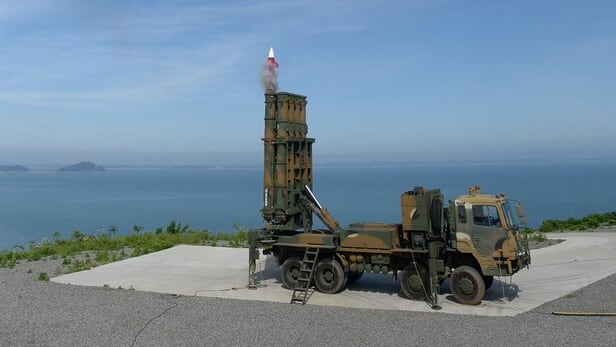
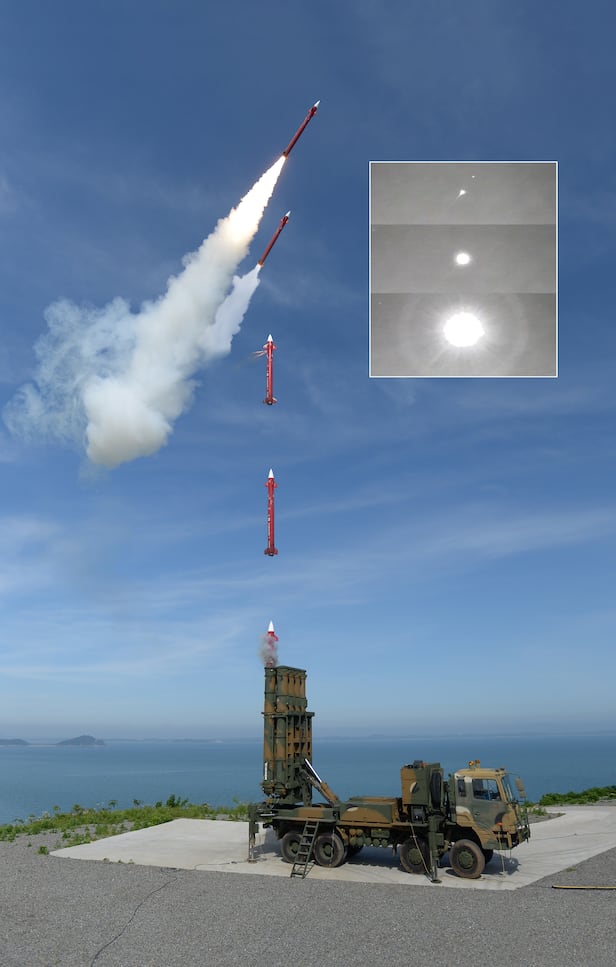
Cheongung II firing image. /Courtesy of LIG Nex1

The conflict between the two companies escalated last September when LIG Nex1 signed a comprehensive contract with Iraq for Cheongung II without consulting Hanwha Aerospace, among others, over pricing or delivery terms. As the dispute continued, a mediation meeting was arranged by the National Assembly in November of last year. It is reported that this meeting only reached an agreement on the overarching goal of successfully exporting to Iraq.

The leadership of the Iraq negotiations is also related to the long-range surface-to-air missile, L-SAM, which has export potential. In the development process of L-SAM, LIG Nex1 and Hanwha's defense affiliates participated in a structure similar to that of Cheongung II. Concerns arise that similar issues will continue to emerge if the conflict between the companies is not resolved amicably.

Currently, many countries in the Middle East are showing interest in Cheongung II and L-SAM II. The Defense Acquisition Program Administration, which has initiated the development of L-SAM II, hopes to expand exports of the Korean layered air defense network from Cheongung II to L-SAM II. A DAPA official stated, "Both sides have agreed to cooperate closely, and the government will play an appropriate mediating role."


TIDBIT FROM MARKZ , 15 MARCH

 MarkZ  

 [via PDK]  

In Iraq: “Parliament awaits the arrival of the 2025 budget” They still expect it mid-month…or by the end of the month. 

They are being vague on purpose. I believe they are hiding a number in it... In this budget they state they are going to “support the local currency” and the development road projects are also a part of it...Iraq is also having conversations as to if the HCL oil and gas laws will finally reach fruition in this session…or not.

The Future of the Iraqi Dinar Scenarios & Signals #iqd #dinarrevaluation

  Daily Iraqi dinar updates with insights from popular dinar gurus. Subscribe for more updates and breaking news. We are not a registered...