FIREFLY:The United States Treasury Secretary just arrived in Iraq and it's a meeting with Sudani and the CBI on the news...
Television is showing Alaq talking about an imminent launch of initiatives to give economic stability...
FRANK: Many American officials are going to Iraq. To see the new Secretary of Treasury join the CBI and Alaq and Sudani in his meeting is very big news...This is big. We have been waiting for this Secretary of Treasury to show up. I am excited to see what the results are after the meeting..
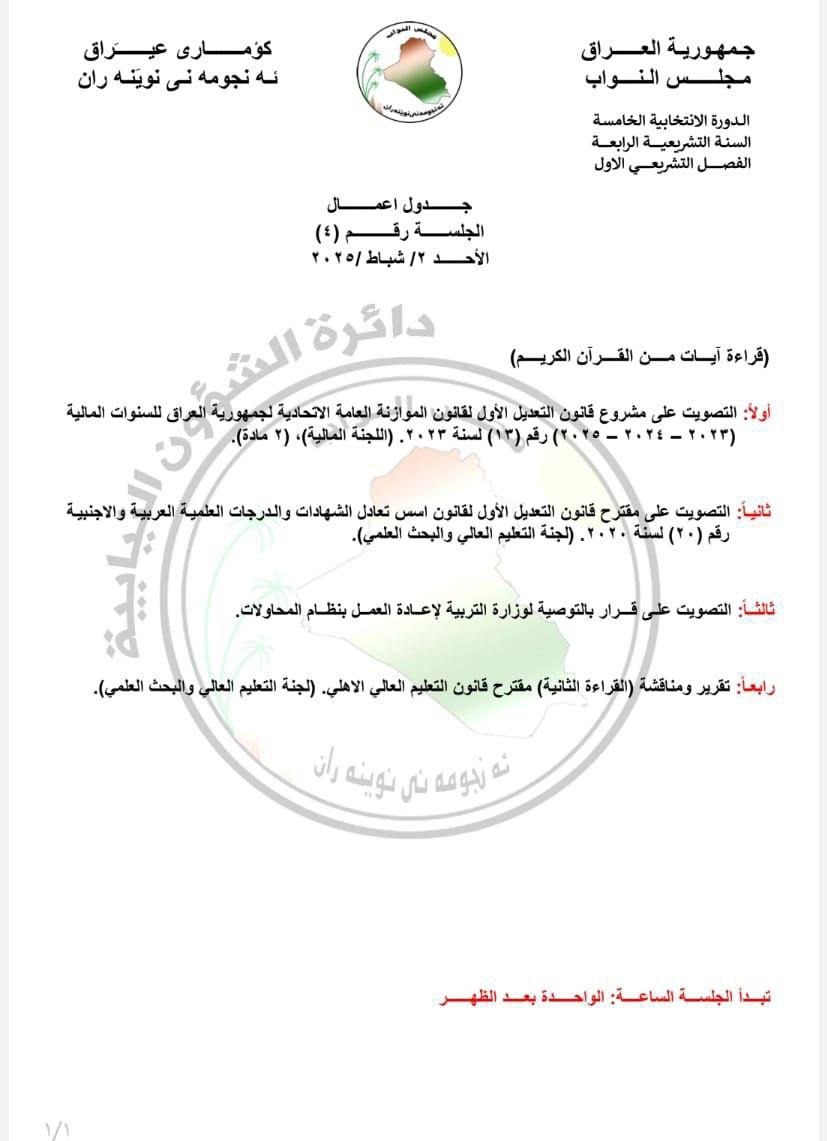
Shafak News / The media department of the House of Representatives published, on Thursday, the agenda of parliament for its next session on Sunday, and included a vote on the first amendment to the budget law. According to an informed source, the political blocs agreed to pass it as received from the government.
According to the agenda, which was reported to Shafax News Agency, next Sunday’s session included voting on the draft law on the first amendment to the federal budget law.
The session also includes voting on the proposed first amendment to the law of the principles of the equivalent of Arab and foreign degrees and scientific degrees, as well as voting on a decision recommending the Ministry of Education to re-work the system of attempts.
The last paragraph on the agenda, including the report and discussion of the “second reading”, the proposal of the Civil Higher Education Law.
It is noteworthy that the paragraph of the vote on the budget was included in more than one agenda of the parliament sessions during the past period, without voting on it, as a result of the differences that reached the stage of breaking the quorum of the session, because this paragraph was not passed.
An informed source told Shafaq News that “Prime Minister Mohammed Shia Al-Sudani and the heads of the political blocs agreed to approve the budget amendment in a session on Sunday, according to the latest proposal submitted by the government.”
According to the source, based on the agreement, “the presidency of the House of Representatives decided to include the paragraph in the agenda, and set on Sunday a date for the resumption of sessions and voting on the budget law.”
In this video, the speaker discusses significant developments in Iraq’s political and economic landscape, focusing on the strategic policies of Prime Minister Muhammad Shi Al Sudani’s administration.
The discussion highlights Iraq’s transition from a period of decline to a phase of leadership and innovation, particularly in energy and economic diversification. The speaker emphasizes the government’s commitment to moving away from a reliance on oil, promoting sustainable energy, and enhancing international relations.
Key initiatives include cooperation with the World Bank on strategic projects, the Central Bank’s role in financing industrial growth, and ongoing collaborations with American companies. As Iraq prepares for a more robust economic future, the upcoming amendments to the budget law are expected to play a crucial role in shaping the country’s financial landscape.
🌍 Qualitative Shift in Diplomacy: Iraq’s strategic policies signify a notable improvement in international and regional relations.
🛢️ Economic Diversification: The government aims to reduce reliance on oil through initiatives focused on renewable energy and non-oil revenues.
🤝 World Bank Cooperation: Discussions with the World Bank highlight potential financing for key infrastructure projects, including railways and energy links.
🏦 Central Bank Initiatives: The Central Bank is set to launch a major initiative aimed at financing industrial projects, contributing to economic growth.
🇺🇸 Strengthening US-Iraq Relations: Anticipated initiatives are expected to enhance the already growing relationship between Iraq and the United States.
🏗️
Infrastructure Development: The focus on infrastructure is designed to attract local and international investments, particularly in construction and manufacturing.
📈 Upcoming Budget Amendments: The Iraqi Parliament is set to discuss amendments to the budget law, seen as vital for economic stability and growth.
Key Insights
🌎 Strategic Diplomacy: The qualitative shift in Iraq’s diplomacy suggests a move from isolation to proactive engagement with international and regional partners. This reflects the government’s intent to reposition Iraq as a key player in the Middle East, enhancing its influence and fostering collaborative investments. The focus on diplomacy is not just about political ties but includes economic partnerships that can lead to sustainable development.
⚡ Energy Transition: Iraq’s commitment to transitioning to renewable energy sources is not only crucial for environmental sustainability but also for creating new industries and economic opportunities. The emphasis on sustainable energy aligns with global trends towards reducing carbon emissions and highlights Iraq’s potential as a regional energy hub, moving beyond traditional oil dependency.
💼 World Bank Engagement: The discussions with the World Bank underscore the importance of international financial institutions in Iraq’s development. By securing funding for strategic projects, the government is laying the groundwork for infrastructure improvements that can bolster economic activity and attract foreign investment. This partnership is essential for achieving long-term economic stability.
🏦 Central Bank’s Role: The Central Bank’s initiative to finance industrial projects demonstrates a proactive approach to economic development. By implementing unconventional monetary policies, it aims to stimulate the economy and support the growth of the industrial sector. This focus on financial stability is critical, as it provides the necessary foundation for broader economic reforms.
🇺🇸 Enhanced US-Iraq Relations: The anticipated financial initiatives signal a strengthening of ties between Iraq and the United States, particularly in sectors like energy and infrastructure. As American companies show increasing interest in Iraq, this relationship is likely to foster economic growth and stability in the region, with potential benefits for both parties.
🏗️ Investment in Infrastructure: Iraq’s focus on infrastructure development is pivotal for attracting both local and international investments. By improving its transportation and energy sectors, Iraq can not only enhance its economic prospects but also create jobs and reduce unemployment. The emphasis on construction and development aligns with the government’s broader economic strategy.
📊 Budget Law Amendments: The upcoming amendments to the budget law reflect a crucial moment in Iraq’s economic planning. By addressing the cost of oil production and ensuring that the budget aligns with national interests, these amendments are expected to have a significant impact on Iraq’s fiscal stability and economic growth trajectory. The involvement of various political factions in this process highlights the collaborative effort needed for effective governance.
Conclusion
The video sheds light on the transformative changes occurring in Iraq under Prime Minister Muhammad Shi Al Sudani’s leadership. With a clear focus on diversifying the economy, enhancing international relations, and investing in sustainable energy, Iraq is poised for a significant economic renaissance.
The discussions surrounding the World Bank cooperation, Central Bank initiatives, and amendments to the budget law all point towards a future where Iraq can harness its vast resources and strategic partnerships for sustainable development. As the country navigates through this critical phase, the coming weeks and months will be pivotal in shaping Iraq’s economic landscape and its role on the global stage.
The Ministry of Commerce will open next Saturday the activities of the Baghdad International Exhibition in its 48th session with the participation of 1000 local and foreign companies, for seven days, in conjunction with the launch of the activities of Baghdad, the Arab capital of tourism 2025.
The Director General of the Ministry’s Exhibitions and Commercial Services Company, Mustafa Nizar Al-Ani, said in a press statement that the exhibition, which will be held under the slogan (Development, Investment and Prosperity), and with the participation of 20 countries, will coincide with the launch of Baghdad, the Arab Tourism Capital 2025, under the patronage of Prime Minister Mohammed Shia Al-Sudani.
He pointed out that the local and foreign companies that will be present on the exhibition grounds, have reached 1000 companies, some of which have never participated in the exhibition, such as Tunisia, Russia and Lebanon, indicating that the two largest pavilions in the exhibition will be the Kingdom of Saudi Arabia, the Sultanate of Oman, which is the guest of honor, which participated in the largest pavilion of the current year with an area of 500 m2, while the gold sponsor of the exhibition will be the State of Qatar, as well as the preparation of two large halls concerned with Iraqi industries.
Al-Ani added that the international session of the exhibition will include several events, including seminars and international meetings between Iraq, Jordan, and other countries, and is a major economic event, noting that Iraq is witnessing major economic changes within the government program, pointing out that Iraq’s ambition is to attract large numbers of companies in the session, attract Arab and foreign investors, and contract for projects in various aspects.
He added that the exhibition will witness the hosting of the largest tourist pavilion of the Tourism Authority, with the participation of the public and private sectors, and the participation of numbers of travel and tourism companies in the capital, in celebration of Baghdad, the capital of Arab tourism, and the presentation of artistic and entertainment activities, and shows on the most important archaeological sites, Baghdad heritage alleys, displayed on large screens for visitors, and the presentation of roses to Arab delegations, gifts, shields and posters bearing the slogans of {Baghdad Sweet Sweet Sweets}, as well as gifts given to visitors of the exhibition.
The General Manager of Exhibitions and Commercial Services Company, also noted that the current session is different from the previous sessions by displaying the latest technologies and innovations from various sectors, including technological, industrial and commercial.
He pointed out that the Ministry of Commerce has completed its logistical preparations to rehabilitate the infrastructure of the exhibition, including decorating the gardens, rehabilitating green squares, streets and squares, stressing the application of new mechanisms for the entry of visitors, and the formation of teams to carry out decoration works according to the conditions of participation for each hall, with the companies continuing to erect their wings.
In a recent discussion about the ongoing turmoil in the Gaza Strip, former President Donald Trump expressed controversial views regarding the living conditions of Palestinians and potential solutions to the conflict.
He suggested the possibility of relocating a significant portion of the Palestinian population to other countries, such as Egypt, Lebanon, and Syria, in an effort to provide them with a more stable and comfortable life. The conversation sparked debate over the implications of such a relocation, especially considering the historical context of the Palestinian people and their longstanding connection to the land. While Trump emphasized the need for peace and stability in the Middle East, his proposals raised questions about the viability of a two-state solution and the rights of Palestinians to their homeland.
The dialogue reflects a complex interplay of historical grievances, national identities, and the search for effective conflict resolution in a region fraught with deeply rooted challenges.
🌍 Historical Context: Trump acknowledges the long-standing history of civilizations in the Gaza Strip and the persistent violence that has plagued the region.
🏠 Relocation Proposals: The suggestion to move Palestinians to neighboring countries sparked significant controversy and debate regarding their rights and connection to their homeland.
🤝 Peace Aspirations: Trump expresses a desire for peace in the Middle East, indicating that he is open to dialogue and negotiation with leaders in the region, including Israeli Prime Minister Benjamin Netanyahu.
🗣️ Feedback from Palestinian Leaders: The reactions from Palestinian representatives regarding potential relocation and peace initiatives are pivotal in shaping future discussions.
🌐 Public Sentiment: The video showcases a mix of opinions from the public and leaders, indicating a strong desire for a just solution rather than displacement.
✈️ International Responsibility: The conversation touches on the broader international responsibility in addressing the Palestinian plight, emphasizing that mere relocation is not a solution.
💬 Trump’s Support: The speaker expresses confidence in Trump’s ability to effect positive change in the region, reflecting a
segment of public opinion that sees him as a potential catalyst for peace.
Key Insights
🌏 Historical Complexity: The Gaza Strip has been a focal point of conflict for thousands of years, with many civilizations having a presence in the area. Trump’s acknowledgment of this history is significant because it frames the discussions around the current state of affairs, illustrating that the roots of the conflict are deep and multifaceted. Understanding this complexity is crucial for any effective resolution.
🚷 Displacement vs. Stability: Trump’s suggestion to relocate Palestinians raises critical ethical questions about displacement. While he aims for stability and comfort for the Palestinian people, forcibly moving individuals from their ancestral homes is not a viable solution. It highlights the moral dilemma of prioritizing stability over the right to self-determination and the preservation of cultural identity.
🕊️ Two-State Solution Viability: The conversation hints at the viability of the two-state solution, a long-standing proposal for resolving the Israel-Palestine conflict. Trump’s comments suggest a potential shift in focus away from this solution; however, the lack of clarity on how to achieve peace complicates the discourse. A true resolution must involve both parties agreeing to coexist peacefully within their respective states.
🌍 Regional Dynamics: The potential for Egypt, Lebanon, or Syria to absorb Palestinian refugees is laden with political implications. Each of these nations has its own internal challenges and may not be able to accommodate more refugees without significant social and economic strain. This aspect of the proposal reflects a misunderstanding of regional dynamics and the complex relationships between these nations.
🤝 Need for Dialogue: Trump’s willingness to meet with Netanyahu and his openness to discussions with Palestinian leaders signal a potential for renewed dialogue. This aspect is crucial for any peace process, as successful negotiations require an understanding of the perspectives and needs of all parties involved.
📣 Public Sentiment and Leadership
: The expressed confidence in Trump from the speaker indicates a segment of the population that believes in his potential to create meaningful change. This public sentiment can influence political strategies and initiatives, but it also underscores the importance of leadership that genuinely seeks to address the root causes of conflict rather than superficial solutions.
🔄 Global Responsibility: The dialogue emphasizes the global community’s role in addressing the Palestinian situation. The international community must engage in proactive measures to ensure the rights of Palestinians are respected and upheld, recognizing that solutions must come from a place of understanding and respect for historical grievances rather than unilateral decisions.
In conclusion, the discussion surrounding Trump’s comments on Gaza and the Palestinian people reveals a complex tapestry of historical context, ethical considerations, and aspirations for peace. It highlights the need for thoughtful dialogue that respects the rights and identities of all involved while seeking to forge a path toward a stable and just resolution to one of the world’s most enduring conflicts. The conversations around such topics must transcend simplistic solutions, recognizing the depth of feelings and stakes at play for millions of people.