They put two different articles... states two different things...They said they were going end the use of the dollar and the currency auctions by January 2nd.
I don't think that information is credible because the second article stated going into early 2025 is when they would be suspending use of the dollar/currency auctions. That makes more sense because the daily currency auctions are a tool used by the central bank to stabilize the daily market value of the dinar...They'll more realistically stop somewhere in early 2025..
In this video, the host discusses significant economic developments in Iraq, particularly concerning the Central Bank’s currency policies and the broader economic strategy leading into 2025.
The Central Bank of Iraq is set to end currency auctions and the use of an electronic platform for currency transfers, marking a pivotal shift in its monetary policy.
While initial reports indicated that these changes would take effect on January 2, 2025, recent updates suggest that currency auctions will continue into early 2025, with a remittance auction scheduled for January 7. The host emphasizes the importance of these changes as prerequisites for potential rate adjustments, which are necessary for Iraq’s economic revitalization.
Additionally, the video highlights Iraq’s plans to establish a Sovereign Wealth Fund aimed at bolstering economic growth through export-oriented strategies and domestic production. The host also covers various economic indicators, including a reported increase in budget revenues, primarily driven by oil, and ongoing infrastructure projects. The video concludes with an overview of political developments, including delayed legislative sessions due to economic uncertainty, and future collaborations with international partners like Japan.
📈 Currency Auctions Transition: The Central Bank of Iraq will end currency auctions, with ongoing auctions extending into early 2025.
🏦 Sovereign Wealth Fund Vision: Plans unveiled for a Sovereign Wealth Fund to drive economic growth through export-oriented strategies
.
🌍 Infrastructure Development: Iraq is preparing to present major infrastructure projects to international investors.
📊 Oil Revenue Dominance: Oil revenues accounted for 88% of Iraq’s budget, highlighting the economy’s dependence on oil.
⚡ Electricity Expansion: Completion of 90% of the electrical interconnection project aims to enhance electricity supply by summer 2025.
📅 Legislative Delays: Critical laws are pending due to the delay in parliamentary sessions since September 2023, awaiting currency rate changes.
🤝 International Relations: Discussions are underway with Japan to strengthen ties and learn from their governance experience.
Key Insights
🔄 Currency Policy Changes as Economic Indicators: The decision to end currency auctions signals a broader shift in Iraq’s economic policy, reflecting an intention to stabilize the currency and potentially increase its value. The continuation of auctions until early 2025 suggests a transition period where adjustments may take place gradually, allowing stakeholders time to adapt.
🌱 Importance of Sovereign Wealth Fund: Establishing a Sovereign Wealth Fund is crucial for Iraq’s economic future. This fund is expected to manage national wealth and invest in sectors that can diversify the economy away from oil dependency, promoting sustainable growth and enhancing economic resilience.
🚧 Infrastructure Projects for Economic Growth: The development road project is a strategic move to attract foreign investment and improve the country’s infrastructure. This is essential for facilitating trade and increasing Iraq’s competitiveness in the global market, which is especially relevant as the country seeks to rebuild and develop its economy post-conflict.
📉 Budget Reliance on Oil Revenues: The heavy reliance on oil revenues underscores the vulnerabilities of Iraq’s economy. While oil revenues have provided significant funding, the slight decrease in their contribution indicates a need for diversification. Strategies focusing on increasing non-oil revenues could mitigate risks associated with fluctuating oil prices.
⚡ Enhanced Electricity Supply for Future Development: The near completion of the electrical interconnection project is vital for supporting industrial growth and meeting the energy demands of a growing economy. Improved electricity access will facilitate operations for businesses and encourage investment, making it a key component of economic development.
📆 Legislative Gridlock and Economic Reform: The prolonged delay in parliamentary sessions due to currency rate changes highlights the interconnectedness of political stability and economic reform. The inability to pass critical laws may hinder progress in implementing necessary economic changes, reflecting the urgency for a stable legislative environment.
🌐 International Collaboration as a Growth Strategy: Iraq’s pursuit of international partnerships, such as with Japan, signals an openness to learning from successful governance models. This collaboration could enhance Iraq’s institutional frameworks and promote transparency, thereby building investor confidence and encouraging economic participation.
In conclusion, the video encapsulates a transformative period for Iraq as it navigates crucial economic and political changes. The Central Bank’s decisions regarding currency auctions and the establishment of a Sovereign Wealth Fund are pivotal steps toward revitalizing the economy. The emphasis on infrastructure development and international partnerships reflects a strategic approach to ensuring long-term growth and stability. However, significant challenges remain, particularly the need to diversify the economy and improve legislative processes to facilitate necessary reforms. As Iraq looks toward early 2025, the unfolding developments in its economic landscape will be critical to watch.
The financial adviser to the Prime Minister, Mazhar Mohamed Saleh, confirmed on Thursday that the future of the country will depend on the transformation of natural resources into productive capitalist assets, while the project of renaisssing natural resources will come in parallel with the strategy of the path of development.
Saleh said in a statement reported by the official news agency, and seen by “Economy News”, “Iraq ranked ninth globally in the value of its stocks of natural wealth, which exceeds the current market value of 16 trillion dollars, at a time when it ranks first globally in the concentration of natural resources in one square kilometer,” pointing out that “the features of the future of the country in a comprehensive renaissance will depend on the transformation of those natural sovereign wealth into productive capital assets used in the movement of diversification of the national economy.”
He added: “This requires an economic model in managing and investing in diversified wealth (except oil and gas),” pointing out that “the closest thing to mind is the manufacture of industrializable natural resources to generate value-added chains that maximize national income and generate accelerated opportunities for sustainable development in our country, whether towards export or export replacement.”
He pointed out that “the project of renaissance with natural resources will undoubtedly come in parallel with the strategy of the development path in generating a leading industrial renaissance in the national economy, which Iraq is characterized in building the future of its economy for the twenty-first century in two directions: the first is an export-oriented development model, and the other is a development model aimed at maximizing input and output tables and replacing imports within the national economy.
He explained that “the national market is in the stage of formation and development, and that the strategy of the government program is approaching the philosophy of partnership through the concept of the social market, because the country’s contribution to the GDP (national income) is close to 65%, and this requires an important role for the state in economic legislation and laws.
Saleh pointed out that “improving the entity of the national market and building its role starts from two directions: the first is to provide market guarantees by approving the social security law for the labor and business sector, and the second is the financing partnership by providing easy financing to the forces generating market activity responsible for absorbing 60% of the labor force,” pointing out that “the beginning in the Riyada program led by Prime Minister, Mohammed Shia Al-Sudani, by providing the necessary financing to employ youth with productive national projects, as well as preparing to launch Riyada Bank for the same purpose without overlooking the great role of the Iraq Fund for Development.”
He continued: “In 2037, Iraq will become one of the nations of a housing gift, as young people of working age will dominate 60% of the population,” adding that “the national strategy for the private sector will increase the contribution of the private sector to more than 53% in GDP within the next ten years.”
Saleh concluded that “my message for the Iraqi people is to take out of the concerns of fear of worrying about the unilateralism of the current oil economy and the link between this to the consumption cycle, which we live as part of its well-beings, and to look forward to a future productive era, the era of the investment economy with Iraq’s enormous material and human wealth, which is the diverse era of digital material production and connected to the global economy and with the arm of the path of development, investment in natural resources and the diversification of production networks in the national economy that guarantee human well-being and the sustainability of its development in our country.”
The Iraqi Dinar revaluation is for the "The New Republic". This is why D. Trump doesn't have to be sworn in by congress in the traditional sense if they refuse. Because the answer to that will be "The Brunson Case".
Under common law he is no longer running for president of the defunct 1871 US Corp Act that we are no longer under since July 4th 2020.
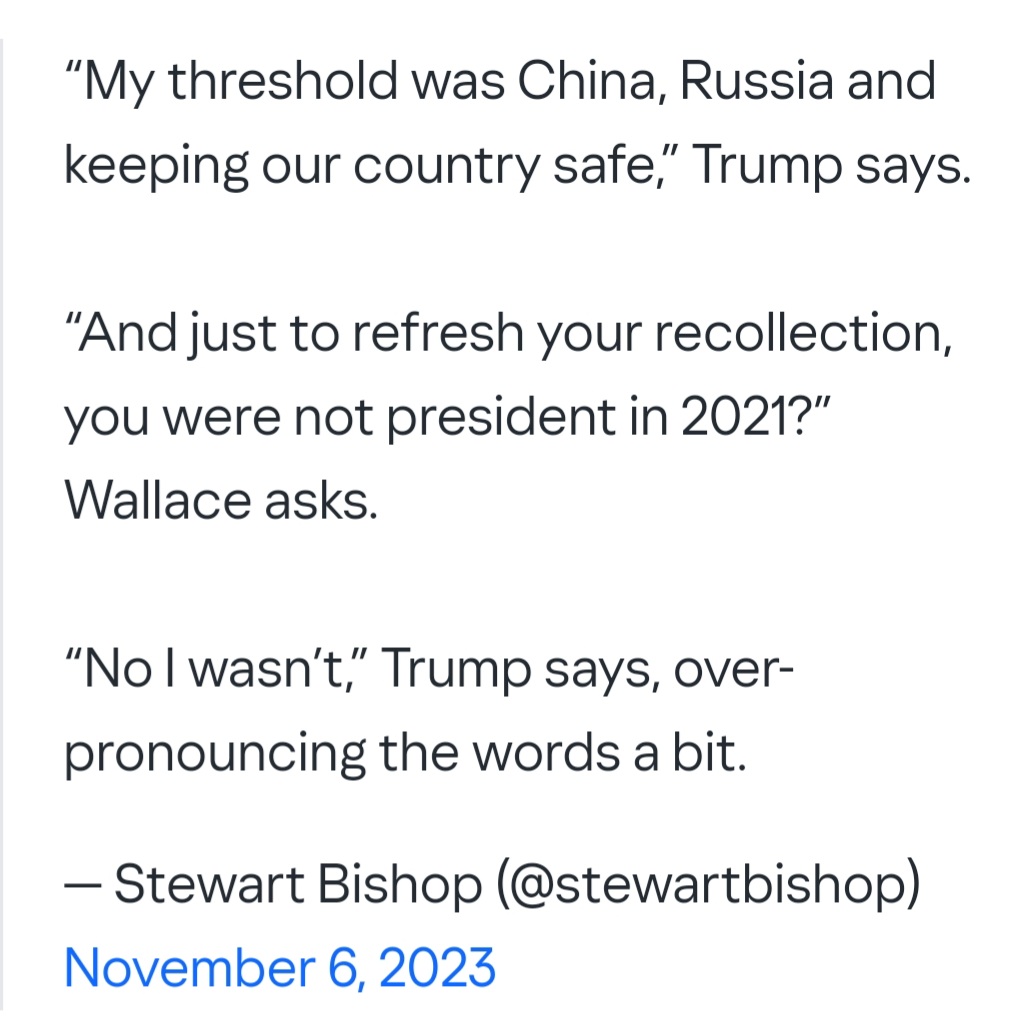
This is why he said under oath in court that he was not president in the last days of 2021 leading up to Joe Biden inauguration.
The general public has no clue about this. This is why people are skeptical about the Iraqi Dinar. They are not looking at this as a opportunity for the country of Iraq and the world to remove itself from the Rothschilds banking system permanently.
So this will be "The Trump Card".
Once the revaluation initiates we will be officially on the other side of a world model that will be no longer under control of the Deep State banking Cartel. This is why things will happen very fast.
Why do you think Donald Trump already has a celebration planned starting in May this year? People are thinking way too small when it comes to this currency revaluation.
https://yahoo.com/news/trump-forgets-years-president-while-235023431.html
…