Wednesday, December 4, 2024

AFTER YEARS OF SUSPENSION… IS THERE NO NEED TO LEGISLATE THE “OIL AND GAS LAW”? WITH MNT GOAT COMMENTS, 4 DEC

 AFTER YEARS OF SUSPENSION… IS THERE NO NEED TO LEGISLATE THE “OIL AND GAS LAW”?

(Mnt Goat-Of course the author is wrong in this opinion. Yes there is still a need. This is not me saying this, instead it is the constitution of the countless articles we have read over the years, especially more recent ones. 

The Oil and Gas Law referendum is REQUIRED by the Iraqi constitution and they can not just disregard it, if they want to. They must pass the law in parliament.)

Political conflicts are escalating in Iraq, casting a shadow over the two-decade-old oil and gas law, disrupting efforts to regulate the exploitation of oil wealth and its distribution between the region and the central government.

In this context, the member of the Patriotic Union of Kurdistan, Ghiath Al-Surji, explained today, Wednesday, the reasons for not legislating the oil and gas law, noting that the need to legislate such a law has disappeared, especially after the issuance of judicial decisions regarding the oil and exports file.

Since the first session of the Iraqi Council of Representatives in 2005, the draft oil and gas law has remained in the drawers, as disagreements prevent its approval in its final form. Despite the passage of more than two decades since the fall of the former Iraqi regime in 2003, the most important law concerning the restructuring of the Iraqi economy has not actually seen the light of day, and the concerned parties, whether the federal government, the Kurdistan Regional Government, or the oil-producing provinces, have not reached a final agreement.

Al-Surji said in a statement followed by “Al-Alam Al-Jadeed”, “The region was waiting for the legislation of the oil and gas law to resolve all the problems related to this wealth between Baghdad and Erbil, but today the situation is different after the issuance of a judicial decision by the Paris Court to stop the export of oil from Kurdistan to Türkiye.”

He added, “The international judicial decision, in addition to the Federal Court decision, stipulated that the oil would be owned by everyone, meaning that the authority over this wealth would be in the hands of the federal government in Baghdad.”

He explained that “the judicial decision two years ago obliged the region not to export oil to Turkey and made the authority over it under the supervision of Baghdad, so the issue of oil and gas and the legislation of the law related to it will be unnecessary, especially since the judicial decision made the oil revenues under the authority and supervision of Baghdad.”

This disruption raises fears of continued disputes that threaten the stability of the Iraqi economy and keep the oil wealth file in the circle of political tensions.

On November 18, the acting Minister of Natural Resources in the Kurdistan Regional Government, Kamal Mohammed, set the beginning of next year as the date for resuming oil exports from Kurdistan via the Turkish port of Ceyhan.

On November 15, MP Ali Al-Mashkoor, a member of the Parliamentary Oil and Gas Committee, attributed the delay in approving the Oil and Gas Law to points of contention behind which the Kurdistan Region stands.

On November 5, the Iraqi Council of Ministers approved a proposal to amend Article (12/Second/C) of the Triennial Budget Law No. (13 of 2023), which stipulates the delivery of oil from the Kurdistan Region of Iraq to the state-owned Oil Marketing Company (SOMO).

It is noteworthy that the Oil and Gas Law has undergone 11 amendments and has never reached Parliament.

(Mnt Goat -This statement is NOT true. I have an article telling us that the Oil and Gas law did its first reading in parliament and kicked back to the Al-Sadani’s cabinet for revisions. This is where it now lies awaiting agreements on those changes so they can resend back to parliament for a second reading.)

Iraq’s oil and gas law, which has been awaiting legislation since 2005 , stipulates that responsibility for managing the country’s oil fields should be vested in a national oil company, overseen by a federal council specializing in this matter.

The Kurdistan Oil Law stipulates that the Ministry of Oil in the region or whoever it authorizes shall assume responsibility for organizing and supervising oil operations as well as all activities related to them, including marketing oil, as well as negotiating and concluding agreements and implementing all licenses, including oil contracts concluded by the regional government. The Iraqi government also has the right to participate in the management of fields discovered before 2005, but fields discovered after that are subject to the regional government.

On February 21, the Federal Supreme Court ruled that the federal government would be responsible for paying the salaries of Erbil government civil servants, with the amount paid at source in Baghdad deducted from the KRG’s share, and the KRG must submit monthly accounts detailing each salary paid. This is effectively a stricter reset of the original “budget payments for oil revenues” deal agreed between the KRG and the federal government in November 2014.

There are no government statistics on oil exported from the Kurdistan Region, but the Iraqi Oil Ministry published an analysis in May 2023, saying the regional government had committed “legal and procedural violations” in selling oil that caused significant losses.

The financial returns of the regional government constitute no more than 80 percent on average after deducting the production costs (the cost of producing a barrel of oil), while the financial returns of the first and second licensing rounds (held by Baghdad) constitute from 94.5 percent to 96.5 percent, and the cost of production is equivalent to (4) times the production costs in the licensing rounds of the federal Ministry of Oil. According to the Ministry of Oil

Iraq exports an average of 3.3 million barrels of crude oil per day, and black gold constitutes more than 90 percent of the Iraqi treasury’s resources.

In August 2023, the government formed a committee to draft the oil and gas law and present it to the government for voting and then passing it to the House of Representatives. The committee included the Minister of Oil, the Minister of Natural Resources in the Kurdistan Region, the Director General of SOMO, and senior staff in the Federal Ministry of Oil, in addition to the producing governorates such as Basra, Dhi Qar, Maysan, and Kirkuk.

For years, the points of contention between Baghdad and Erbil have not been resolved, but Al-Sudani recently revealed that an agreement had been reached with Erbil on these points, in addition to including in his ministerial program the resolution of these items, most notably the enactment of the Oil and Gas Law and the implementation of Article 140 regarding the disputed areas.

In mid-February 2022, the Federal Court issued a decision declaring the Kurdistan Region’s oil and gas law unconstitutional, and prevented it from exporting oil for its own benefit, with the export to be through Baghdad exclusively, based on a lawsuit filed by the federal Ministry of Oil.
MAJEED: " So they have to fulfill what they promised within two weeks" , 4 DEC

 MAJEDD

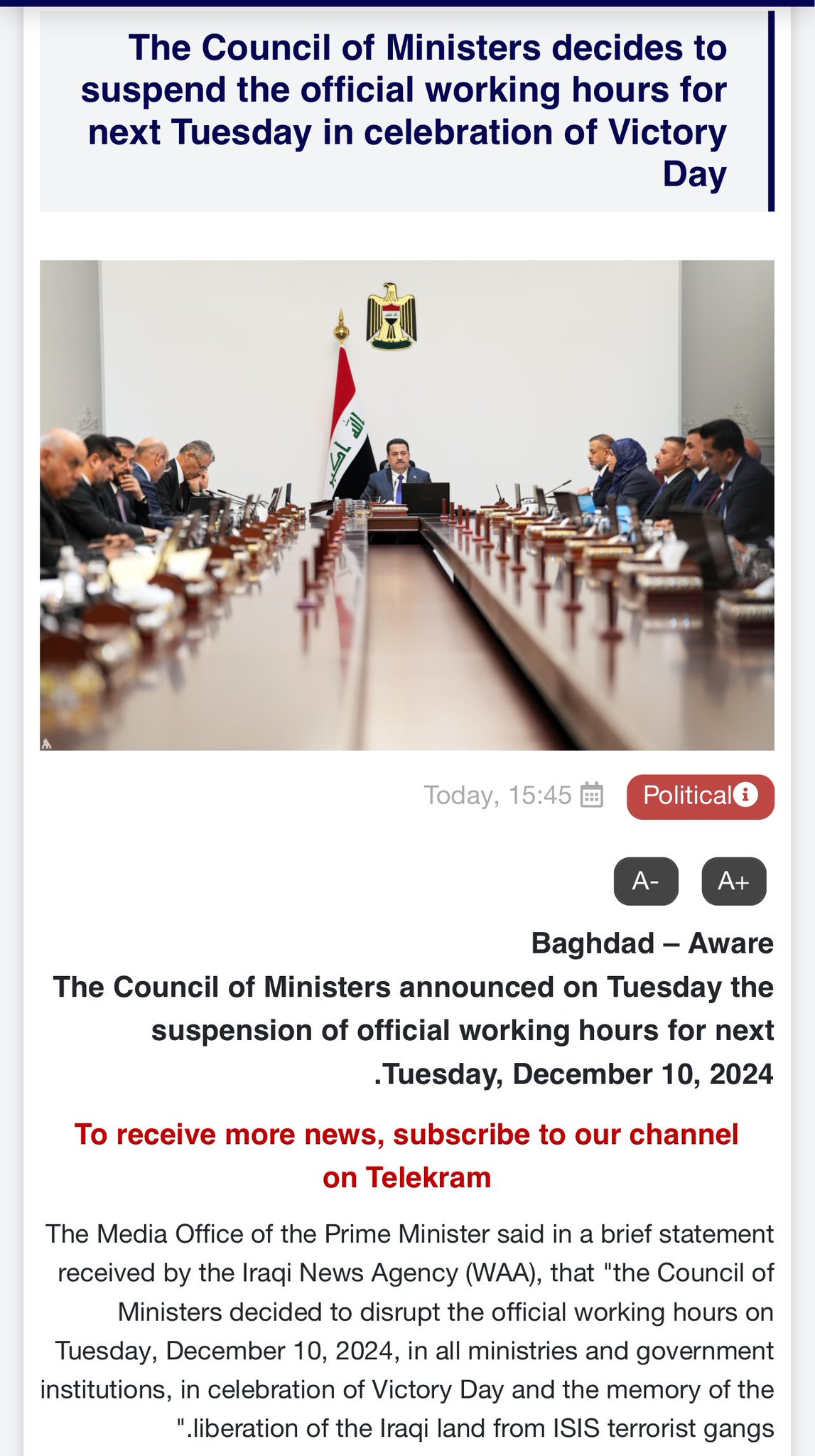
The council of ministers decided to cancel the working hours of next Tuesday for the celebration of victory day Last Monday Iraq said : we will complete everything in the monetary system & launching system for soft loans for investors within two weeks. The monetary reform is done 100% Launching system four soft loans for investors needs a new rate because these loans will come from 2025 budget So they have to fulfill what they promised within two weeks


Image

Historic Dinar Revaluation Confirmed by Trump! 🎉 @DINARREVALUATION #iraqidinar #iraqidinarinvestor


IRAQ SIGNS CONTRACT WITH ITALIAN CONSULTING FIRM ON FIRST PHASE OF DEVELOPMENT ROAD, 4 DEC

 IRAQ SIGNS CONTRACT WITH ITALIAN CONSULTING FIRM ON FIRST PHASE OF DEVELOPMENT ROAD

The Ministry of Transport announced today, Wednesday, the signing of a consulting contract with BTP Company, to provide consulting services regarding the first phase of the Development Road Project (regarding the current railways).

A statement by the Ministry’s media office stated that the consulting services contract for the first phase of the development road project was signed between the Iraqi General Railways Company and the Italian company BTP. 

The statement added that the first phase of the project includes preparing a technical and economic feasibility study and design work to rehabilitate, modernize and develop the current national railway network. 

The statement indicated that this vital project is funded by the investment plan for 2024 and according to the directives of the Council of Ministers, to be a strategic line ready for the safe transport of incoming cargo via railway lines, from the Grand Faw Port, which the ministry intends to operate in its first phase during the coming year.

It is noteworthy that Prime Minister Mohammed Shia Al-Sudani recently chaired a meeting with a delegation from the consulting company for the Development Road Project, to discuss the economic model for the project, in the presence of the Minister of Transport, Mr. Razzaq Muhaibis Al-Saadawi. 

During the past two days, the excavation and connection works of the immersed tunnel manufacturing basin with the Khor Al Zubair Canal were completed, in preparation for floating the ten concrete pieces that make up the tunnel in the navigation canal.

The completion of the road linking Faw Port to Safwan City via the immersed tunnel will soon begin, then it will enter through two bridges, as the completion rate of the first bridge has reached 98%, and the second 96%. While the completion rate of the quay structures for the container terminal has reached 100%, and the road linking Faw and Umm Qasr ports 92.43%, with increasing completion rates in the immersed tunnel, and the completion rate in the first phase of marine excavation and backfilling works has reached 79.33%. As for the navigation channel of the Grand Faw Port, the completion rate has reached 77.41%, and the completion rate in the port components is 81%, and in the container yard 88.

MNT GOAT : "Sounds to me like yet another conspiracy exposed" , 4 DEC

 MNT GOAT

😊 Next I want to review the article titled “MP ACCUSES FORMER IRAQI CENTRAL BANK EMPLOYEE OF BEING BEHIND US SANCTIONS”. Over the weekend on Sunday, the Parliamentary Integrity Committee accused a former employee of the Central Bank of being behind the banking sanctions imposed on some Iraqi banks by the US Federal Reserve. 

As we know, the number of banks sanctioned is 32 out of 72 banks operating in Iraq.  Oh…. what amazing news! This is “WOW!” News for today. But why do I consider this WOW! news? 

A member of the Parliamentary Integrity Committee, Vian Dakhil, said in a statement received by (Kalima) and I quote “that a former employee of the Central Bank hid the emails received from the Federal Bank, JP Morgan and Citibank to inquire about some issues related to the bank’s work”.

  Sounds to me like yet another conspiracy exposed. Think about it. This issue has caused the price of the dollar on the black market to rise and fluctuate over and over again from the official CBI rate since the demand for the dollar out paces the supply. 

The IMF made it clear that the CBI must be able to control the official rate for a minimum of 90 days to consider it STABLE. Have they done this? Are they able to do this? What is a major factor in not being able to do this? Was it taking the dollars from these 32 banks and creating a shortage of dollars? Just look at the delay in the Project to Delete the Zeros also due to this conspiracy?

The author adds that failure to respond to these issues of the corruption with the dollar led to some banks being punished, stressing that most banks do not know the reason for the penalties imposed on them.

 On the other hand, economic expert Mustafa Akram Hantoush said that the statements of the members of the Parliamentary Integrity Committee are closer to reality than the statements of the Central Bank of Iraq. 

He added that the collapse of the Iraqi banking system and the punishment of 32 Iraqi banks without any clear charges during a period of (a year and a half) is not normal and from the banking work perspective this may be the first incident of this kind in the world. 

Hantoush pointed out that the worst thing is the lack of serious solutions from the Central Bank of Iraq to this situation, but rather the move towards cancelling the (Fitr) platform by the end of 2024 and handing over the dollar file to banks affiliated with foreign investors and banks (Jordanian and Gulf), according to Shafak News.

Hantoush wondered whether the Central Bank of Iraq knows that by not finding solutions for the Iraqi banking sector, it will fire the mercy bullet at the entire Iraqi banking system and it will be punished as a whole, which will lay off nearly (100) thousand workers in the Iraqi private banking sector for the benefit of Jordan and the Gulf States, and why are Iraqi banks not guaranteed to open an account for them in the correspondent banks in dollars (Citibank / JP Morgan) like the countries of the region did.

He continued, “Why has the mechanism for cooperation and auditing with Ernst & Young regarding transfers in currencies other than the dollar not yet been determined and announced?” I assure everyone that I also checked on the information on this article with my CBI contact. 

Yes, the CBI did know about the conspiracy and wanted to begin the process to transfer the currency auctions to the correspondent banks. In another article from today’s news (see above) we also read and I quote “that Al-Alaq  announced the Central Bank’s success in implementing the transition plan for “foreign transfers, in line with international practices and standards, and that it is currently taking place smoothly and transparently – especially covering imports at the official exchange rate”. It is currently taking place smoothly and transparently? Really? 

Al-Alaq also told us the CBI is using unconventional financial practices to implement these financial reforms. In my past Newsletter I already explained why the CBI is going this and we can now clearly see yet more at to why in this article. 

In short, the CBI must conduct breakthroughs in the financial reforms, even it means many GOI, economists or even parliamentary officials not fully understanding these unconventional moves. The push is on. How many times has the Finance Committee or Parliament interviewed the Al-Alaq over his decisions to manage the monetary policy of Iraq? 

I believe strongly that Al-Alaq knows that if he is guided by conventional practices alone and doesn’t not take some risks in spite of being criticized by his peers, it will be decades longer in finally realizing the dream of the dinar. Let me give you one example of what I mean by the actions of Al-Alaq in handling foreign transfers. Read the next article.

https://mntgoatnewsusa.com/latest-mnt-goat-newsletter/

ARIEL & REINALDO JC : When that 3.50/0.285 pops up on the Forex market I will be posting it


TRADE BANK OF IRAQ EXPLAINS THE REASON FOR STOPPING ATMS, 4 DEC

 TRADE BANK OF IRAQ EXPLAINS THE REASON FOR STOPPING ATMS

  The Trade Bank of Iraq (TBI) denied, in a statement received by {Euphrates News}, a copy of it: “The stoppage of one of the ATMs.”

He stressed that “what sometimes happens is a temporary interruption in the Internet service, which is then reconnected moments later.” Trade Bank of Iraq (TBI) explains the reasons for the stoppage of one of the ATMs


(Folks this happens all the time in my country. ATM machines are not infallible and do break down or need to filled with more currency from time to time. They need down time. I can see there was a knee jerk reaction to this situation that got out of hand. This article is just clarifying the situation and should also mean something to my readers too not to listen to the hyped up news.)

The Trade Bank of Iraq (TBI) denied the validity of what was circulated about the stoppage of one of the ATMs, explaining that what sometimes happens is a temporary interruption in the Internet service that is reconnected moments later.

The bank’s media advisor, Aqil Al-Shuwaili, explained in a statement: “The bank has not recorded any permanent stoppage of the ATMs,” noting that “momentary interruptions occur due to weak Internet connection, which is common in ATMs in all countries of the world due to technical problems in the communications networks.”

He pointed out that “the message appearing in the ATM confirms that the ATM has stopped due to weak network and momentary disconnection,” noting that “the bank owns 357 ATMs, including 140 distributed in commercial places, 40 in branches, in addition to 180 in the capital, Baghdad, while the rest of the devices were distributed to all governorates of Iraq.”

He explained: “The bank has a specialized maintenance team to deal with electronic or mechanical malfunctions immediately, in addition to providing the customer service number attached to each bank card, where customer inquiries are received 24 hours a day.”