🚨 Iraq is drawing a clear line: Prime Minister Ali al-Zaidi has rejected any proposal to keep US-led international coalition forces in the country after September 30, 2026.
🗓️ October 1, 2026 is being described by Baghdad as the beginning of a new era of full Iraqi sovereignty, with no foreign military presence.
🇺🇸 The withdrawal does not mean the end of cooperation with the United States. Iraq says future relations will focus on security cooperation, economic ties and specialized training based on mutual respect.
🔫 This is also highly significant for the ongoing debate over Iraq’s armed factions. Once foreign troops leave, one of the main arguments used by Iran-aligned factions for maintaining independent weapons becomes much weaker.
🎯 The key question: Will the end of the foreign military mission make it easier for Al-Zaidi to bring all weapons under state authority—or will the factions demand new conditions?
⚠️ September 30 → October 1 could become a major turning point for Iraq.
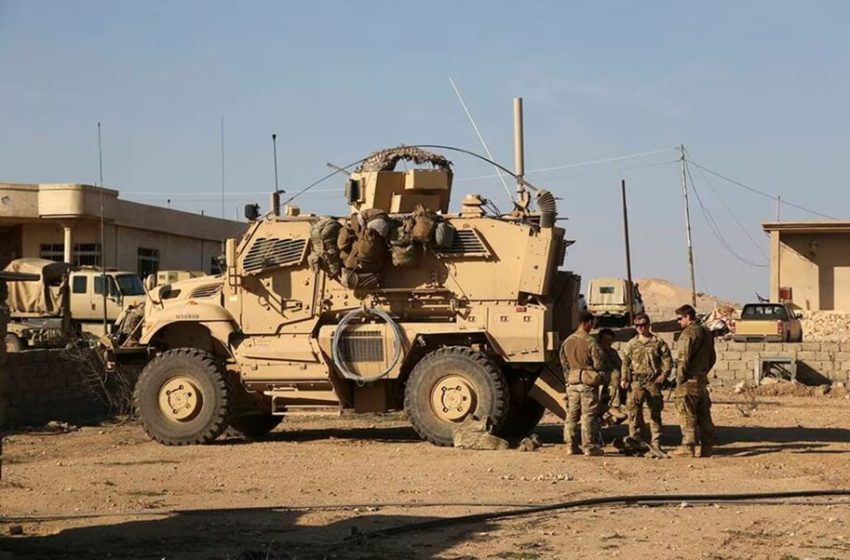
US Army soldiers stand outside their armored vehicle on a joint base with Iraqi army south of Mosul, Iraq. Photo: Khalid Mohammed/AP
Baghdad (IraqiNews.com) – Iraqi Prime Minister Ali al-Zaidi has publicly rejected a plan to keep any US-led international coalition forces in Iraq after the September 30, 2026, deadline.
The spokesperson for the Iraqi government, Haider al-Aboudi, said during a press briefing that Baghdad remains strictly committed to the conclusion of the foreign military mission in the country, the state-run Iraqi News Agency (INA) reported.
Al-Zaidi said earlier that October 1, 2026, will mark a new day in Iraq’s statehood when the country achieves complete sovereignty free of foreign troops.
The military mission of the international coalition will expire on September 30, 2026, and the decision is final and irreversible, according to al-Zaidi.
The prime minister underscored that October 1 will bring in a new period of total Iraqi independence and full territorial sovereignty, with no foreign military presence.
Iraq’s future interactions with the international coalition’s member states will focus on direct security, economic, and specialized training cooperation based on mutual respect.
The international coalition was first formed in 2014 to combat the emergence of the terrorist group ISIS.
After Iraq declared military victory over ISIS in 2017, international coalition forces continued to provide advice and training services at Baghdad’s request.
The official withdrawal of the international coalition follows a bilateral arrangement agreed upon by Baghdad and Washington.
Amanj Raheem, Secretary of the KRG Council of Ministers, emphasized that while ASYCUDA implementation is critical to boosting transparency and non-oil revenues, delays at border crossings have caused Kurdistan's transit income to plummet by 78% since March 2026, according to CBI data.
🇮🇶🚨 ASYCUDA: ANOTHER PIECE OF IRAQ’S ECONOMIC PUZZLE? 💰💱
📰 NEWS SUMMARY
Iraqi Kurdistan is moving toward implementing ASYCUDA, a digital customs management system designed to modernize and improve transparency at border crossings.
Talks between Erbil and Baghdad are reportedly focused on issues including:
🔹 Customs revenue sharing 🔹 Trade exemptions 🔹 Border-crossing control 🔹 Integration of customs systems
The goal is to improve transparency, reduce revenue leakage, and increase Iraq’s non-oil revenues.
🔎 DEEPER ANALYSIS
And this is where things become interesting for those watching Iraq’s economic and monetary reforms. 👀🇮🇶
ASYCUDA does NOT automatically mean the CBI is preparing to revalue the dinar. ❌💵
But it can be viewed as one of the economic infrastructure pieces Iraq needs to move toward a more formalized, transparent, and integrated economy.
Why?
Because a major monetary reform does not happen in isolation.
Iraq needs to strengthen several areas first:
🏦 Banking infrastructure 💰 Non-oil revenues 🧾 Tax and customs administration 🌐 International trade 💵 The foreign-exchange market 📊 Financial transparency 🇮🇶 State economic control
And ASYCUDA fits directly into that broader architecture.
Digital customs systems give the government better visibility over trade flows and the revenues generated at border crossings.
That means greater control, improved collection, and stronger economic formalization.
💱 SO WHAT DOES THIS HAVE TO DO WITH THE DINAR?
This is where we need to be very clear.
We cannot say:
“ASYCUDA = RV.” ❌
The more accurate connection is:
ASYCUDA → stronger economic control → greater transparency → stronger fiscal position → greater financial integration → better conditions for future monetary reforms. 📈🇮🇶
In other words, ASYCUDA could be part of the process, not necessarily the final event.
And this matters because Iraq has been working for years on an economic transformation that goes far beyond the exchange rate.
The bigger question is not simply:
💵 “When will the dinar change value?”
It is:
🇮🇶 “Is Iraq building the economic conditions necessary to support and sustain major monetary reform?”
ASYCUDA is one piece of that puzzle.
Not the final piece.
But definitely a piece worth watching. 👀
🇮🇶 THE BIGGER PICTURE
When we look at ASYCUDA alongside banking reforms, efforts to reduce the parallel market, financial-system modernization, and the expansion of non-oil revenues, we begin to see a much bigger picture.
Iraq doesn't simply need a new number for its currency.
It needs an economy capable of supporting and sustaining whatever major monetary reform comes next.
⏳ That's why every step in Iraq's economic infrastructure deserves attention.
Because before we focus only on the number attached to the dinar, perhaps we should first look at the entire system being built behind that number. 🇮🇶💱
📢 Valthor claims that between September 5 and September 7, 2026, a massive release of funds connected to the so-called Tier 4B will take place as part of an alleged global currency revaluation and transition toward a Quantum Financial System (QFS).
💵 According to the information circulating, 847 billion Tier 4B accounts would be unlocked, with funds ranging from $100,000 to $50 million per account
.
💱 Reported currency revaluation rates:
🇮🇶 Iraqi Dinar: $3.22 per IQD 🇻🇳 Vietnamese Dong: $0.47 per VND 🇿🇼 Zimbabwe Dollar: $15.00 per ZWL 🇰🇼 Kuwaiti Dinar: $4.18 per KWD
📅 Reported timeline:
🔹 Sept. 5–7: Asset transfers 🔹 Sept. 8: Alleged closure of the old banking system 🔹 Sept. 10: Alleged full operation of the QFS
⚠️ IMPORTANT: These claims are part of the GCR/QFS narrative and have not been officially confirmed by the U.S. Treasury, Federal Reserve, Pentagon, IMF, or other recognized international financial institutions.
🔎 At this time, this should be treated as unverified information, not an official financial announcement.
🇮🇶💵 IRAQ’S SMALL-BANKNOTE SHORTAGE: A NECESSARY STEP BEFORE “DELETE THE ZEROS”
📢 NEWS SUMMARY
Merchants and consumers in Kirkuk are reporting growing shortages of 250, 500, and 1,000 dinar banknotes. Many of the notes available are also worn, damaged, or difficult to use.
Interestingly, CBI issuance figures show that the number of these denominations has actually increased since 2022. This means the problem is not simply how many notes have been issued, but how many are actually available and fit for circulation.
🔎 ANALYSIS
This may look like a small problem, but it could be an important piece of Iraq’s broader monetary reform.
Before Iraq can successfully activate a major currency reform such as the “Delete the Zeros” project, the Central Bank of Iraq needs to ensure that the cash system is functioning efficiently.
That means:
🔄 Removing damaged notes from circulation
💵 Replacing them with new, usable notes
🏦 Ensuring banks have adequate supplies
📍 Redistributing denominations to areas experiencing shortages
📊 Monitoring actual cash circulation—not just issuance numbers
This is not necessarily about printing massive amounts of new money. It is about making sure the currency already in the system is usable, properly distributed, and efficiently managed.
And this is where I believe this story becomes much more interesting.
If Iraq is preparing for a significant monetary restructuring, it would make sense to first clean up and strengthen the existing cash infrastructure.
You don't remodel the house before fixing the foundation. 🏠🇮🇶
The small-banknote shortage may therefore be a relatively minor issue on the surface, but resolving it could be an important and even indispensable operational step before any major redenomination is implemented.
👀 As always, we should watch what the CBI actually does next.
One thing is certain: a successful “Delete the Zeros” project would require a banking and cash system capable of supporting the transition.
🇮🇶💵 Step by step, the pieces of the monetary reform puzzle continue to come into focus.
Small banknote shortage causes daily disruption in Kirkuk markets
2026-09-03 10:44
Shafaq News- Kirkuk
Merchants and residents in Kirkuk, northern Iraq, are increasingly struggling to obtain 250-dinar ($0.19), 500-dinar ($0.38) and 1,000-dinar ($0.76) banknotes, with traders reporting shortages of small denominations and growing difficulties using worn or damaged notes in daily transactions.
Abbas Ahmed, a shopkeeper in Kirkuk’s Doctors Street market, told Shafaq News that obtaining the three denominations has become increasingly difficult. “When customers pay with larger notes, some shops ask them to buy another item rather than give them their change.”
Some small-denomination notes reaching shops are also torn, dirty or heavily worn, making merchants and customers reluctant to accept them.
Samer Abdullah, a currency exchanger on Republic Street, noted a sharp increase in demand for small denominations, while supplies remain inconsistent.
Residents and merchants often turn to exchange shops for smaller notes, but the quantities available fluctuate. Some notes brought in for exchange are already damaged and need to be replaced rather than returned to circulation.
Small-denomination notes change hands more frequently than larger ones, making them more vulnerable to wear and tear, Abdullah explained.
Describing the shortage as a daily problem, Hamza al-Jubouri, a wholesaler in Kirkuk’s Citadel Market, told Shafaq News that small amounts of change are often needed in wholesale and retail transactions, leaving merchants with limited options when the required denominations are unavailable.
Some traders hold on to 250-dinar, 500-dinar, and 1,000-dinar notes rather than spend them, fearing they will be unable to replace them later. This further reduces the number of these notes circulating in the market.
Shafaq News’ review of currency issuance data shows that the number of 1,000-dinar notes rose from 718 million in 2022 to 775 million in 2026. The number of 250-dinar notes increased from 795 million to 818 million, while 500-dinar notes fell slightly from 147 million to 145.4 million.
Together, the three denominations accounted for about 1.738 billion notes in 2026, compared with roughly 1.660 billion in 2022, an increase of about 78.4 million notes.
The figures do not indicate how many of those notes are physically available in shops or remain in good enough condition for daily use. They reflect issuance data rather than the number of notes actually circulating or the proportion that has become damaged.
The Central Bank of Iraq (CBI) continues to list 250-dinar, 500-dinar and 1,000-dinar notes among the country’s officially circulating denominations. It has also stated that older notes remain legal tender alongside newer issues.
In an interview with Shafaq News, Economist Ali Khalil said the availability of small denominations should be measured not only by the number of notes issued but also by the number that remain fit for circulation.
Frequent handling makes small-denomination notes particularly vulnerable to damage, meaning some of the issued supply may have been removed from circulation or require replacement.
Khalil pointed out that the existence of more than one billion notes across the three denominations does not necessarily indicate a surplus in the market. “Damaged notes may no longer be usable even if they remain part of the official issuance figures.”
He called for stronger mechanisms to replace damaged notes, ensure a steady supply of new notes and monitor the movement of cash through banks, exchange shops and merchants.
The CBI has procedures for handling damaged banknotes, including criteria for their replacement depending on the type and extent of damage. An electronic service is also available through the Ur platform to submit requests for the replacement of damaged banknotes.
In 2020, the central bank reinstated penalties related to shortages of 1,000-dinar, 500-dinar, and 250-dinar notes, effective Oct. 1 of that year, under rules governing the circulation and replacement of banknotes and their counting and sorting.
Office worker Suhad Ibrahim told Shafaq News that consumers are among those most affected because they have little control over the availability of small denominations when making everyday purchases.
Customers who pay more than the price of an item sometimes do not receive their full change or are asked to buy another item to avoid losing the remaining amount.
The shortage is particularly noticeable in shops, markets and public transportation, where small cash payments are common.
Despite their low face value, 250-dinar, 500-dinar and 1,000-dinar notes remain an important part of Iraq’s cash-based economy. While official figures show an increase in the number of 250-dinar and 1,000-dinar notes since 2022 and a slight decline in 500-dinar notes, merchants in Kirkuk continue to report difficulty obtaining small denominations in usable condition.
Article: "Sources told Al-Mustaqilla that the plan to remove zeros from the Iraqi currency is entering advanced stages, with a plan to replace the currency in early 2027"
Quote: "The discussions are currently focused on developing a clear implementation plan for the replacement process, the transitional period during which the two currencies will be traded...
as well as the procedures related to bringing the largest possible amount of cash ...into the formal financial system...If it is decided...then renaming...could make every thousand dinars of the old currency equivalent to one dinar of the new currency...
The Iraqi public is waiting for any official announcement in the coming days that could move one of the most sensitive financial issues in the country from the stage of studies and discussions to the stage of decision and implementation."
---
🇮🇶🔥 IRAQ’S CURRENCY REFORM: IS THE DINAR BEING PREPARED FOR A NEW MONETARY PHASE? 💵🌎
There are several pieces of information surrounding Iraq’s currency reform that become much more interesting when viewed together.
One of the most important questions is not simply whether Iraq will remove the three zeros, but what could come after the currency restructuring.
Could Iraq eventually move toward a more flexible exchange-rate system and allow the dinar to participate more freely in international markets?
The evidence shows that this possibility has already been considered within Iraq’s economic discussions.
📰 🇮🇶 THE 2024 CURRENCY DEBATE: FLOATING THE DINAR
In a May 17, 2024 report, Shafaq News examined Iraq’s exchange-rate volatility, the gap between the official and parallel markets, and the possibility of allowing the Iraqi dinar to float.
At that time, the official rate was approximately:
💵 1,305 IQD per USD for cash sales
💵 1,310 IQD per USD for international remittances
while reports placed the parallel-market rate around:
💵 1,450 IQD per USD
The article explained that some Iraqi economists were proposing a currency “float” as a way to eliminate the gap between the official and parallel markets.
But the discussion was not simply about allowing the dinar to freely float without controls.
Another proposal was a “managed float”, in which market forces would have greater influence while the Central Bank of Iraq would retain the ability to intervene.
Prime Minister’s Financial Advisor Mudher Saleh explained that the CBI is currently the primary institution responsible for managing the supply and demand of foreign currency in Iraq.
He discussed what would happen if Iraq moved toward a floating exchange-rate system.
His warning was significant.
He said that under a full float, nobody would know what the new exchange rate would be.
He also warned that removing the CBI's dominant role in supplying foreign currency could expose Iraq to inflationary pressures and speculation.
In other words, Saleh was not announcing a future RV.
He was explaining the potential consequences of changing the exchange-rate regime.
And that distinction matters.
💡 BUT SOMETHING VERY IMPORTANT WAS ALREADY BEING DISCUSSED
Even though the 2024 article was largely cautious about a full currency float, it establishes something important:
🇮🇶 Changing the way Iraq’s exchange rate is determined was already being seriously discussed within the Iraqi economic debate.
The question was not simply:
“Should Iraq keep doing exactly what it is doing forever?”
The discussion included:
🔹 Maintaining the existing exchange-rate structure 🔹 Moving toward a managed float 🔹 Allowing greater market influence 🔹 Addressing the official/parallel-market gap 🔹 Potentially establishing a new exchange-rate point through market mechanisms
This is significant because Iraq's economic circumstances today are not necessarily identical to those of 2024.
📈 WHAT ABOUT “RAISING THE EXCHANGE RATE”?
The same article contains another important detail.
It states that a study by World Bank experts had recommended “raising the exchange rate.”
That does NOT mean the World Bank ordered Iraq to revalue the dinar.
It also does not mean the CBI announced a future RV.
But it demonstrates that the question of a different exchange-rate level has been part of the economic discussion surrounding Iraq.
The article also notes that the IMF had praised the CBI’s efforts to tighten monetary policy and strengthen its liquidity-management framework.
So there was already an ongoing discussion about:
💵 Exchange-rate policy 🏦 Monetary policy 📊 Liquidity management 🌎 International financial integration 💱 The relationship between the official and parallel markets
🇮🇶 NOW LOOK AT WHAT IS BEING REPORTED ABOUT 2027
This is where the newer information becomes especially interesting.
A recent report attributed to Al-Mustaqilla says that the plan to remove zeros from the Iraqi currency is entering advanced stages, with a plan to replace the currency in early 2027.
The report says discussions are focusing on:
🔹 A clear implementation plan
🔹 The currency-replacement process
🔹 The transition period
🔹 A period during which the old and new currencies could circulate together
🔹 Procedures to bring the largest possible amount of cash into the formal financial system
And then comes one of the most important statements.
The article gives the hypothetical example that:
💵 1,000 old dinars could become 1 new dinar.
That is the classic three-zero redenomination concept.
For example:
💵 1,000 old IQD → 1 new IQD
💵 10,000 old IQD → 10 new IQD
💵 25,000 old IQD → 25 new IQD
The important point is that this would be a redenomination of the currency unit.
It should not automatically be interpreted as a 1,000-times increase in economic purchasing power.
🏦🔥 THE CASH ON THE STREETS MAY BE ONE OF THE MOST IMPORTANT PIECES
This part of the report deserves special attention.
The plan reportedly includes procedures to bring as much cash as possible back into the formal financial system.
Why would that matter?
Because if Iraq is preparing to replace its currency, authorities would need to know where a substantial portion of the physical currency is and bring it into a controlled banking environment.
That could help Iraq:
🏦 Increase deposits in the banking system
🔎 Improve financial transparency
💵 Identify and capture old banknotes
🔄 Facilitate conversion from old to new denominations
📊 Improve control over the money supply
🚨 Reduce informal financial activity
💸 Combat money laundering
This makes the “cash coming off the streets and into the banks” portion of the report particularly significant.
It is not simply about collecting banknotes.
It could be part of the operational preparation for a currency-replacement process.
🌎💵 AND THEN COMES THE FOREX QUESTION
This is where all of these pieces begin to connect.
The 2024 article demonstrates that greater exchange-rate flexibility and even a floating or managed-floating system were already being considered.
The newer report discusses:
currency replacement + removal of zeros + lower denominations + formalization of cash.
And according to information previously reported by
Mnt Goat, contacts described to her from the CBI have also indicated that the longer-term objective is for the Iraqi dinar to move toward a more internationally tradable position after the monetary reforms.
That information should be treated as reported contact information rather than an official public CBI announcement, but it is notable because it points in the same general direction as the broader monetary-reform discussion.
So the potential sequence becomes increasingly interesting:
🇮🇶 Currency reform
⬇️
💵 Remove the three zeros / restructure denominations
⬇️
🏦 Bring more physical cash into the formal banking system
⬇️
🔄 Replace old currency with new denominations
⬇️
🌎 Increase integration with the international financial system
⬇️
💱 Greater exchange-rate flexibility / possible future international trading
⬇️
📈 Potential change in the dinar’s exchange-rate value
The final steps remain dependent on actual CBI decisions and official announcements.
🚨 THE BIG DISTINCTION: REFORM VS. REVALUATION
This is where the discussion needs to remain very clear.
Removing the zeros does not automatically equal a 1,000-times revaluation.
A redenomination changes the numerical unit.
A revaluation changes the exchange value of the currency.
They are separate decisions.
However, if Iraq were simultaneously restructuring its currency, strengthening its banking system, formalizing cash, improving financial compliance, integrating more deeply with international markets, and eventually changing its exchange-rate regime, then the monetary transformation would be considerably broader than simply replacing banknotes.
And that is exactly why the current discussion deserves attention.
🔥 WHAT MAKES THE CURRENT SITUATION DIFFERENT?
The economic environment in 2024 was not necessarily the same as the environment Iraq is facing today.
The 2024 debate showed that Iraqi economic officials and analysts were already considering different approaches to the exchange-rate system.
Today, we are seeing additional discussion surrounding:
🏦 Banking-sector modernization
💵 Currency reform
🔄 Possible replacement of existing denominations
💰 Bringing cash into the formal banking system
🌎 International financial integration
📊 Liquidity management
🚨 Anti-money-laundering and compliance measures
And now there is reported information pointing toward early 2027 as a possible timeframe for currency replacement.
Taken together, these developments make it reasonable to ask whether Iraq is gradually preparing the financial infrastructure for a larger monetary transition.
🇮🇶💥 THE BIGGER PICTURE
The story may therefore be bigger than simply:
“Will Iraq delete the zeros?”
The more important question may be:
What monetary system is Iraq preparing to have AFTER the three zeros are removed?
If the currency is replaced…
If lower denominations are introduced…
If large amounts of cash are brought back into the banking system…
If the banking sector becomes increasingly integrated with international standards…
If Iraq continues strengthening its financial infrastructure…
And if the possibility of a different exchange-rate regime remains part of the economic discussion…
then the post-redenomination exchange-rate policy becomes one of the most important questions to watch.
That does not guarantee a future RV.
But it does show that the concept of changing Iraq’s exchange-rate framework has already been considered, while the newer currency-replacement reports suggest that the redenomination discussion may be moving toward a more practical stage.
🇮🇶💵 The next major piece of the puzzle would be an official announcement from the CBI or the Iraqi government confirming the currency-replacement timetable, the transition mechanism, the new denominations, and—most importantly—what exchange-rate policy will accompany the new monetary structure.
🔥 That is where the real significance of this developing story could ultimately be revealed.